
What we have seen in agency selection work is this: many brands search for an ecommerce agency when what they really need is a narrower answer about platform, growth bottlenecks, or internal capability. That confusion is where expensive shortlists usually begin.
If you want a senior view on whether you need a general ecommerce agency, a Shopify specialist, or a hybrid operating model, Contact StoreBuilt.
Table of contents
- Keyword decision and research inputs
- Quick answer: what an ecommerce agency does
- What an ecommerce agency actually covers
- When UK brands usually need one
- Ecommerce agency vs Shopify agency
- How to evaluate agency fit in the UK market
- StoreBuilt example
- Final StoreBuilt point of view
Keyword decision and research inputs
Primary keyword: what is an ecommerce agency
Secondary keywords:
- ecommerce agency UK
- what does an ecommerce agency do
- shopify agency UK
- ecommerce growth agency
- ecommerce agency vs in-house
Search intent: explanatory with clear commercial evaluation intent underneath.
Funnel stage: upper-middle.
Page type: educational guide with partner-selection framing.
Why StoreBuilt can realistically win this topic:
- The topic is broad, but the buyer journey becomes commercial quickly.
- StoreBuilt can explain the real scope of work behind ecommerce agency engagements rather than writing a generic definition.
- UK searchers often need help deciding whether they need a full-service ecommerce agency or a narrower Shopify specialist.
Research inputs used:
- Current SERP review around
what is an ecommerce agency,ecommerce agency UK,Shopify agency UK, and related hiring queries. - UK competitor article and resource review across Charle, Swanky, Eastside Co, Underwaterpistol, and We Make Websites.
- Public keyword-style modifier research using live search phrasing around pricing, hiring, migration, CRO, and Shopify support.
Quick answer: what an ecommerce agency does
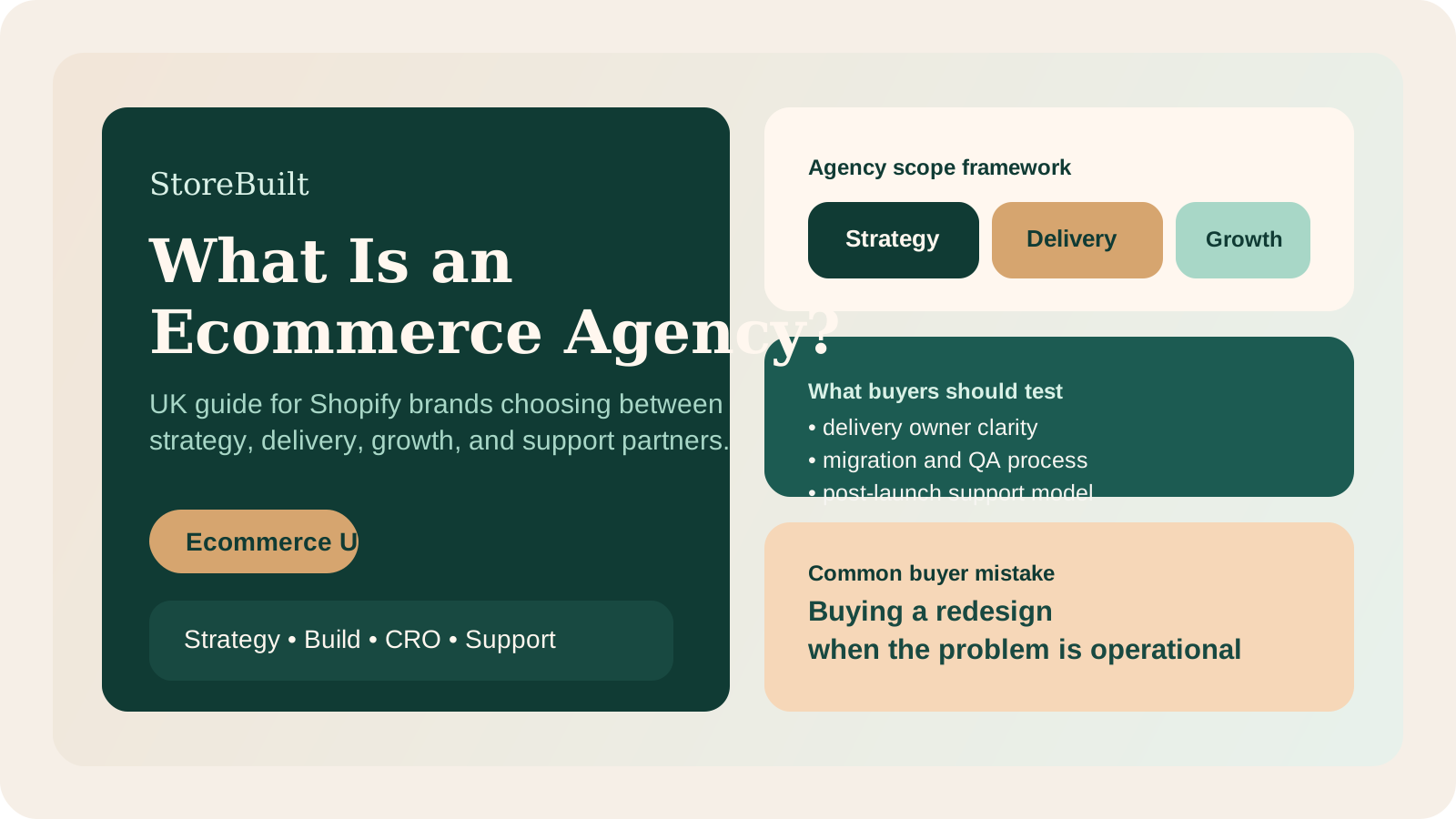
An ecommerce agency is a specialist partner that helps brands launch, improve, or scale online commerce operations. That work can include strategy, design, development, migrations, search visibility, CRO, retention, analytics, and post-launch support.
The important detail is this: a real ecommerce agency should improve how the business trades, not just how the website looks.
That distinction matters because many teams still buy agency services as if they are commissioning a design project. In practice, the commercial risk usually sits elsewhere:
- weak category and product page structure
- poor migration planning
- fragmented app stacks
- unclear data ownership
- slow release workflows
- conversion problems that are really operational problems in disguise
The better agencies are solving those layers as a connected system.
What an ecommerce agency actually covers
The strongest UK ecommerce agencies usually operate across four layers.
| Layer | What it includes | Why it matters |
|---|---|---|
| Strategy | discovery, platform advice, roadmap shaping, KPI planning | Stops teams buying the wrong scope |
| Delivery | UX, Shopify theme work, integrations, migration execution | Gets the store live without avoidable chaos |
| Growth | CRO, SEO, merchandising, lifecycle retention, experimentation | Turns launch into compound performance |
| Support | QA, release management, bug handling, incremental improvements | Keeps the store commercially usable after go-live |
This is why broad phrases like full-service agency are not enough. Buyers need to know which of these layers the agency genuinely owns well.
In the ecommerce UK market, the common failure mode is hiring a team that can design a polished front-end but cannot support the trading reality behind it. A brand then launches a cleaner store, but category management remains clumsy, campaigns are still slow to ship, and the conversion gap barely moves.
If your current setup feels like that, see StoreBuilt support and audit services.
When UK brands usually need one
The right time to hire an ecommerce agency is not always when revenue is highest. It is usually when complexity is rising faster than your internal team can absorb it.
Typical triggers include:
- a migration from WooCommerce, Magento, BigCommerce, or an older Shopify build
- flat conversion despite strong traffic acquisition
- internal bottlenecks around merchandising, content, and release speed
- international expansion, B2B, subscriptions, or omnichannel requirements
- agency-handover recovery after weak prior delivery
The wrong trigger is simply “the site feels a bit dated.” Visual age can matter, but it is rarely the first commercial problem to solve.
The better question is: what is costing us the most right now?
| Symptom | Often the real problem |
|---|---|
| Traffic is steady but revenue is soft | PDP proof, category UX, checkout friction |
| Marketing wants to move faster | theme flexibility, content workflow, release process |
| SEO output is high but results are weak | wrong page types, poor internal linking, technical debt |
| Ops team is frustrated | app sprawl, integration gaps, unclear system ownership |
Once you frame the need that way, it becomes easier to judge whether you need a general ecommerce partner or a sharper Shopify specialist.
Ecommerce agency vs Shopify agency
This is the decision many UK brands actually mean when they search for an ecommerce agency.
| Model | Best fit | Risk |
|---|---|---|
| General ecommerce agency | Broad channel support with mixed platform needs | Shopify depth may be thin |
| Shopify specialist agency | Shopify-first brands with delivery and growth complexity | Need clearer scope discipline upfront |
| Freelancer or small specialist pod | Small teams with narrow execution needs | Limited bench strength and coverage |
| Hybrid internal plus agency | Mid-market teams with internal ownership already in place | Governance can get messy without clear roles |
From the competitor review, one pattern was clear: Charle, Swanky, Eastside Co, Underwaterpistol, and We Make Websites all signal overlapping claims around growth, UX, migrations, and Shopify experience. The difference for buyers is not in the slogans. It is in the operating depth behind them.
A Shopify specialist is usually stronger when:
- Shopify is your core revenue platform
- migration quality matters
- you need senior theme and app architecture decisions
- SEO and CRO need to connect directly to storefront delivery
- post-launch support is as important as launch
If the majority of your commercial risk sits inside Shopify execution, a broad ecommerce agency can become an expensive detour.
How to evaluate agency fit in the UK market
Use operating questions, not inspiration questions.
| Question | What it tests |
|---|---|
| Who will own delivery after the sales process? | Delivery reality |
| How do you handle redirects, data, and analytics in a migration? | Operational maturity |
| What does the first 90 days after launch look like? | Commercial continuity |
| How do you improve conversion beyond redesign work? | Real growth capability |
| How do you structure support and prioritisation? | Long-term usefulness |
A useful buyer shortcut is to ask every shortlisted agency to define the store’s likely constraints after launch. Weak agencies keep talking about design taste. Better agencies talk about content governance, QA discipline, merchandising control, release risk, and KPI movement.
Commercial comparison table for buyers
| Buyer need | Better fit |
|---|---|
| Need a brand-new DTC site with serious launch support | Shopify specialist agency |
| Need mixed platform marketing and a light commerce layer | Broader ecommerce agency |
| Need one-off design refresh only | Designer or small build partner |
| Need sustained optimisation after launch | Shopify agency with CRO, SEO, and support depth |
That table is simple, but it removes a lot of shortlist noise.
StoreBuilt example
One UK retailer approached the search as an “agency selection” problem. After discovery, the real issue was narrower: the team needed a migration-safe Shopify build, stronger category UX, and ongoing support after launch. They did not need a broad digital agency with large channel overhead.
Once the brief was rewritten around delivery realities rather than generic agency language, the shortlist improved immediately. Budget conversations became cleaner because the scope was tied to actual business risk instead of abstract transformation language.
That is usually what a good ecommerce agency decision looks like. Clarity comes from identifying the operating problem first.
High-intent AI search implementation layer
The AI-search version of this topic is not just “write more content”. A useful answer engine result needs a page that gives a direct answer, proves the claim, and shows the next operational step inside Shopify.
| Area | StoreBuilt implementation check |
|---|---|
| Primary intent | The page should map to ecommerce agency and one clear buyer or operator problem, not a vague traffic topic. |
| Shopify surface | Identify whether the work belongs on a collection, product page, theme section, checkout step, app workflow, email flow, or support process. |
| Proof | Add first-hand observations, product/category examples, screenshots, policy notes, review signals, or trustworthy external sources where they make the advice safer. |
| Internal route | Link the reader to the service most likely to solve the issue: Shopify store design and development. |
| Measurement | Check Search Console, analytics, assisted conversions, enquiry quality, and AI-response mentions after the update rather than judging success by pageviews alone. |
For this article, the useful research inputs are: Shopify Help documentation, StoreBuilt implementation patterns, UK ecommerce SERP intent, and common founder/operator questions. StoreBuilt would prioritise practical Shopify setup, theme structure, page hierarchy, product data, and launch-ready implementation before expanding into broader supporting content.
If this topic maps to a live store problem, review the related StoreBuilt service or Contact StoreBuilt with the store URL and the issue you want fixed.
Final StoreBuilt point of view
An ecommerce agency should be judged as a commercial systems partner, not a website supplier. In the ecommerce UK market, the most useful agency is the one that helps the internal team trade better, ship faster, and make fewer expensive platform decisions under pressure.