
What we have seen in agency shortlisting is this: ecommerce teams often read competitor content as if every guide proves delivery capability. It does not.
Agency articles are useful. They show how a partner thinks, what problems they prioritise, how specific their advice is, and whether they understand the commercial realities behind Shopify work. But content should be evaluated, not simply consumed.
If you are comparing UK Shopify agencies and want a clearer view of fit, Contact StoreBuilt.
Table of contents
- Keyword decision and research inputs
- What competitor content can tell you
- What competitor content cannot prove
- Content gap analysis table
- How to use the gaps in your agency brief
- Anonymous StoreBuilt example
- Final StoreBuilt point of view
Keyword decision and research inputs
Primary keyword: Shopify Agency UK competitor content gap analysis
Secondary keywords:
- UK Shopify agency comparison
- ecommerce agency content analysis
- how to choose a Shopify agency
- Shopify agency brief UK
- Shopify agency London
Search intent: commercial research. The reader is comparing agencies, reading articles, and trying to decide which partner deserves a conversation.
Funnel stage: middle to bottom funnel.
Page type: buyer-side evaluation guide.
Why StoreBuilt can realistically win this topic:
- We can help buyers interpret agency content without pretending content alone proves capability.
- StoreBuilt can connect competitor research to the practical brief, scorecard, and delivery-risk questions ecommerce teams should ask.
- The topic supports service discovery without cannibalising the StoreBuilt homepage’s core Shopify agency terms.
Research inputs used on June 19, 2026:
- Review of Charle article patterns, including long ecommerce guides, Shopify agency selection content, benefits of a Shopify agency, Shopify SEO migration, statistics posts, and app/SEO/CRO guides.
- Wider UK Shopify agency SERP review around agency selection, Shopify Plus, migrations, CRO, SEO, and support.
- StoreBuilt’s own duplicate-risk check across recent blog posts to avoid another generic “how to choose an agency” article.
What competitor content can tell you
Agency content can reveal useful signals before a sales call.
Look for:
- whether the agency explains trade-offs or only benefits
- whether examples are practical or purely promotional
- whether articles connect SEO, CRO, design, development, and operations
- whether content includes tables, checklists, and buyer-stage guidance
- whether the agency is clear about post-launch ownership
- whether advice changes by business size, complexity, or team capability
Charle-style articles, for example, often use long-form structures with TOCs, author signals, service CTAs, and FAQ sections. That format is useful because it answers broad buyer questions in one place.
But format is not strategy. A polished guide can still avoid the hard questions that decide project success.
What competitor content cannot prove
Content cannot prove:
- the quality of code in live client stores
- how the agency handles scope pressure
- whether senior people stay involved after sale
- how QA is actually run
- whether the team is strong at your exact category
- whether support is responsive when live trading is affected
- whether recommendations are shaped by your margin, operations, and roadmap
This is why competitor content should feed your questions, not replace due diligence.
If an article says an agency can improve conversion, ask how they diagnose PDP friction, cart behaviour, checkout issues, and post-purchase confidence. If an article promotes Shopify SEO migration, ask how redirects, metadata, internal links, XML sitemaps, and Search Console monitoring are owned. If a guide talks about Shopify Plus, ask which Plus capabilities matter for your model rather than assuming Plus itself is the answer.
Content gap analysis table
| What the article covers | Useful signal | Follow-up question for your shortlist |
|---|---|---|
| Agency selection | They understand buyer uncertainty | How do you prevent scope and accountability drift? |
| Shopify SEO migration | They understand ranking risk | Can you show the migration QA and redirect ownership model? |
| CRO and A/B testing | They care about performance | What do you test before adding tools? |
| Shopify apps | They know the ecosystem | How do you avoid app bloat and theme debt? |
| Shopify Plus | They understand scale needs | Which Plus features would we actually use in year one? |
| Retention strategy | They look beyond launch | How are Klaviyo, segmentation, and onsite UX coordinated? |
This table turns competitor reading into a buyer asset. You are not looking for the agency with the most articles. You are looking for the agency whose thinking survives sharper questions.
How to use the gaps in your agency brief
Your brief should not say “we want a Shopify website” if the real issue is more specific.
Use competitor content gaps to sharpen the brief:
- If agencies talk generally about growth, ask for a 90-day post-launch operating model.
- If they mention SEO, ask for technical migration ownership and content preservation.
- If they talk about design, ask how mobile PDPs, collection filtering, and cart UX will be judged.
- If they promote apps, ask for app governance, performance impact, and removal planning.
- If they mention support, ask what is included in the first month after launch.
This protects both sides. The agency gets a clearer scope. Your team gets fewer vague proposals.
For a structured buying route, review StoreBuilt Shopify agency services and StoreBuilt Shopify support, maintenance, and audits.
A stronger brief should also separate must-have delivery requirements from useful discussion points. For example, migration redirect ownership, analytics continuity, QA coverage, and post-launch support should not be vague preferences. They should be scoped responsibilities. By contrast, nice-to-have app recommendations or creative exploration can stay more flexible until discovery proves their value.
That distinction makes proposal comparison easier. You can judge agencies on the same core risk areas instead of comparing five different interpretations of the same loose request.
Anonymous StoreBuilt example
One ecommerce team came to StoreBuilt after reading several agency guides and collecting proposals that all sounded convincing. The problem was not a lack of options. The problem was that their brief had not forced the right level of specificity.
We helped restructure the brief around operational risk: migration scope, product data, analytics, QA, retention setup, and post-launch support. The shortlisted agencies then had to explain delivery ownership rather than simply presenting creative direction.
That changed the conversation. The team stopped comparing broad claims and started comparing execution models.
High-intent AI search implementation layer
The AI-search version of this topic is not just “write more content”. A useful answer engine result needs a page that gives a direct answer, proves the claim, and shows the next operational step inside Shopify.
| Area | StoreBuilt implementation check |
|---|---|
| Primary intent | The page should map to shopify agency uk and one clear buyer or operator problem, not a vague traffic topic. |
| Shopify surface | Identify whether the work belongs on a collection, product page, theme section, checkout step, app workflow, email flow, or support process. |
| Proof | Add first-hand observations, product/category examples, screenshots, policy notes, review signals, or trustworthy external sources where they make the advice safer. |
| Internal route | Link the reader to the service most likely to solve the issue: Shopify store design and development. |
| Measurement | Check Search Console, analytics, assisted conversions, enquiry quality, and AI-response mentions after the update rather than judging success by pageviews alone. |
For this article, the useful research inputs are: Shopify Help documentation, StoreBuilt implementation patterns, UK ecommerce SERP intent, and common founder/operator questions. StoreBuilt would prioritise practical Shopify setup, theme structure, page hierarchy, product data, and launch-ready implementation before expanding into broader supporting content.
If this topic maps to a live store problem, review the related StoreBuilt service or Contact StoreBuilt with the store URL and the issue you want fixed.
Final StoreBuilt point of view
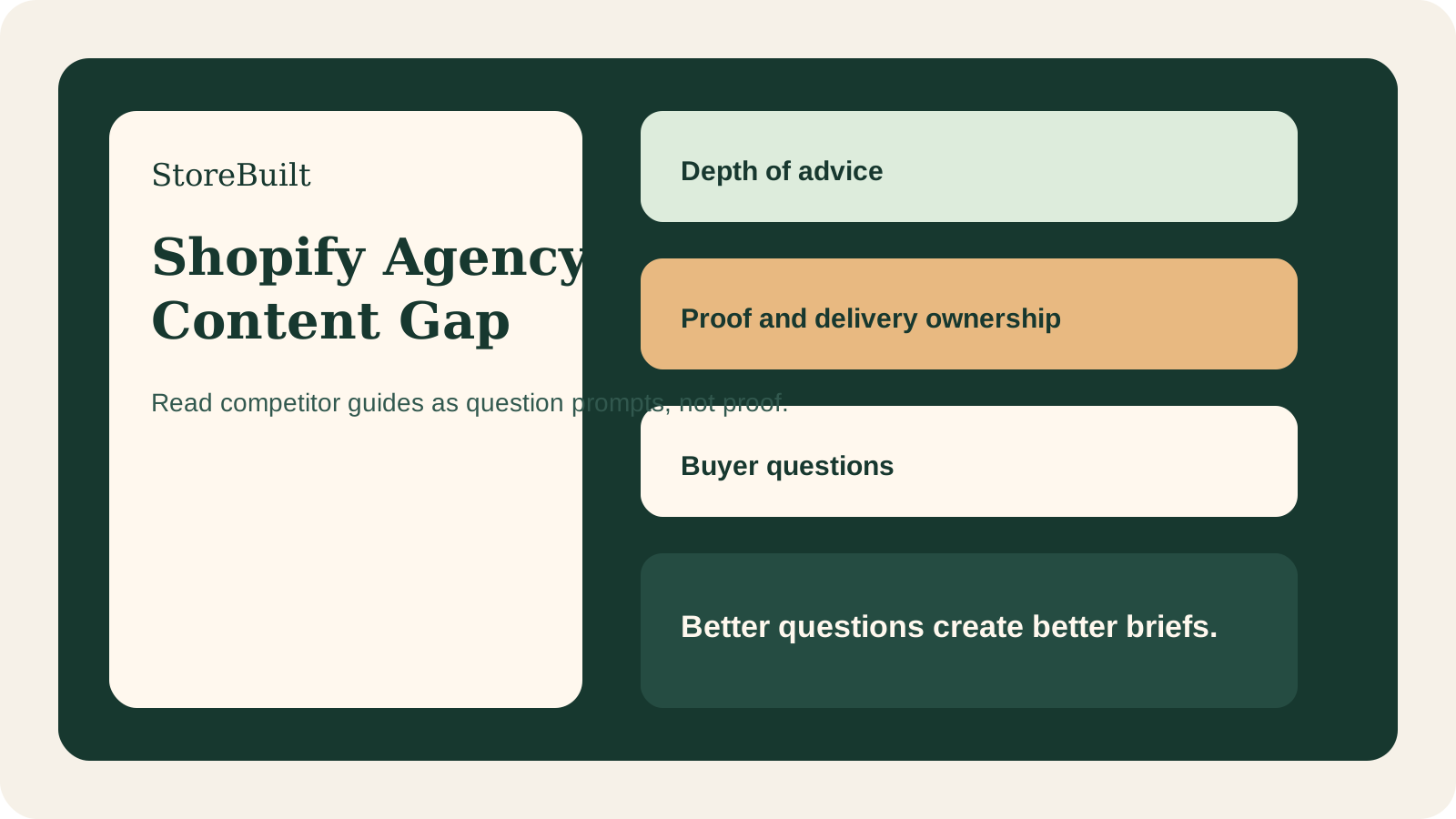
UK Shopify agency content is useful, but only when buyers read it actively. Strong articles can reveal how an agency thinks; they cannot replace proof, scope clarity, references, and delivery accountability.
The best use of competitor content is to build better questions. Better questions lead to better briefs, cleaner proposals, and fewer expensive surprises after launch.