
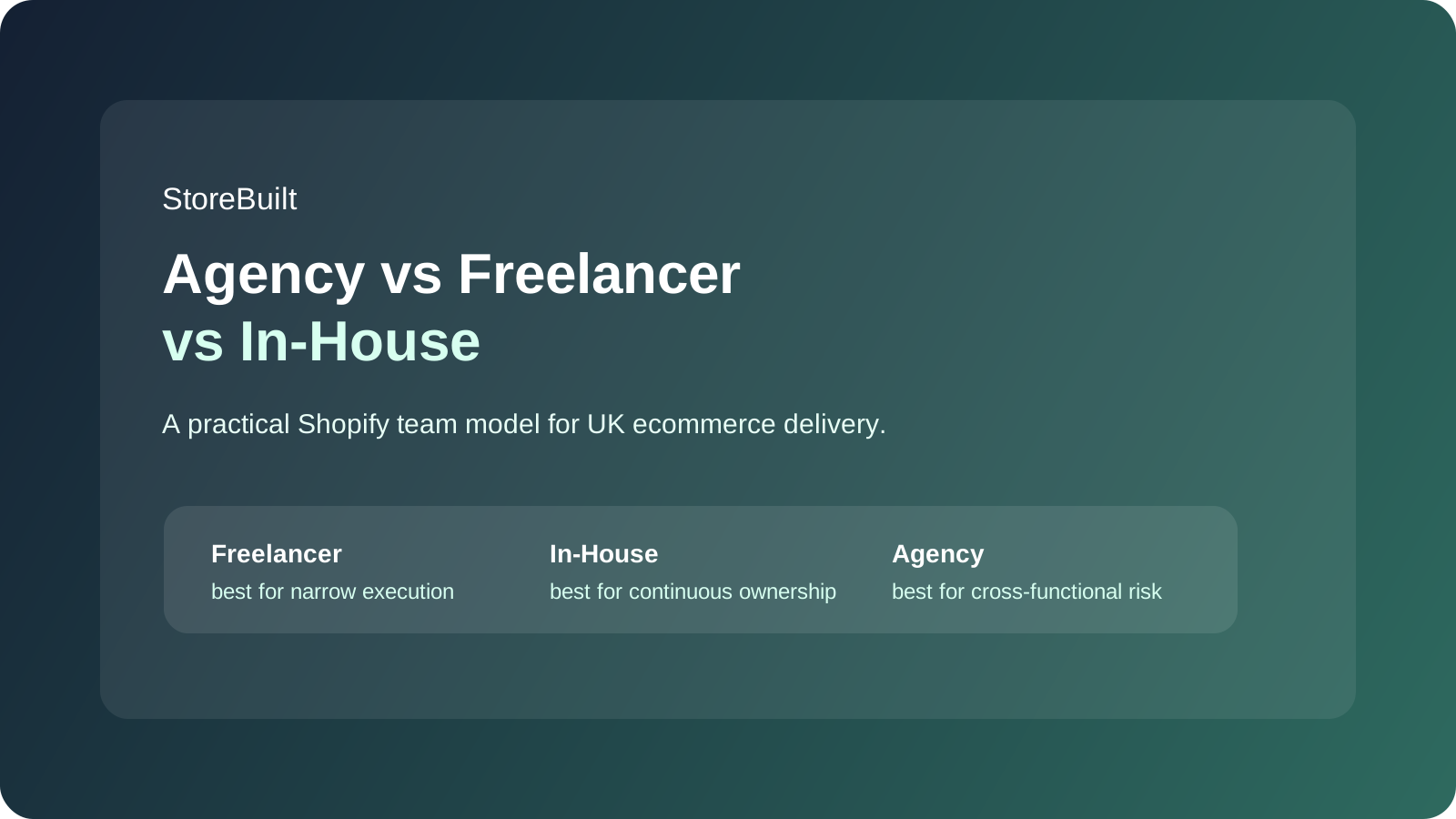
What we have seen in Shopify delivery is this: the wrong team model usually feels cheap at the start and expensive by month three. That is when slow approvals, backlog drift, inconsistent QA, and unclear ownership start compounding.
If you want help deciding which team model actually fits your roadmap, Contact StoreBuilt.
Table of contents
- Keyword decision and research inputs
- What each model is actually good at
- Cost is only one layer of the decision
- Decision table by business situation
- Common mistakes UK teams make
- StoreBuilt example
- Final StoreBuilt point of view
Keyword decision and research inputs
Primary keyword: shopify agency vs freelancer vs in house
Secondary keywords:
- shopify agency uk
- freelancer vs agency ecommerce
- in-house ecommerce team vs agency
- shopify support model
Search intent: commercial comparison. The reader is evaluating delivery structure before a redesign, migration, support retainer, or growth programme.
Funnel stage: middle to bottom.
Page type: comparison guide with practical scoring logic.
Why StoreBuilt can win this topic:
- We work across retained support, build projects, migrations, and post-handover recovery, so we see where each model succeeds and where it breaks.
- We understand that delivery model questions are rarely abstract. They are tied to launch timing, workload shape, and internal capability gaps.
- We can translate the choice into speed, risk, commercial clarity, and operational sustainability.
Research inputs used:
- Current SERP review around agency vs freelancer vs in-house and Shopify support model terms.
- UK competitor content review including Charle and other Shopify/ecommerce agencies publishing selection and buyer-education guides.
- Public keyword-style clustering around staffing choice, delivery model, retainer logic, and ecommerce team structure.
What each model is actually good at
Most content on this topic gets vague quickly. So keep it simple.
Freelancer
A freelancer is usually strongest when the scope is narrow, the brief is already clear, and the business can absorb coordination internally.
That can work well for:
- theme tweaks
- landing pages
- small conversion experiments
- bug fixes
- isolated development tasks
The problem is that many ecommerce brands hire a freelancer for work that is not actually narrow. Once strategy, QA, UX, analytics, or release coordination enter the picture, the model can become fragile.
In-house
In-house works best when workload is continuous and the business already knows what good looks like.
The biggest advantage is context. Internal teams understand product priorities, campaign calendars, customer nuance, and stakeholder politics in a way external partners never fully will.
The limitation is coverage. One in-house hire rarely brings equal strength across Shopify development, CRO, UX, SEO, analytics QA, and operational support. That means the business often still needs outside help.
Specialist Shopify agency
A specialist agency tends to be the best fit when the work is cross-functional and risk-sensitive.
That includes:
- replatforming
- redesigns
- roadmap-heavy optimisation
- multiple stakeholder teams
- launch governance
- structured support after go-live
The core value is not simply execution capacity. It is coordinated ownership.
Cost is only one layer of the decision
UK ecommerce teams often compare day rates or monthly retainers without pricing the hidden cost of coordination failure.
| Model | Visible cost profile | Hidden cost risk |
|---|---|---|
| Freelancer | Usually lowest short-term cost | Delays, unclear QA, dependency on one person |
| In-house | Salary plus overhead, tools, onboarding | Coverage gaps and slower specialist depth |
| Agency | Higher upfront monthly or project spend | Paying for capability you do not actually use if the scope is too light |
This is why “cheapest” is usually the wrong framing.
The more useful framing is:
- How much internal management time will this model consume?
- How expensive would a weak launch or delayed roadmap be?
- How often will this work need multiple disciplines at once?
If the answer to that last question is “often”, a freelancer-only model becomes harder to defend.
Decision table by business situation
| Business situation | Best-fit model | Why |
|---|---|---|
| Stable store, light backlog, clear briefs | Freelancer | Efficient for tactical execution |
| Fast-growing store with ongoing workload and strong leadership | In-house + specialist support | Keeps context internal while filling specialist gaps |
| Replatforming, redesign, or complex roadmap | Shopify agency | Cross-functional ownership matters more than lowest cost |
| Brand with no clear ecommerce owner internally | Shopify agency | Provides structure and decision support |
| Mature internal team needing overflow dev and QA | Freelancer or agency pod | Depends on scale and cadence |
| Store requiring ongoing CRO, SEO, and support rhythm | Agency or hybrid | Consistency and accountability matter |
If the current need is stabilisation, QA rhythm, and structured release ownership, StoreBuilt’s support and audit service is usually the more relevant route than a pure design brief.
Common mistakes UK teams make
Hiring a freelancer to solve an ownership problem
Freelancers can execute work well. They are not a substitute for missing strategy, missing prioritisation, or unclear stakeholder control.
Hiring in-house too early
An in-house ecommerce hire can be powerful, but only when the business has enough work quality and enough leadership clarity to keep that person focused. Otherwise they become a catch-all operator for every unresolved request.
Hiring an agency for very light work
This is the reverse mistake. If the need is truly ad hoc, agency overhead may not be justified.
Ignoring post-launch reality
The wrong model often looks fine during pre-launch planning because everyone is focused on the build. The operational test comes later, when releases, bugs, content changes, and conversion improvements begin competing for attention.
StoreBuilt example
One merchant came to us after trying to split a major Shopify roadmap across one internal marketer, one freelance developer, and an external designer. Individually, none of those choices were unreasonable.
Together, they created a system with no stable centre.
Tickets moved, but priorities drifted. Release confidence was low because QA ownership was weak. Commercial decisions such as search UX and mobile PDP clarity stayed unresolved because each discipline saw only part of the problem.
Once delivery was restructured around one accountable workflow, the pace improved even before output volume did. The main gain was reduced coordination drag.
High-intent AI search implementation layer
The AI-search version of this topic is not just “write more content”. A useful answer engine result needs a page that gives a direct answer, proves the claim, and shows the next operational step inside Shopify.
| Area | StoreBuilt implementation check |
|---|---|
| Primary intent | The page should map to shopify agency uk and one clear buyer or operator problem, not a vague traffic topic. |
| Shopify surface | Identify whether the work belongs on a collection, product page, theme section, checkout step, app workflow, email flow, or support process. |
| Proof | Add first-hand observations, product/category examples, screenshots, policy notes, review signals, or trustworthy external sources where they make the advice safer. |
| Internal route | Link the reader to the service most likely to solve the issue: International expansion and localisation. |
| Measurement | Check Search Console, analytics, assisted conversions, enquiry quality, and AI-response mentions after the update rather than judging success by pageviews alone. |
For this article, the useful research inputs are: Shopify Help documentation, StoreBuilt implementation patterns, UK ecommerce SERP intent, and common founder/operator questions. StoreBuilt would prioritise Markets setup, localisation, hreflang, currencies, duties, content adaptation, and operational checks before expanding into broader supporting content.
If this topic maps to a live store problem, review the related StoreBuilt service or Contact StoreBuilt with the store URL and the issue you want fixed.
Final StoreBuilt point of view
In the ecommerce UK market, the right Shopify team model depends less on ideology and more on workload shape, internal maturity, and project risk. Freelancers are excellent for defined tasks. In-house teams are powerful when workload is continuous and leadership is clear. Agencies are strongest when the work spans disciplines and failure would be expensive. The mistake is not choosing one model over another. The mistake is asking one model to solve a problem it was not designed to own.