
What we have seen in agency shortlists is this: most buyers spend too much time reviewing portfolios and not enough time pressure-testing how the agency actually behaves once delivery gets difficult.
If you want StoreBuilt to review your shortlist or scope before you sign with an agency, Contact StoreBuilt.
Table of contents
- Keyword decision and research inputs
- Why reference checks matter more than most teams expect
- What UK Shopify competitors are good at selling
- The 12 reference-check questions worth asking
- How to interpret the answers
- A simple scorecard for agency references
- StoreBuilt example
- Final StoreBuilt point of view
Keyword decision and research inputs
Primary keyword: shopify agency reference checks
Secondary keywords:
- shopify agency questions to ask
- how to vet a shopify agency
- shopify agency uk shortlist
- ecommerce agency due diligence
Search intent: commercial evaluation from brands moving from shortlist to final decision.
Funnel stage: bottom of funnel.
Page type: due-diligence guide.
Why StoreBuilt can realistically win this topic:
- The query is high-intent and specific to real buyer pain late in the selection process.
- StoreBuilt can explain the gap between sales messaging and delivery reality clearly.
- Most competitor content focuses on choosing agencies broadly, not how to pressure-test them.
Research inputs used on June 8, 2026:
- Current SERP review for
shopify agency questions to ask,how to choose a shopify agency, and related shortlist intent. - UK competitor content review across Charle and other Shopify agencies publishing selection and proposal guidance.
- StoreBuilt observations from agency takeover, recovery, migration, and support-handover conversations.
Why reference checks matter more than most teams expect
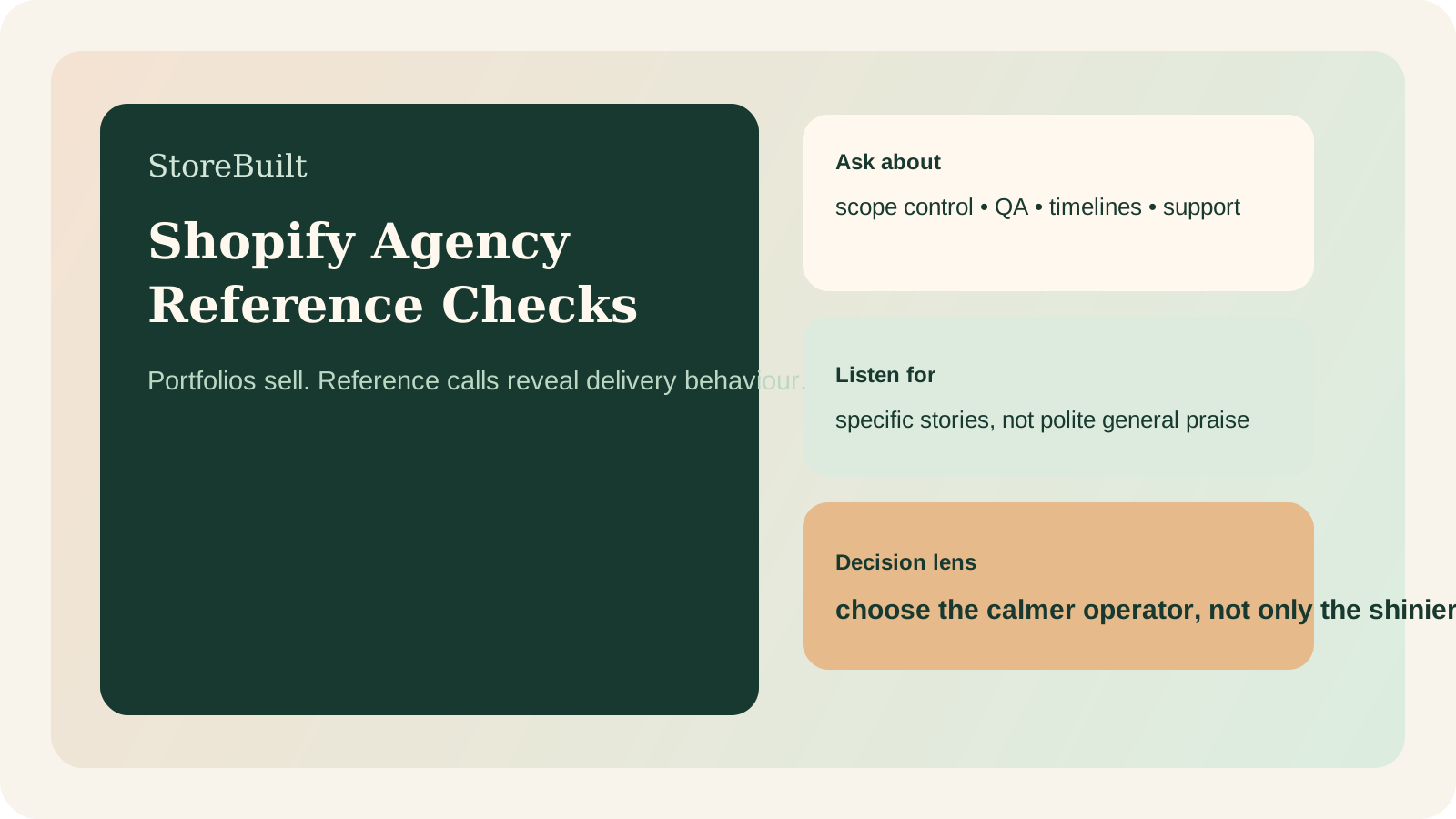
Portfolios tell you whether the agency can present work attractively. Reference checks tell you whether the agency can survive ambiguity, pressure, timeline change, and post-launch reality with your team still trusting them.
That is a different standard entirely.
In UK ecommerce, the most expensive agency mistakes usually come from one of these gaps:
- the sold team is not the delivery team
- scope control is weak
- communication slows once build work begins
- post-launch support is vague
- QA discipline is weaker than the proposal implied
None of those issues is easy to see from the website alone.
What UK Shopify competitors are good at selling
The current agency market is very polished. Competitors such as Charle, Swanky, Underwaterpistol, Eastside Co, blubolt, and other UK Shopify specialists are all strong at signalling expertise through:
- strong case-study presentation
- commercial language around growth and optimisation
- multi-service positioning across design, SEO, CRO, migrations, and support
That means the buyer’s problem is not lack of information. It is signal quality.
Reference checks help answer the questions the agency site cannot:
- Were they proactive when priorities changed?
- Were timelines handled honestly?
- Did post-launch support feel strong?
- Were senior people still present after the sale?
The 12 reference-check questions worth asking
Ask past or current clients these directly.
- What did the agency do especially well once delivery started?
- Where did the project become harder than expected?
- Did the team who sold the project stay meaningfully involved?
- How clearly did they handle scope changes and budget conversations?
- Were deadlines realistic, and if they moved, how was that communicated?
- How good was QA before launch or release milestones?
- Did they understand your commercial priorities, not just design preferences?
- Were they strong on Shopify specifics such as apps, migrations, merchandising, or support?
- How easy were they to work with during stressful moments?
- What happened after launch?
- Would you use them again for a similar project?
- What would you do differently if you were re-running the project now?
These questions work because they move beyond “Were they good?” and into how the relationship behaved under pressure.
How to interpret the answers
Reference calls are useful only if you listen for patterns.
| Answer pattern | What it usually means |
|---|---|
| ”They were great, no issues” with no detail | weak evidence or polite filtering |
| Strong praise plus one or two concrete trade-offs | more credible signal |
| Clear mention of proactive communication and prioritisation | usually a healthy delivery culture |
| Repeated vagueness around support or handover | post-launch risk |
| Praise for strategy but weaker comments on implementation | execution gap |
What you want is not perfection. It is specificity. Real clients usually remember where the agency was especially useful and where project tension showed up.
A simple scorecard for agency references
Use a lightweight scoring model after every call.
| Criteria | Strong signal | Score |
|---|---|---|
| Senior involvement | senior people stayed visible after sale | 1-5 |
| Scope control | changes were discussed clearly and early | 1-5 |
| Communication | the team was responsive and direct | 1-5 |
| Shopify delivery depth | technical and commercial work both felt strong | 1-5 |
| QA and launch confidence | few surprises, clear release handling | 1-5 |
| Post-launch usefulness | support did not disappear after go-live | 1-5 |
This is especially useful when several agencies have similarly polished portfolios.
If you are already comparing proposals and want a sharper framework, StoreBuilt can help you scope the right Shopify partner path.
Questions not to rely on
Avoid wasting the whole call on:
- “Did you like the site?”
- “Was the agency nice to work with?”
- “Did the project succeed?”
Those questions are too broad. They invite vague reassurance.
The real value comes from asking about:
- decision-making under pressure
- budget and scope honesty
- how the agency handled ambiguity
- what happened after launch
StoreBuilt example
A brand came to us after shortlisting multiple agencies with similar-looking portfolios. On paper, the options were difficult to separate. Once the team ran proper reference checks, the decision became clearer.
One agency was praised for visual work but described as less structured once scope changed. Another was described as commercially sharper and calmer during launch pressure, even though its site presentation was less dramatic. That difference mattered more than aesthetics because the project included migration risk and post-launch iteration.
The shortlist improved the moment the buyer stopped judging agencies like design galleries and started judging them like operating partners.
If your shortlist still feels too glossy to call confidently, start with a free Shopify audit and use that output to sharpen the selection conversation.
High-intent AI search implementation layer
The AI-search version of this topic is not just “write more content”. A useful answer engine result needs a page that gives a direct answer, proves the claim, and shows the next operational step inside Shopify.
| Area | StoreBuilt implementation check |
|---|---|
| Primary intent | The page should map to shopify agency uk and one clear buyer or operator problem, not a vague traffic topic. |
| Shopify surface | Identify whether the work belongs on a collection, product page, theme section, checkout step, app workflow, email flow, or support process. |
| Proof | Add first-hand observations, product/category examples, screenshots, policy notes, review signals, or trustworthy external sources where they make the advice safer. |
| Internal route | Link the reader to the service most likely to solve the issue: Shopify store design and development. |
| Measurement | Check Search Console, analytics, assisted conversions, enquiry quality, and AI-response mentions after the update rather than judging success by pageviews alone. |
For this article, the useful research inputs are: Shopify Help documentation, StoreBuilt implementation patterns, UK ecommerce SERP intent, and common founder/operator questions. StoreBuilt would prioritise practical Shopify setup, theme structure, page hierarchy, product data, and launch-ready implementation before expanding into broader supporting content.
If this topic maps to a live store problem, review the related StoreBuilt service or Contact StoreBuilt with the store URL and the issue you want fixed.
Final StoreBuilt point of view
Agency reference checks are one of the highest-leverage steps in a Shopify shortlist because they reveal how the partner behaves after the pitch is over.
For UK ecommerce teams in 2026, the best reference call is not the one that gives you comfort. It is the one that gives you clarity about communication, scope discipline, QA, and post-launch usefulness before the contract is signed.