
What we have seen in discovery calls is this: many brands ask for a Shopify web designer when the actual requirement is a mix of design, theme engineering, merchandising logic, CRO, and post-launch support.
If you need help defining whether your next project is a design brief or a full Shopify delivery brief, Contact StoreBuilt.
Table of contents
- Keyword decision and research inputs
- What a Shopify web designer actually does
- Where the role usually stops
- Shopify web designer vs Shopify agency
- How UK ecommerce teams should scope the brief
- StoreBuilt example
- Decision table for hiring routes
- Final StoreBuilt point of view
Keyword decision and research inputs
Primary keyword: what is a shopify web designer
Secondary keywords:
- Shopify web designer UK
- Shopify designer vs developer
- Shopify agency vs freelancer
- ecommerce website designer Shopify
- Shopify store design UK
Search intent: educational with commercial evaluation intent.
Funnel stage: middle to bottom.
Page type: explanatory guide with decision framework.
Why StoreBuilt can realistically win this topic:
- We regularly inherit briefs where the stated role does not match the actual delivery need.
- We understand the gap between visual design scope and live-store performance scope.
- We can explain when a specialist designer is enough and when a wider Shopify partner is safer.
Research inputs used in angle selection:
- Current SERP scan for
what is a shopify web designer,Shopify designer UK, and role-comparison intent. - UK agency article pattern review, especially Charle-style educational content and broader Shopify service positioning.
- Keyword-style clustering around Shopify design, freelancer, agency, and scope-definition terms.
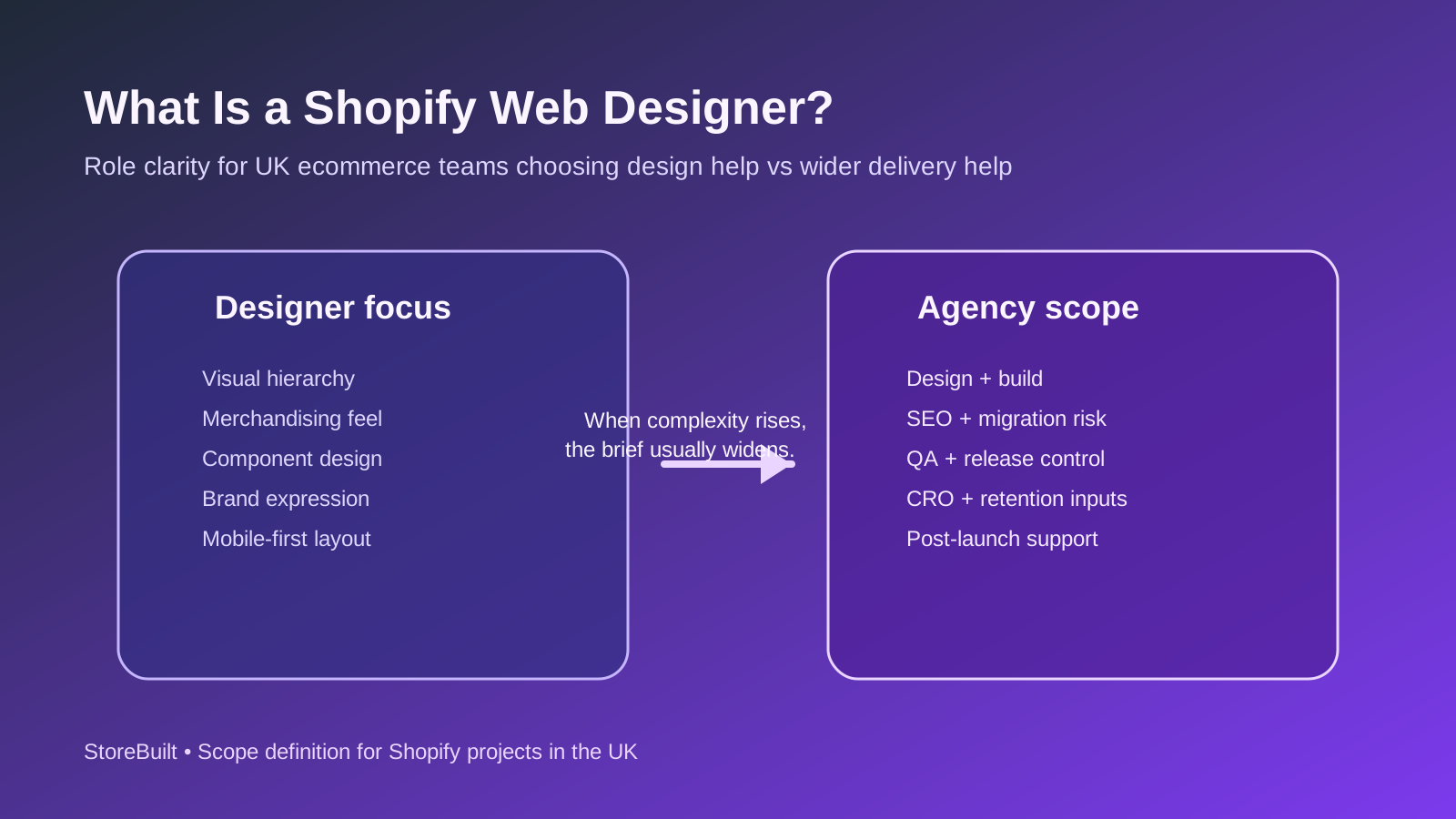
What a Shopify web designer actually does
A Shopify web designer usually focuses on the visual and experiential layer of the store.
Typical responsibilities:
- homepage and collection-page layout direction
- product-page hierarchy and content presentation
- visual merchandising logic
- brand expression across templates
- component and section design for the storefront
In the best cases, a strong Shopify designer also understands:
- mobile-first hierarchy
- conversion-sensitive layout decisions
- theme constraints
- how apps affect the final UX
That last part matters. A web designer who does not understand how the live Shopify theme behaves can create elegant concepts that become compromised in implementation.
Where the role usually stops
This is where many UK ecommerce teams get caught out.
A Shopify web designer is not automatically responsible for:
- theme engineering and technical implementation
- migration planning
- redirect strategy and SEO preservation
- analytics instrumentation
- app integration logic
- checkout experimentation
- post-launch support and release governance
Some freelancers and specialists can cover part of this wider scope. But the more your project includes platform decisions, data dependencies, or post-launch accountability, the less useful a design-only brief becomes.
That does not make the designer less valuable. It just makes the buying decision clearer.
Shopify web designer vs Shopify agency
Use this comparison when deciding what kind of partner you actually need.
| Need | Shopify web designer | Shopify agency |
|---|---|---|
| Strong visual refresh | Often a strong fit | Also a fit, but may be broader than needed |
| Theme implementation and QA | Sometimes, depending on skillset | Usually core scope |
| Migration, redirects, or data complexity | Rarely full ownership | Usually better fit |
| Ongoing CRO, SEO, retention, and support | Usually outside scope | Stronger fit |
| Cross-functional delivery governance | Usually limited | Usually stronger |
The keyword point here is ownership.
If your team needs one person to improve visual quality on an already stable store, a Shopify web designer may be exactly right.
If you need a partner to diagnose blockers, coordinate implementation, and own outcomes across multiple workstreams, you are no longer buying only design.
For brands already shortlisting broader partners, StoreBuilt Shopify design and development is the more relevant path.
How UK ecommerce teams should scope the brief
Before you hire, write the brief around the bottleneck, not the job title.
Ask:
- Is the main problem visual quality, weak conversion, technical debt, or operating complexity?
- Are you changing only templates, or also apps, data, content, and internal processes?
- Who owns QA, SEO risk, analytics, and launch stability?
- Is this a one-off redesign or a longer growth and support relationship?
A practical brief should define:
| Brief area | What to include |
|---|---|
| Commercial goal | What business outcome should improve |
| Scope boundary | What is in and out of the project |
| Template priority | Which pages matter most commercially |
| Technical dependencies | Apps, integrations, migration, analytics, SEO risk |
| Ownership model | Who signs off design, build, QA, and launch |
Many projects go wrong because the design brief is clean, but the delivery environment is messy.
StoreBuilt example
One UK ecommerce team came in looking for a Shopify web designer because they felt the storefront no longer matched the brand. Once we reviewed the brief, the deeper issue was not only aesthetics. Collection architecture was weak, merchandising logic was inconsistent, and the project also required app rationalisation and launch QA.
A design-only hire would have improved surface quality but left the real commercial blockers in place. The better route was to define the work as a conversion-led storefront restructure with design, implementation, and governance tied together.
That is the distinction teams need to make early. Good design matters. But good design without operating clarity often produces disappointing launches.
Decision table for hiring routes
| Situation | Best-fit route |
|---|---|
| You need a sharper visual system on a technically stable store | Shopify web designer |
| You need design plus theme implementation | Designer with strong technical partner, or agency |
| You need redesign, CRO, app cleanup, and launch governance | Shopify agency |
| You need an ongoing roadmap after launch | Agency or retained ecommerce partner |
If you want to review what a broader Shopify delivery partner can take on, browse StoreBuilt work.
High-intent AI search implementation layer
The AI-search version of this topic is not just “write more content”. A useful answer engine result needs a page that gives a direct answer, proves the claim, and shows the next operational step inside Shopify.
| Area | StoreBuilt implementation check |
|---|---|
| Primary intent | The page should map to what is a shopify web designer and one clear buyer or operator problem, not a vague traffic topic. |
| Shopify surface | Identify whether the work belongs on a collection, product page, theme section, checkout step, app workflow, email flow, or support process. |
| Proof | Add first-hand observations, product/category examples, screenshots, policy notes, review signals, or trustworthy external sources where they make the advice safer. |
| Internal route | Link the reader to the service most likely to solve the issue: Shopify store design and development. |
| Measurement | Check Search Console, analytics, assisted conversions, enquiry quality, and AI-response mentions after the update rather than judging success by pageviews alone. |
For this article, the useful research inputs are: Shopify Help documentation, StoreBuilt implementation patterns, UK ecommerce SERP intent, and common founder/operator questions. StoreBuilt would prioritise theme architecture, Online Store 2.0 sections, metafields, template governance, and storefront implementation before expanding into broader supporting content.
If this topic maps to a live store problem, review the related StoreBuilt service or Contact StoreBuilt with the store URL and the issue you want fixed.
Final StoreBuilt point of view
A Shopify web designer is a valuable role, but it is not a catch-all answer for every ecommerce problem. UK brands usually get better results when they define the bottleneck honestly, then hire for the actual delivery need rather than the most familiar title.
When the issue is bigger than visuals, a wider Shopify partner is usually the safer commercial decision.