
What we have seen in shortlist reviews is this: many ecommerce teams still use Shopify Partner, Shopify agency, Shopify Expert, and Shopify Plus Partner as if they all mean the same thing. In 2026, they do not.
If you want a practical second opinion on a Shopify shortlist or partner claim, Contact StoreBuilt.
Table of contents
- Keyword decision and research inputs
- Quick answer: what a Shopify Partner is
- What changed in Shopify partner branding
- Shopify Partner vs Shopify agency
- How UK brands should use partner status in shortlisting
- Practical buyer checklist
- StoreBuilt example
- Final StoreBuilt point of view
Keyword decision and research inputs
Primary keyword: what is a shopify partner
Secondary keywords:
- Shopify Partner UK
- Shopify Partner vs Shopify agency
- Shopify Experts replacement
- Shopify Plus Partner 2026
- Shopify agency UK
Search intent: explanatory with buyer-evaluation intent.
Funnel stage: upper-middle.
Page type: educational guide with shortlisting advice.
Why StoreBuilt can realistically win this topic:
- The topic is broad but highly relevant to commercial shortlisting.
- Many competitor pages still use older programme language, which creates buyer confusion.
- StoreBuilt can connect partner terminology to real buying decisions instead of repeating directory-style definitions.
Research inputs used:
- Current SERP review around
what is a Shopify Partner,Shopify Partner UK, and related shortlisting queries. - Official Shopify Partner Help content and current pricing/plan pages reviewed on June 5, 2026.
- UK competitor and agency-library scan across Charle, Swanky, Eastside Co, We Make Websites, and other Shopify-focused partners.
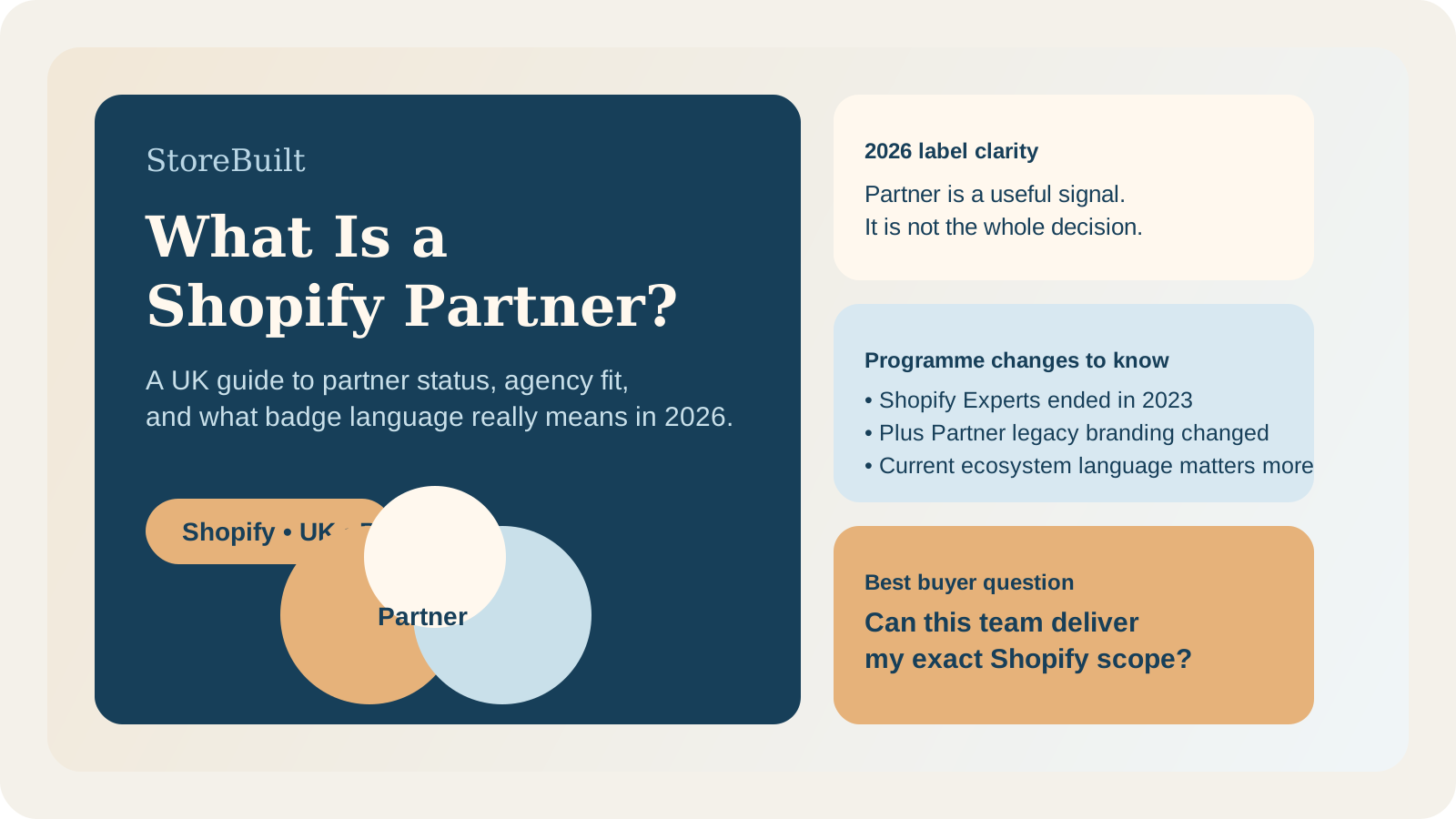
Quick answer: what a Shopify Partner is
A Shopify Partner is an individual or organisation that participates in Shopify’s Partner ecosystem and can build stores, create apps, develop themes, or support merchants through Shopify-related services.
That is the platform definition.
The buyer mistake is assuming partner status automatically proves delivery quality.
It does not.
Partner status tells you the company is inside Shopify’s ecosystem. It does not, by itself, tell you whether that team is strong at migrations, CRO, B2B, internationalisation, design systems, or post-launch support.
So the right interpretation is:
- useful signal: ecosystem familiarity
- incomplete signal: actual fit for your project
What changed in Shopify partner branding
This matters more in 2026 than it used to.
According to Shopify Help content reviewed on June 5, 2026, the old Shopify Experts branding was discontinued in December 2023, and the old Plus Partner programme was discontinued in December 2024. Shopify’s newer partner-programme structure and updated tier language now matter more than those legacy labels.
That means buyers should be cautious when an agency leans too heavily on old badge language without clarifying what it means today.
| Term | 2026 reality |
|---|---|
| Shopify Partner | Active umbrella ecosystem term |
| Shopify agency | Commercial service description, not a formal Shopify badge by itself |
| Shopify Expert | Legacy language, no longer current programme branding |
| Shopify Plus Partner | Legacy programme term, no longer current in the old form |
This does not mean an agency using legacy language is automatically weak. It does mean the buyer should ask for current evidence of capability rather than relying on a historic label.
Shopify Partner vs Shopify agency
This is the distinction most buyers actually need.
| Label | What it tells you | What it does not tell you |
|---|---|---|
| Shopify Partner | The company operates in Shopify’s ecosystem | Whether it is the right delivery team for your scope |
| Shopify agency | The company sells Shopify-related delivery services | Whether it has platform depth or specialist bench strength |
| Specialist Shopify agency | Usually signals sharper focus on Shopify execution | Whether its commercial model fits your team stage |
In other words, Partner is not the same thing as best fit.
In the ecommerce UK market, project fit usually depends more on these questions:
- Is the work mostly migration, redesign, support, CRO, or retention?
- Does the project need B2B, subscriptions, international selling, or ERP integration?
- Will the internal team need help after launch?
- Is the brand looking for a roadmap partner or just implementation capacity?
That is why StoreBuilt recommends treating partner status as an initial confidence signal only, not as the selection decision.
How UK brands should use partner status in shortlisting
Use it as a filter, not a verdict.
Good use of partner status
- confirms the agency is embedded in Shopify’s ecosystem
- suggests some platform familiarity
- helps narrow a large search down to plausible candidates
Bad use of partner status
- assuming it guarantees migration quality
- assuming it proves commercial strategy strength
- assuming all partners have the same capability depth
- ignoring operating model, support quality, and ownership clarity
Charle-style competitor content performs well because it takes a broad platform concept and translates it into a buyer decision. That is the right model here too. Buyers do not need a badge glossary. They need help deciding what to trust.
If you are comparing partners and want the shortlist tied to real trading constraints, see StoreBuilt migration and replatforming services.
Practical buyer checklist
Use this before signing with any Shopify Partner or agency.
| Check | Why it matters |
|---|---|
| Named delivery owner | Reduces sales-to-delivery mismatch |
| Clear migration methodology | Protects data, redirects, and analytics continuity |
| Post-launch support model | Shows whether the relationship works after go-live |
| Relevant live-store examples | Proves more than generic Shopify capability |
| Specific explanation of CRO and SEO approach | Separates real operators from surface-level claims |
| Internal-team enablement plan | Prevents long-term platform dependence |
The strongest partners can explain not just what they build, but how your team will run it afterward.
Current Shopify signal worth knowing
Another useful 2026 point: Shopify’s UK pricing page now presents current plan pricing in GBP, while Shopify Plus pricing is shown as starting from £1,800 GBP per month on a 3-year term on the UK pricing page reviewed on June 5, 2026. That matters because many buyers move from partner research straight into plan-level budget discussions.
If an agency talks confidently about Shopify Plus but vaguely about operational implications or ongoing cost structure, keep asking questions.
StoreBuilt example
One ecommerce team came into the process wanting “a Shopify Partner” because that felt like the safest signal. After review, the real need was a team strong in category UX, migration governance, and support continuity. The winning shortlist changed once those needs replaced badge language as the decision frame.
A few agencies looked impressive at the partner-label level. Fewer looked strong when judged against redirects, content governance, release management, and post-launch ownership.
That is usually what happens when shortlisting becomes more technical and more honest.
High-intent AI search implementation layer
The AI-search version of this topic is not just “write more content”. A useful answer engine result needs a page that gives a direct answer, proves the claim, and shows the next operational step inside Shopify.
| Area | StoreBuilt implementation check |
|---|---|
| Primary intent | The page should map to shopify partner and one clear buyer or operator problem, not a vague traffic topic. |
| Shopify surface | Identify whether the work belongs on a collection, product page, theme section, checkout step, app workflow, email flow, or support process. |
| Proof | Add first-hand observations, product/category examples, screenshots, policy notes, review signals, or trustworthy external sources where they make the advice safer. |
| Internal route | Link the reader to the service most likely to solve the issue: Shopify store design and development. |
| Measurement | Check Search Console, analytics, assisted conversions, enquiry quality, and AI-response mentions after the update rather than judging success by pageviews alone. |
For this article, the useful research inputs are: Shopify Help documentation, StoreBuilt implementation patterns, UK ecommerce SERP intent, and common founder/operator questions. StoreBuilt would prioritise practical Shopify setup, theme structure, page hierarchy, product data, and launch-ready implementation before expanding into broader supporting content.
If this topic maps to a live store problem, review the related StoreBuilt service or Contact StoreBuilt with the store URL and the issue you want fixed.
Final StoreBuilt point of view
In 2026, Shopify Partner is a useful ecosystem signal, not a buying shortcut. For UK ecommerce brands, the right partner is the team whose operating model, technical depth, and post-launch support match the real work ahead.