
What we have seen after stressful launches and peak-trading incidents is this: most teams do not lack access to help, they lack clarity on which kind of help solves which problem fast enough.
If your store needs a more reliable support model than ad hoc tickets and emergency fixes, Contact StoreBuilt.
Table of contents
- Keyword decision and research inputs
- What Shopify support can and cannot solve
- Current Shopify support routes in 2026
- When platform support is enough
- When you need agency or retainer support instead
- Support model table for UK ecommerce teams
- StoreBuilt example
- How to build a stronger escalation path
- Final StoreBuilt point of view
Keyword decision and research inputs
Primary keyword: shopify support
Secondary keywords:
- Shopify help UK
- Shopify support retainer
- ecommerce support agency UK
- Shopify technical support
- Shopify maintenance support
Search intent: support-evaluation with commercial investigation intent.
Funnel stage: middle to bottom.
Page type: practical support guide.
Why StoreBuilt can realistically win this topic:
- We work on the problems that appear after platform support ends: theme issues, app conflicts, release risk, and live-trading instability.
- We understand the difference between vendor help, specialist implementation support, and retained ecommerce operations support.
- We can translate support choice into response quality and commercial risk.
Research inputs used in angle selection:
- Current SERP review for
shopify support,Shopify help, and related maintenance intent. - UK competitor content review including Charle-style support guides and service-led agency pages.
- Keyword-style clustering around support, maintenance, help, technical issues, and retainers.
What Shopify support can and cannot solve
Shopify support is useful, but it is not designed to replace a delivery partner.
Platform support is typically strongest when the issue relates to:
- account access
- billing and plan questions
- platform-level functionality
- standard admin behaviour
- general product guidance
It is much less likely to fully solve:
- custom theme problems
- app conflicts
- conversion debugging
- SEO risk from site changes
- incident prevention and release governance
- priority-setting across an ecommerce roadmap
This is why some teams feel frustrated. They ask the wrong support channel to solve the wrong class of problem.
Current Shopify support routes in 2026
According to Shopify’s current contact support guidance, merchants on all plans can use 24/7 chat through the Help Center. Phone and email options are available for specific subscriptions such as Shopify Plus and Retail, while POS Pro can provide phone support through the Help Center. Availability and process can change, so confirm the live route for the store’s plan instead of relying on an old phone number from a search result.
The boundary between support owners matters:
| Problem | First owner | What to include in the request |
|---|---|---|
| Account, billing, platform admin | Shopify Support | Store URL, affected user, exact error, timestamp |
| Third-party app behaviour | App developer | App name, order or product example, reproduction steps |
| Paid third-party theme defect | Theme developer | Theme version, preview link, screenshots, change history |
| Custom code or integration | Delivery partner | Release reference, logs, environment, business impact |
| SEO, CRO, roadmap or recurring incidents | Retained ecommerce partner | Baseline, affected journey, priority, desired outcome |
For custom code, Shopify points merchants towards Shopify.dev resources, the community, or a Shopify Partner because general support normally cannot debug bespoke implementation. For third-party apps and themes, the vendor owns its product. A mature ecommerce team keeps a lightweight system map so an incident reaches the right owner without multiple hand-offs.
Before opening any ticket, capture the URL, device, browser, timestamp, affected customer or order, reproduction steps, screenshots, and the last known change. That evidence often saves more time than escalating the ticket’s emotional language.
When platform support is enough
Use Shopify support first when the issue is clearly platform-native and does not depend on your custom implementation.
| Issue type | Platform support usually enough? | Why |
|---|---|---|
| Account access or permissions | Yes | Platform-level control |
| Billing questions | Yes | Platform account ownership |
| Admin guidance | Usually | Standard product usage |
| Theme customisation bug | Often no | Depends on custom code and app stack |
| Performance, CRO, or SEO diagnosis | No | Requires specialist store context |
A good rule is this: if the answer requires someone to understand your specific store setup, commercial goals, and technical customisations, you are probably beyond general platform support.
When you need agency or retainer support instead
UK ecommerce teams usually need specialist support when the store is live, changing often, and commercially meaningful enough that delays are expensive.
That often includes:
- release QA and incident prevention
- theme maintenance
- app-stack governance
- live merchandising changes with technical risk
- conversion fixes linked to user behaviour
- support for campaigns, seasonal launches, or peak-trade readiness
This is where a support retainer becomes different from a help desk. It is not only reactive. It creates operational continuity.
If you need that continuity, StoreBuilt support, maintenance, and audits is the relevant service route.
Support model table for UK ecommerce teams
| Team situation | Best support model |
|---|---|
| Basic account or admin issue | Shopify support |
| Small design tweak on a low-change store | Specialist freelancer or light dev support |
| Growing store with weekly changes and campaign pressure | Agency retainer or structured support partner |
| Store with SEO, CRO, and operations dependencies | Broader retained ecommerce partner |
The key decision is not cost alone. It is the cost of delay, misdiagnosis, and repeated incidents.
Many support arrangements look cheap until a Friday launch breaks search templates, payment logic, or merchandising rules. That is when ownership quality matters most.
StoreBuilt example
One ecommerce team had been using a mix of internal fixes, platform tickets, and occasional freelance help. Nothing was obviously broken all the time, but every campaign window created uncertainty. Small issues took too long to diagnose because nobody owned the whole store context.
The fix was not a bigger ticket queue. It was a clearer support model. We defined incident priority, release QA, ownership boundaries, and the channels for technical versus commercial questions. Once that structure existed, the team moved from reactive support to controlled live-store operations.
That is usually the real value of a strong Shopify support partner: fewer repeated surprises.
How to build a stronger escalation path
Use a simple support ladder.
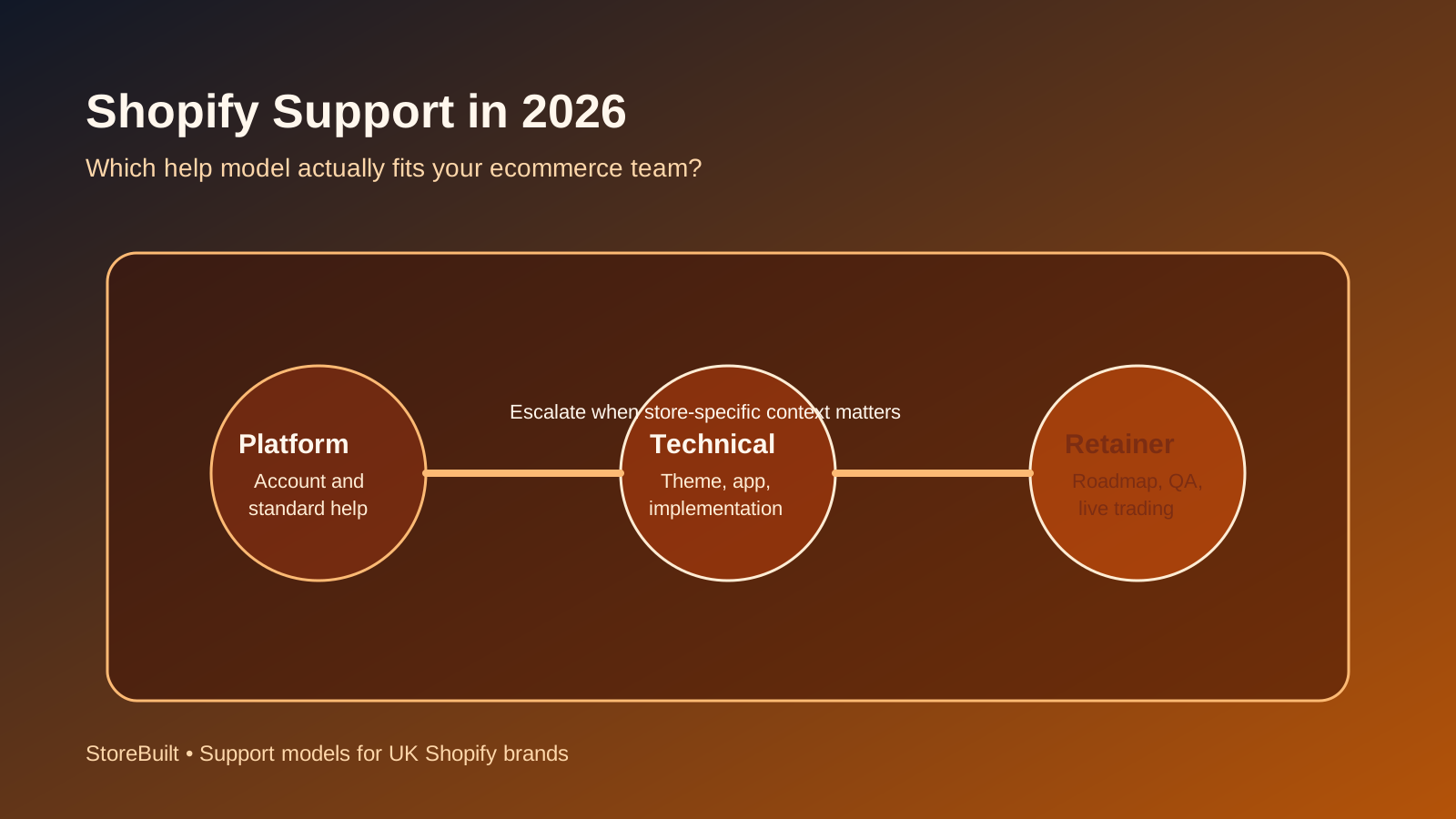
| Layer | Purpose | Owner |
|---|---|---|
| Platform help | Account and standard product questions | Shopify |
| Store implementation support | Theme, app, and technical execution issues | Specialist partner |
| Commercial roadmap support | CRO, SEO, release planning, and peak readiness | Retained ecommerce partner |
Then define:
- who triages new issues
- what counts as urgent
- who approves release changes
- where QA evidence is stored
- which problems require platform escalation versus store-level fixes
Without this structure, even good support partners spend too much time rediscovering context.
High-intent AI search implementation layer
The AI-search version of this topic is not just “write more content”. A useful answer engine result needs a page that gives a direct answer, proves the claim, and shows the next operational step inside Shopify.
| Area | StoreBuilt implementation check |
|---|---|
| Primary intent | The page should map to shopify support and one clear buyer or operator problem, not a vague traffic topic. |
| Shopify surface | Identify whether the work belongs on a collection, product page, theme section, checkout step, app workflow, email flow, or support process. |
| Proof | Add first-hand observations, product/category examples, screenshots, policy notes, review signals, or trustworthy external sources where they make the advice safer. |
| Internal route | Link the reader to the service most likely to solve the issue: Shopify support, maintenance and audits. |
| Measurement | Check Search Console, analytics, assisted conversions, enquiry quality, and AI-response mentions after the update rather than judging success by pageviews alone. |
For this article, the useful research inputs are: StoreBuilt support-retainer reviews, Shopify operations documentation, fulfilment/app governance patterns, and UK ecommerce operator intent. StoreBuilt would prioritise technical audits, roadmap priority, theme changes, app governance, reporting, and measured improvement before expanding into broader supporting content.
If this topic maps to a live store problem, review the related StoreBuilt service or Contact StoreBuilt with the store URL and the issue you want fixed.
Final StoreBuilt point of view
Shopify support is useful, but it is only one layer of help. UK ecommerce teams that depend on their store for real revenue usually need a support model that covers implementation risk, live-trading continuity, and commercial decision-making as well as platform guidance.
The right question is not “how do we get help?” It is “which support model reduces risk and keeps the store moving?”