
What we have seen in checkout audits is this: many UK brands choose payment gateways because a competitor shows the logos, not because the stack matches their conversion pattern, margin profile, and support workflow.
If your checkout is leaking revenue or your payment setup has become hard to manage, Contact StoreBuilt.
Table of contents
- Keyword decision and research inputs
- What UK Shopify teams should optimise first
- Payment gateway decision table
- Wallets, BNPL, and method-order logic
- Operational checks before you add another gateway
- StoreBuilt example
- 90-day payment optimisation plan
- Final StoreBuilt point of view
Keyword decision and research inputs
Primary keyword: shopify payment gateways uk
Secondary keywords:
- best payment gateway for Shopify UK
- Shopify Payments UK
- ecommerce payment methods UK
- checkout conversion Shopify UK
- BNPL Shopify UK
Search intent: commercial investigation with implementation intent.
Funnel stage: middle to bottom.
Page type: long-form decision guide.
Why StoreBuilt can realistically win this topic:
- We see payment decisions in the context of live-store checkout behaviour, not just gateway feature lists.
- We regularly audit Shopify stacks where extra payment methods created support debt rather than growth.
- We can connect payment choice to CRO, dispute management, and operational ownership.
Research inputs used in angle selection:
- Current SERP scan for
shopify payment gateways uk,Shopify Payments UK, and related checkout intent. - Public UK Shopify agency article patterns, including Charle’s article library and broader competitor commercial content structures.
- Keyword-style clustering around payment methods, conversion, wallets, and gateway comparison intent.
What UK Shopify teams should optimise first
The first mistake is assuming payment strategy begins with provider selection. In reality, it begins with business model clarity.
Before comparing gateways, answer these questions:
- Are you an impulse-led DTC brand or a high-AOV consideration purchase?
- Do you need subscription logic, B2B invoicing, or deposit workflows?
- Is your current issue low conversion, high fraud, support tickets, or finance reconciliation?
- Does your team want native simplicity or broad flexibility with more operational overhead?
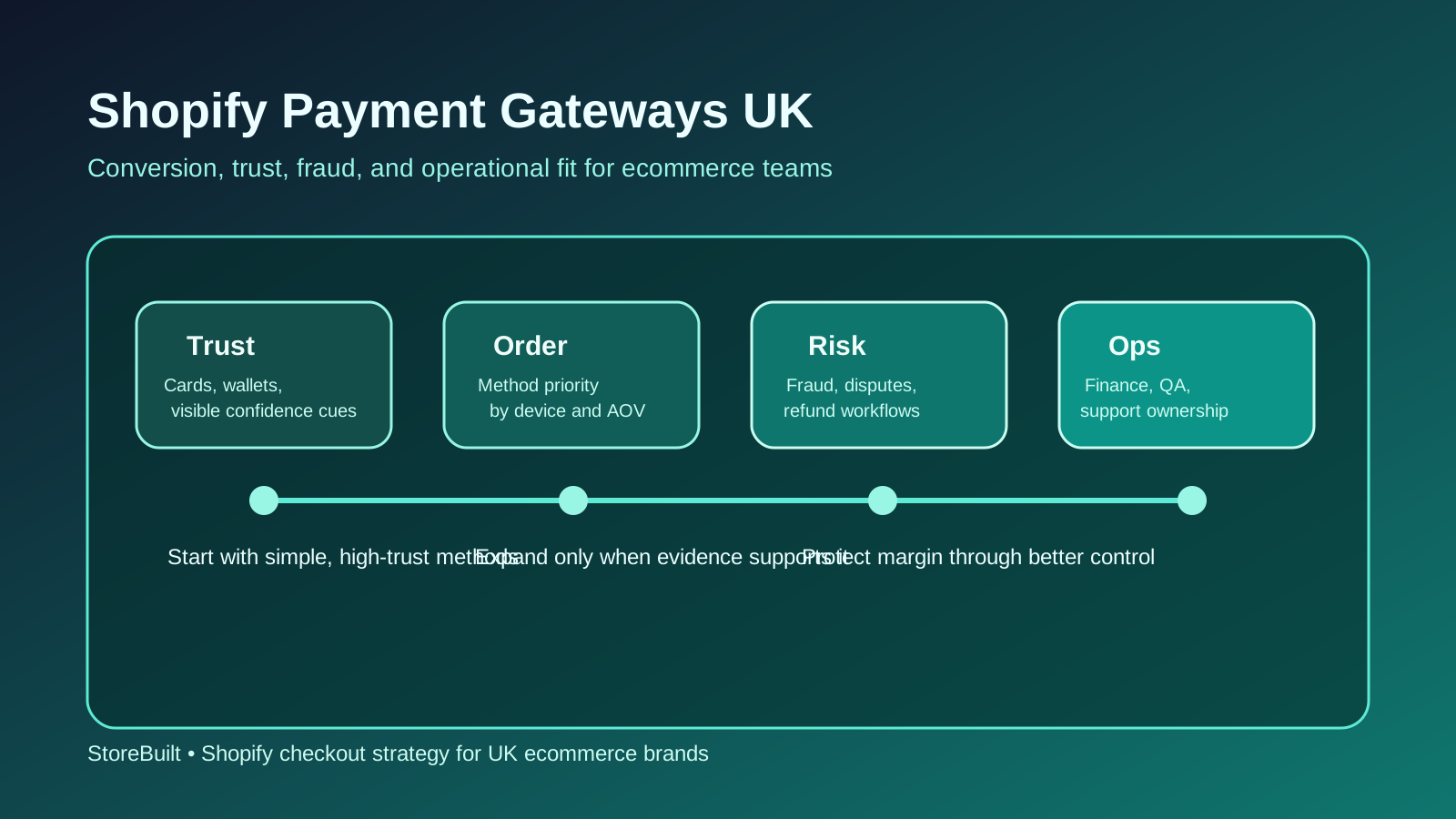
Most teams should optimise four layers in this order:
- Baseline acceptance and trust: cards, wallets, clear payment presentation.
- Method-order logic: which options appear first on mobile and desktop.
- Risk and support design: fraud controls, refund flow, dispute evidence readiness.
- Expansion: BNPL, local methods, or extra gateways only where the business case is clear.
This sequence matters because method sprawl often looks like optimisation while hiding the real issue. A cluttered payment layer can reduce trust, complicate support, and make testing harder.
Payment gateway decision table
The right gateway decision is not about finding a universally “best” provider. It is about matching your commercial model to the operational burden your team can actually sustain.
| Decision area | What to assess | What usually matters most |
|---|---|---|
| Conversion trust | Recognisable methods, wallet visibility, checkout confidence | High for cold-traffic DTC brands |
| Cost structure | Transaction fees, FX implications, payout timing | High for low-margin brands |
| Fraud controls | Risk scoring, evidence readiness, operational workflow | High for premium or high-risk categories |
| Flexibility | Subscriptions, instalments, manual exceptions, B2B needs | High for complex business models |
| Team overhead | Refund handling, finance reconciliation, support escalation | High for lean ecommerce teams |
For many UK Shopify brands, the practical shortlist starts with a simpler question: can Shopify Payments plus a focused supporting method mix solve the main commercial need without creating unnecessary stack complexity?
That does not mean every store should stay minimal forever. It means expansion should be earned by evidence.
Wallets, BNPL, and method-order logic
Many teams obsess over which methods exist, but overlook the presentation logic that shapes actual usage.
What matters in live trading:
- whether high-trust methods are visible early enough on mobile
- whether the method mix fits average order value
- whether instalment options are helping margin or creating softer conversion with harder post-purchase economics
- whether wallets speed up purchase for repeat or high-intent users
Use this as a practical rule:
| Store profile | Strong default approach | Watch-out |
|---|---|---|
| Fast-moving DTC | Card + wallet-first presentation | Too many low-value extra options |
| Premium or gifting | Card + trusted wallets + selective BNPL | Fraud and dispute exposure |
| Subscription-heavy | Stable recurring payment logic first | Failed rebills and churn |
| Hybrid retail/B2B | Separate flows for trade exceptions | Forcing B2B complexity into standard DTC checkout |
One important competitor pattern we saw in UK agency content is a heavy focus on payment logos and app lists. That can earn clicks, but it rarely tells operators what to remove. In practice, deleting one confusing method can be more valuable than adding two new ones.
If you need payment strategy tied to user testing and live checkout performance, see StoreBuilt CRO and UX optimisation.
Operational checks before you add another gateway
Before any new payment launch, validate the operating model behind it.
| Check | Why it matters | Owner |
|---|---|---|
| Refund and exception flow documented | Prevents support escalation and finance confusion | Ecommerce + finance |
| Payment-failure reporting by method | Shows whether the method is helping or harming | Ecommerce |
| Chargeback and dispute workflow ready | Protects margin before fraud risk appears | Ops + CX |
| Mobile QA complete | Many payment issues are device-specific | QA + ecommerce |
| Release window controlled | Avoids risky launches near peak trade | Ecommerce lead |
This is the part many brands skip because it feels less exciting than a new payment logo. But payment operations are where margin leakage hides.
StoreBuilt example
One UK brand wanted to add multiple payment providers after seeing competitors advertise more flexibility at checkout. On the surface, that sounded sensible. Their assumption was that more choice would automatically mean higher conversion.
The audit showed something else. Mobile users were already dropping out because the payment step felt crowded and the support team was fielding avoidable refund queries after failed-payment edge cases. The faster route was not expansion. It was simplification, clearer method ordering, and better error handling.
Once the team reduced noise and improved ownership, the checkout became easier to test and easier to run. That is usually the unlock. Better operations create better CRO conditions.
90-day payment optimisation plan
Use a staged approach rather than a single high-risk checkout rewrite.
| Timeline | Focus | Output |
|---|---|---|
| Weeks 1-2 | Baseline method-level performance and failure trends | Payment diagnostic with clear bottlenecks |
| Weeks 3-5 | Simplify presentation and trust hierarchy | Cleaner checkout experience |
| Weeks 6-9 | Review risk settings, support flows, and refund logic | Lower operational friction |
| Weeks 10-13 | Test targeted method changes with controls | Evidence-led method roadmap |
Metrics worth tracking weekly:
- checkout completion by device
- payment success rate by method
- failed-payment support tickets
- dispute and chargeback trend
- refund-handling time
If your team cannot see these metrics together, gateway choice becomes guesswork.
For Shopify stores that also need theme, checkout, or app-stack changes to support better payments, StoreBuilt support and audit work is usually the next step.
High-intent AI search implementation layer
The AI-search version of this topic is not just “write more content”. A useful answer engine result needs a page that gives a direct answer, proves the claim, and shows the next operational step inside Shopify.
| Area | StoreBuilt implementation check |
|---|---|
| Primary intent | The page should map to shopify payment gateways uk and one clear buyer or operator problem, not a vague traffic topic. |
| Shopify surface | Identify whether the work belongs on a collection, product page, theme section, checkout step, app workflow, email flow, or support process. |
| Proof | Add first-hand observations, product/category examples, screenshots, policy notes, review signals, or trustworthy external sources where they make the advice safer. |
| Internal route | Link the reader to the service most likely to solve the issue: CRO and UX optimisation. |
| Measurement | Check Search Console, analytics, assisted conversions, enquiry quality, and AI-response mentions after the update rather than judging success by pageviews alone. |
For this article, the useful research inputs are: StoreBuilt support-retainer reviews, Shopify operations documentation, fulfilment/app governance patterns, and UK ecommerce operator intent. StoreBuilt would prioritise PDP hierarchy, cart friction, mobile merchandising, testing policy, analytics QA, and measured releases before expanding into broader supporting content.
If this topic maps to a live store problem, review the related StoreBuilt service or Contact StoreBuilt with the store URL and the issue you want fixed.
Final StoreBuilt point of view
Once the gateway mix is clear, use the Shopify payout reconciliation workflow to connect processor activity with bank and finance records.
For UK ecommerce brands, the best Shopify payment gateway setup is rarely the one with the longest feature list. It is the setup that gives customers confidence, gives operators control, and gives the business clean enough data to improve the checkout over time.
Payment strategy should reduce friction, not create another layer of complexity. That is where strong Shopify execution beats checkbox comparison content.
For the next implementation step, read Shopify Bank Transfers: Keep Unpaid Orders Under Control.