
What we have seen in Shopify support handovers is this: many UK brands buy a retainer expecting stability, then receive little more than an inbox for ad hoc fixes. That is not support. That is expensive uncertainty.
If you want StoreBuilt to review your current support agreement, Contact StoreBuilt.
Table of contents
- Keyword decision and research inputs
- What UK competitors signal about support
- The minimum viable Shopify support retainer
- Scope table: what should actually be included
- Commercial red flags in retainer proposals
- StoreBuilt client example
- Final StoreBuilt point of view
Keyword decision and research inputs
Primary keyword: shopify support retainer
Secondary keywords:
- shopify support agency uk
- ecommerce support retainer
- shopify maintenance retainer uk
- ecommerce uk market support model
- shopify technical support for ecommerce brands
Search intent: commercial and solution-aware from teams comparing support models, retainers, and post-launch agency agreements.
Funnel stage: bottom of funnel.
Why StoreBuilt can win this topic:
- Support retainers are one of the clearest areas where Shopify agencies overpromise and under-specify.
- We see the failure points directly during audits, stabilisation work, and post-launch support takeovers.
- We can explain support in operator language, not just sales language.
Research inputs used on June 3, 2026:
- Current SERP review for
shopify support retainer,shopify support agency uk, and support-SLA modifiers. - Public review of UK Shopify agency support and growth partner pages, including Charle-style service positioning and visible support language from Swanky, Superco, and Eastside Co.
- Existing StoreBuilt support, audit, and incident-response patterns from live Shopify delivery work.
What UK competitors signal about support
Most established UK Shopify agencies now sell support as more than bug fixing. The public messaging usually expands into growth, optimisation, experimentation, or retained strategic access.
That shift is good, but it also creates confusion. A retainer can mean at least four different things:
- a ticketed maintenance contract
- a blended support and CRO backlog
- a strategic growth retainer with dev capacity
- a post-launch safety net with limited proactive work
Charle-style commercial content is useful because it tends to frame service decisions in practical terms. Still, no agency positioning page can tell you whether your real-world support needs are covered. Only the scope can do that.
The minimum viable Shopify support retainer
A serious Shopify support retainer for the ecommerce UK market should protect three things at the same time:
- Store stability.
- Release confidence.
- Continuous commercial improvement.
If your agreement only covers incidents, you do not have a growth-ready support model. You have emergency labour.
At minimum, the retainer should include:
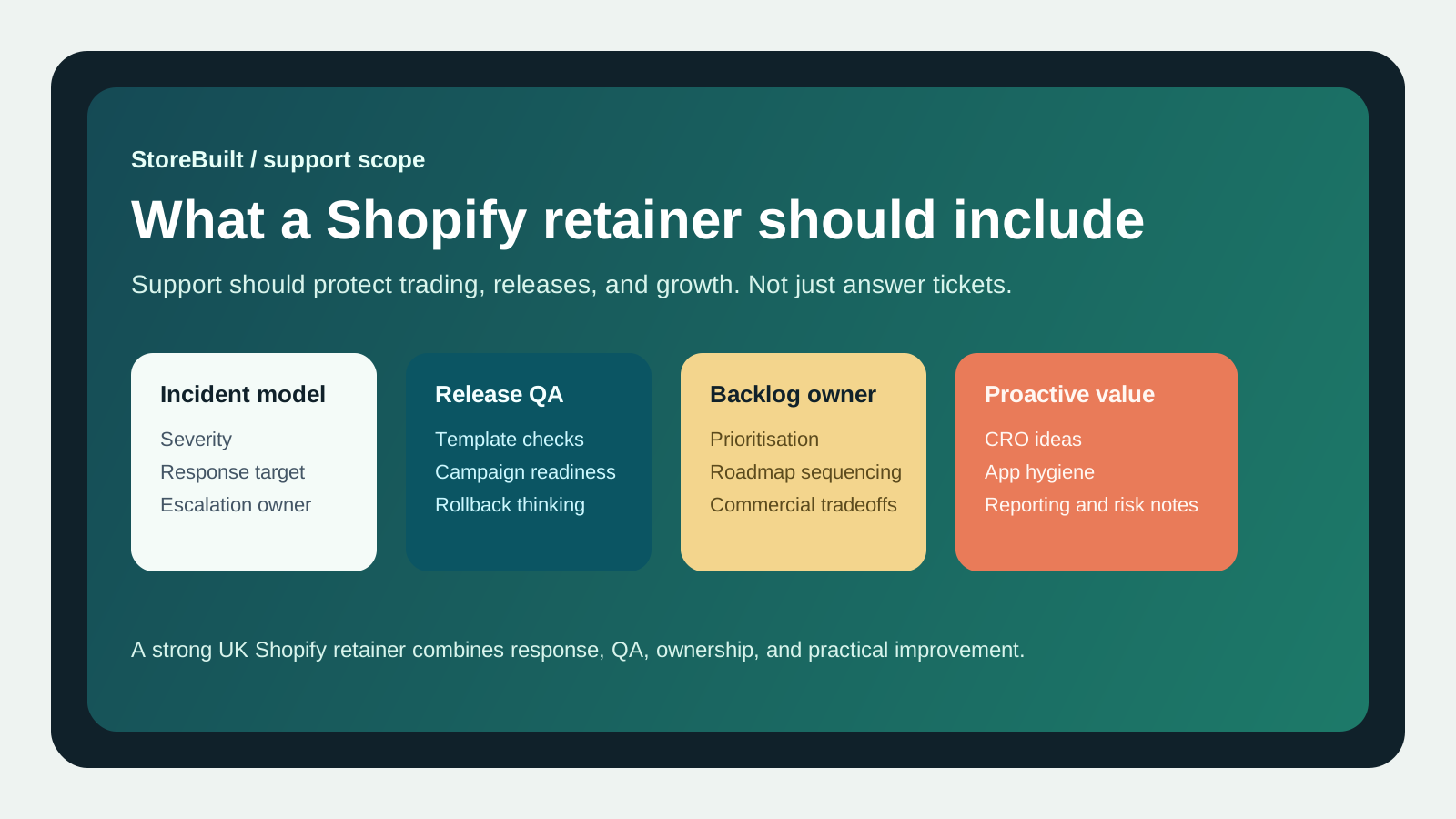
- incident triage with severity levels
- a defined response model
- QA before significant releases
- backlog management
- merchant support for small iterative changes
- proactive technical hygiene reviews
The last point is important. Stores rarely become fragile overnight. They become fragile because nobody is responsible for app sprawl, theme complexity, script conflicts, and release discipline over time.
Scope table: what should actually be included
Use this table to evaluate any support proposal.
| Scope area | Minimum acceptable inclusion | Why it matters |
|---|---|---|
| Incident response | Severity levels, response targets, escalation owner | Prevents confusion when revenue risk appears |
| Release QA | Pre-release checks for core templates and key flows | Reduces avoidable regressions |
| Backlog ownership | Named owner who prioritises and sequences work | Stops the retainer becoming reactive only |
| Small change delivery | Merchant-facing updates, content support, and light UX/dev tasks | Keeps the store moving week to week |
| CRO and merchandising input | At least light advisory support tied to site performance | Ensures support contributes to growth, not just maintenance |
| App and theme hygiene | Regular review of technical debt and overlap | Protects performance and maintainability |
| Reporting | Monthly view of work done, risks, and next priorities | Creates accountability and continuity |
A stronger retainer may also include:
- analytics or tracking support
- campaign-readiness checks before promotions
- ongoing SEO implementation help
- advisory sessions for roadmap planning
For many UK brands, the winning model is not a giant support contract. It is a focused retainer that combines operational reliability with enough proactive thinking to stop issues compounding.
If you want that kind of support rather than a reactive ticket queue, StoreBuilt can help.
Commercial red flags in retainer proposals
Support agreements often look reassuring until you read the exclusions.
Watch for these red flags:
- “Unlimited requests” without any explanation of prioritisation or response limits
- no distinction between incidents and backlog work
- no named senior owner
- vague language around testing responsibility
- all strategic work excluded, even when the retainer is marketed as growth support
- hours pooled in a way that makes urgent work destroy planned improvements
Another common problem is the absence of roadmap ownership. Someone needs to decide whether the next month should focus on checkout fixes, merchandising cleanup, speed, or app rationalisation. Without that layer, support becomes a stream of whoever shouted last.
The better agreements usually define:
- what is considered emergency support
- what needs scoping before work starts
- which work types are included by default
- how unused capacity is handled
- what happens when demand exceeds the monthly allocation
That clarity matters more than a low headline price.
StoreBuilt client example
A UK home and lifestyle brand came to us with a support retainer that looked generous on paper. The agency promised rapid help, growth support, and technical peace of mind.
In practice, none of the commercial priorities moved. Ticket response existed, but backlog ownership did not. Small issues were fixed, larger issues drifted, and nothing connected support time to conversion or operational risk.
After the agreement was restructured around severity, QA, ownership, and proactive reviews, the same monthly spend started producing materially better outcomes. The difference was not extra hours. It was better retainer design.
That is the point ecommerce teams often miss. The scope architecture is more important than the sales wording.
High-intent AI search implementation layer
The AI-search version of this topic is not just “write more content”. A useful answer engine result needs a page that gives a direct answer, proves the claim, and shows the next operational step inside Shopify.
| Area | StoreBuilt implementation check |
|---|---|
| Primary intent | The page should map to shopify support retainer and one clear buyer or operator problem, not a vague traffic topic. |
| Shopify surface | Identify whether the work belongs on a collection, product page, theme section, checkout step, app workflow, email flow, or support process. |
| Proof | Add first-hand observations, product/category examples, screenshots, policy notes, review signals, or trustworthy external sources where they make the advice safer. |
| Internal route | Link the reader to the service most likely to solve the issue: Shopify support, maintenance and audits. |
| Measurement | Check Search Console, analytics, assisted conversions, enquiry quality, and AI-response mentions after the update rather than judging success by pageviews alone. |
For this article, the useful research inputs are: StoreBuilt support-retainer reviews, Shopify operations documentation, fulfilment/app governance patterns, and UK ecommerce operator intent. StoreBuilt would prioritise technical audits, roadmap priority, theme changes, app governance, reporting, and measured improvement before expanding into broader supporting content.
If this topic maps to a live store problem, review the related StoreBuilt service or Contact StoreBuilt with the store URL and the issue you want fixed.
Final StoreBuilt point of view
A Shopify support retainer should not be judged by how comforting it sounds. It should be judged by whether it protects trading continuity, gives the team confidence to ship, and creates a clear path for ongoing improvement.
For UK ecommerce brands, the best retainers combine support, prioritisation, QA, and practical growth thinking in one disciplined operating model. If a proposal cannot clearly explain who owns risk, who owns the backlog, and what is included before problems happen, it is probably not a strong retainer no matter how polished the deck looks.