
What we have seen in Shopify growth work is this: plenty of teams have a strategy, a dashboard, and a backlog. What they do not always have is a weekly operating cadence that turns those things into consistent commercial action.
If your team is busy every week but still reactive, Contact StoreBuilt.
Table of contents
- Keyword decision and research inputs
- What current competitor content signals
- Why Shopify teams need a weekly cadence
- Weekly trading cadence table
- How to connect merchandising, CRO, and operations
- The meeting mistakes that create drift
- StoreBuilt client example
- Final StoreBuilt point of view
Keyword decision and research inputs
Primary keyword: shopify weekly trading cadence
Secondary keywords:
- ecommerce UK market trading cadence
- shopify weekly trading framework
- shopify operating cadence
- ecommerce weekly trading meeting
- shopify growth operations
Search intent: operational and strategic. The reader is usually trying to improve execution quality, ownership, and decision speed across a live Shopify business.
Funnel stage: middle to bottom.
Page type: practical operating framework.
Why StoreBuilt can win this topic:
- We see how Shopify delivery fails when merchandising, support, CRO, and technical changes are not coordinated weekly.
- We structure retainers and support models around working rhythms, not isolated tasks.
- We can explain how a cadence reduces both commercial drift and technical stress.
Research inputs used on June 15, 2026:
- SERP review around weekly trading, Shopify operations, ecommerce cadence, and growth operating model terms.
- Competitor review across public UK Shopify-agency content, including longer decision-stage formats common on Charle-style article hubs.
- StoreBuilt observations from support, CRO, release, and growth workflows across UK ecommerce teams with active trading calendars.
What current competitor content signals
The best UK Shopify content increasingly talks about growth as a system. That is a useful direction. Stronger agency content now connects strategy, CRO, merchandising, and technical delivery more clearly than generic blog content used to.
But there is still a common gap. A lot of articles explain what teams should improve without showing how the work should actually run week to week.
That matters because execution failure is rarely caused by lack of ideas. It is caused by lack of sequence:
- too many priorities enter the same week
- campaign work overrides maintenance work
- technical changes go live without commercial context
- reporting gets reviewed after the next set of changes already started
This is why a weekly cadence is more than meeting hygiene. It is a performance system for a live Shopify business.
Why Shopify teams need a weekly cadence
Shopify stores are unusually exposed to high-frequency change:
- campaigns shift quickly
- merchandising changes regularly
- apps and integrations introduce ongoing risk
- CRO ideas compete with operational fixes
- customer-experience friction appears in real time
Without a cadence, teams usually fall into one of two patterns.
The first is permanent urgency. Everything feels important, so the business becomes dependent on whoever can push hardest.
The second is document-heavy drift. Plans exist, but they are not shaping daily or weekly decisions consistently enough.
A weekly cadence helps by forcing clarity around:
- what is being reviewed
- what is being changed
- who owns the change
- what signal should move if the change is correct
- what must not be destabilised while the change happens
That last point is often overlooked. The best Shopify teams do not only ask, “What should we improve?” They also ask, “What trading stability must we protect while improving it?”
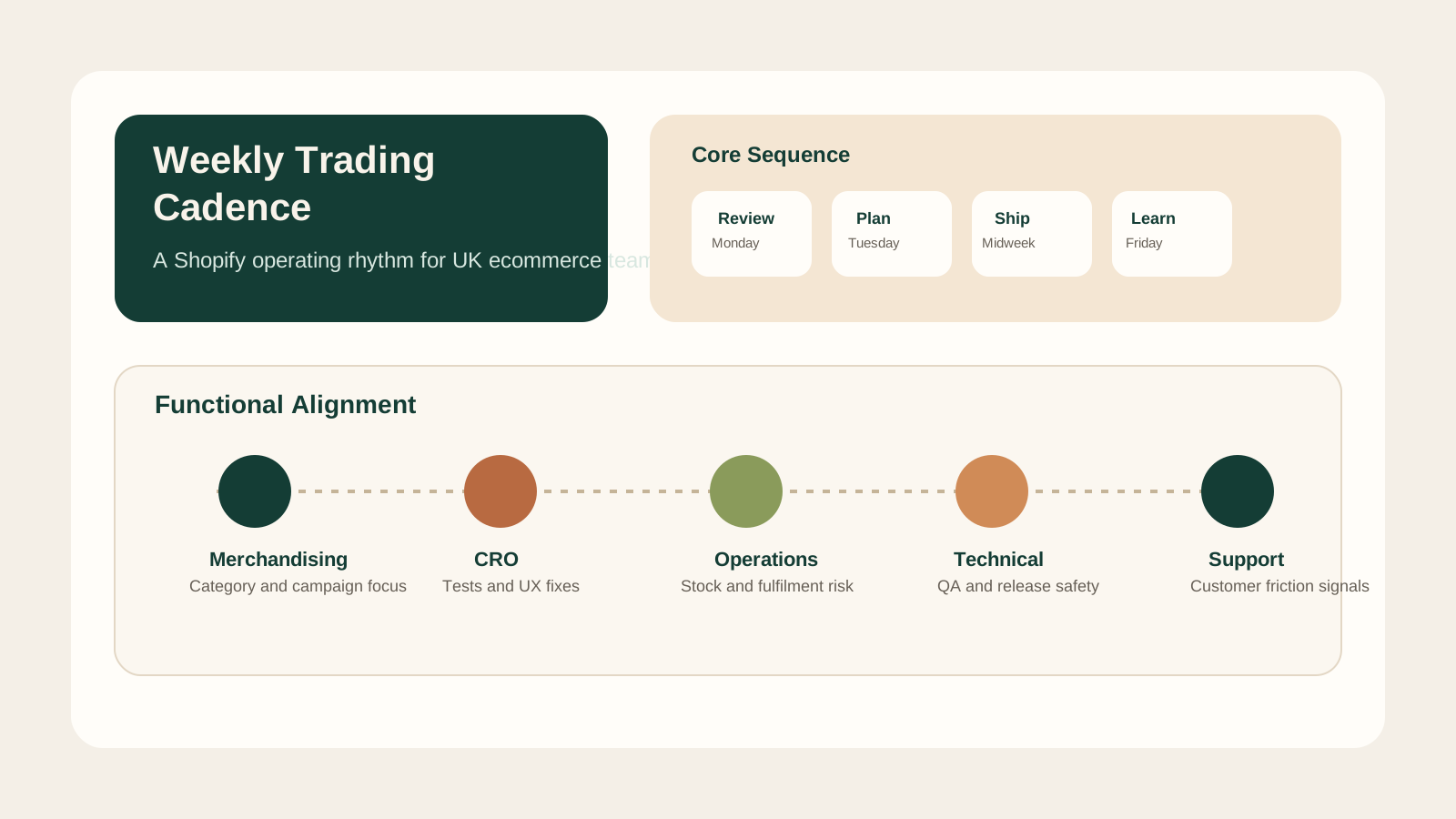
Weekly trading cadence table
| Day or phase | Focus | Typical owner group | Output |
|---|---|---|---|
| Monday review | Performance, stock, campaign, support, and incident signals | Ecommerce lead, merchandising, operations, support | Priority list and risk flags |
| Tuesday planning | Scope what can realistically ship this week | Ecommerce lead, PM, technical owner, CRO | Approved change set |
| Midweek execution | Implement, QA, and publish agreed changes | Technical, design, content, merchandising | Live changes with validation |
| Thursday validation | Check commercial and technical impact | Ecommerce lead, analytics, support | Early-read performance notes |
| Friday learning | Document lessons and next-week carryover | Cross-functional leads | Action log and next cycle inputs |
This does not need to become corporate theatre. The goal is not more meetings. The goal is fewer unowned decisions.
If your Shopify delivery already feels fragmented, StoreBuilt support and audit work is often the right stabilisation path.
How to connect merchandising, CRO, and operations
One of the biggest sources of drift is that each function thinks in a different time horizon.
Merchandising may think in campaign windows.
CRO may think in hypothesis and test cycles.
Operations may think in stock accuracy, fulfilment pressure, and support readiness.
Technical teams may think in release safety and dependencies.
The weekly cadence works when these are translated into one commercial language.
Monday questions that matter
- Which products, categories, or campaigns need attention this week?
- Are stock or fulfilment constraints making certain changes commercially dangerous?
- Which support signals indicate customer friction before revenue drops visibly?
- What should not be touched because it is too close to an important trading event?
Tuesday decisions that matter
- Which change set has clear ownership?
- Which requests are important but should not enter this week’s release?
- What needs QA signoff before it goes live?
- What KPI should move if the work is successful?
Friday learning that matters
- Which change produced a useful signal?
- Which work created noise rather than value?
- Which recurring issue is now clearly systemic and needs a deeper project?
That structure turns the week into an operating loop rather than a sequence of interruptions.
The meeting mistakes that create drift
Not every trading meeting is useful. Some actually make execution worse.
Mistake 1: reviewing too much data
If the meeting becomes a broad analytics tour, nobody leaves with a practical decision. Use a narrower set of metrics tied to the work the team can actually influence this week.
Mistake 2: letting campaign urgency override store health every time
Short-term revenue pressure is real, but if every week is driven entirely by immediate campaign requests, the underlying store gradually gets harder to operate.
Mistake 3: not separating fast fixes from structural work
Some issues need a same-week response. Others need a scoped project. Mixing both in one bucket creates false urgency and poor prioritisation.
Mistake 4: no written carryover logic
If priorities reset each Monday from memory, the team repeats the same conversations. A short action log is enough to stop that.
A simple scorecard for cadence maturity
| Question | Healthy answer | Unhealthy answer |
|---|---|---|
| Do we know what this week’s top three live-store priorities are? | Yes, with owners | Not consistently |
| Are technical and commercial risks reviewed together? | Yes | Usually in separate conversations |
| Do we defer work intentionally when it is too risky for the week? | Yes | Everything urgent enters the same queue |
| Can we say what changed and what signal moved? | Usually | Rarely |
You do not need perfect process to benefit from this. You need repeatable sequence.
StoreBuilt client example
One UK Shopify team had capable people across merchandising, CRM, paid media, operations, and development. The issue was not talent. It was collision. Each function had valid priorities, but the week kept being rebuilt by whichever problem felt most immediate.
We introduced a simpler cadence tied to review, scoping, QA, release, and learning. That did not remove complexity from the business, but it made the complexity more legible. Changes were sequenced more cleanly, campaign work stopped breaking adjacent priorities as often, and the store became easier to run under pressure.
This is why weekly operating rhythm matters. It reduces both strategic drift and team fatigue.
High-intent AI search implementation layer
The AI-search version of this topic is not just “write more content”. A useful answer engine result needs a page that gives a direct answer, proves the claim, and shows the next operational step inside Shopify.
| Area | StoreBuilt implementation check |
|---|---|
| Primary intent | The page should map to weekly trading and one clear buyer or operator problem, not a vague traffic topic. |
| Shopify surface | Identify whether the work belongs on a collection, product page, theme section, checkout step, app workflow, email flow, or support process. |
| Proof | Add first-hand observations, product/category examples, screenshots, policy notes, review signals, or trustworthy external sources where they make the advice safer. |
| Internal route | Link the reader to the service most likely to solve the issue: Shopify support, maintenance and audits. |
| Measurement | Check Search Console, analytics, assisted conversions, enquiry quality, and AI-response mentions after the update rather than judging success by pageviews alone. |
For this article, the useful research inputs are: StoreBuilt support-retainer reviews, Shopify operations documentation, fulfilment/app governance patterns, and UK ecommerce operator intent. StoreBuilt would prioritise store operations, app governance, fulfilment logic, support workflows, reporting, and technical maintenance before expanding into broader supporting content.
If this topic maps to a live store problem, review the related StoreBuilt service or Contact StoreBuilt with the store URL and the issue you want fixed.
Final StoreBuilt point of view
For Shopify brands in the UK ecommerce market, growth is often less about finding another tactic and more about building a better weekly operating system. The teams that improve most consistently are usually the ones that turn strategy into cadence.
If your store is already live and growing, the question is not whether you need a process. You already have one. The real question is whether your current weekly cadence is helping the business compound good decisions or repeat avoidable ones.