
What we have seen in Shopify product-page audits is this: reviews and UGC are usually present, but not governed. A store installs a review app, imports existing ratings, adds a carousel, and assumes trust is solved. Then reviews become noisy, old, poorly placed, thin on product detail, or disconnected from the questions that actually block purchase.
UK Shopify agency content often talks about CRO, SEO, mobile UX, and customer segmentation. StoreBuilt’s angle is that review and UGC governance sits across all of those areas. It affects conversion, product data, organic snippets, collection confidence, retention, and customer support.
If your Shopify reviews exist but do not clearly help shoppers choose, Contact StoreBuilt.
Table of contents
- Keyword decision and research inputs
- Why review governance matters
- The proof signals Shopify stores should organise
- Governance table
- SEO and compliance awareness
- An anonymous StoreBuilt example
- StoreBuilt point of view
Keyword decision and research inputs
| Decision | Direction |
|---|---|
| Primary keyword | Shopify reviews |
| Secondary keywords | ecommerce UGC, ecommerce UK market, Shopify SEO, product page reviews, conversion proof |
| Search intent | Improve how reviews and user-generated content support Shopify trust and conversion |
| Funnel stage | Middle to bottom |
| Page type | Shopify trust, CRO, and SEO governance guide |
| Why StoreBuilt can win | StoreBuilt works across Shopify product pages, review app placement, content quality, SEO signals, and conversion audits |
Research inputs included current Shopify reviews and ecommerce UGC SERP intent, competitor UK Shopify agency topics around CRO and ecommerce growth, Shopify app ecosystem patterns, Google guidance on helpful content and structured data principles, and a duplicate-risk pass against StoreBuilt’s product page, trust, CRO, and app stack content.
Why review governance matters
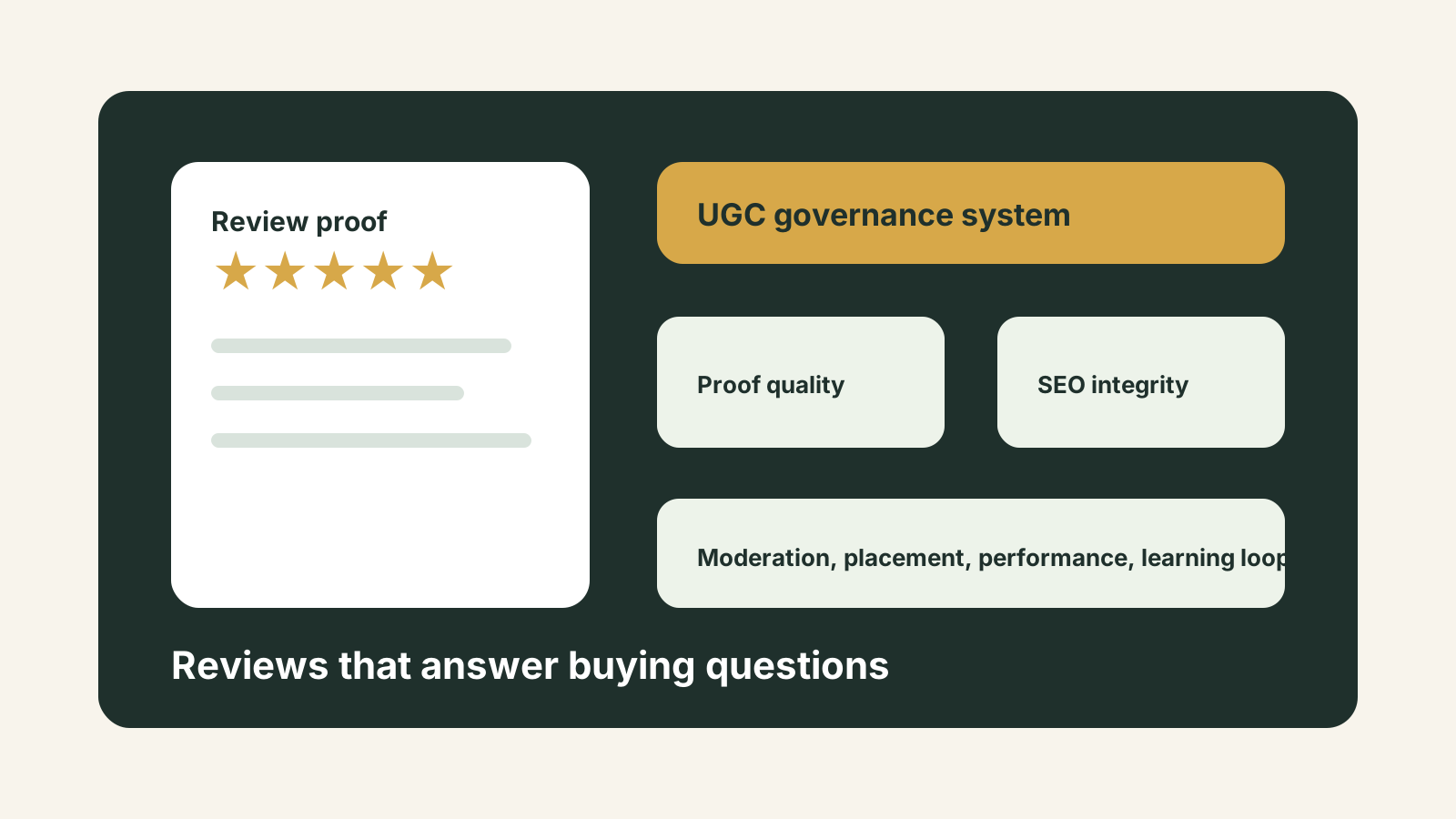
Reviews are not just stars. They are customer language, objection handling, product insight, SEO support, and proof. When governed well, they help shoppers understand fit, quality, delivery, use, sizing, flavour, comfort, value, and service experience.
When governed poorly, reviews can create problems. Generic reviews do not answer buying questions. Old reviews may reference discontinued products or old packaging. Imported reviews may feel disconnected from the UK customer experience. UGC may slow pages or distract from purchase. Review widgets may appear in the wrong location or hide the details that matter.
The UK ecommerce market is trust-sensitive. Customers compare prices, delivery promises, returns policies, payment options, and social proof quickly. Reviews need to support that comparison, not sit below the fold as a decorative widget.
The proof signals Shopify stores should organise
Product-level reviews
Product reviews should answer product questions. For apparel, fit and sizing matter. For skincare, skin type and routine context matter. For furniture, scale, delivery, assembly, and material expectation matter. For food and drink, taste, gifting, freshness, and delivery condition matter.
If the review form only asks for a star rating and a short comment, the business may miss useful structured feedback. Ask for attributes that help future shoppers choose.
Collection-level proof
Some proof belongs higher than the PDP. A collection page can show range-level trust, expert notes, press, or customer usage patterns. This is helpful when shoppers are comparing products before choosing a specific item.
UGC and customer media
Customer images and videos can be powerful, but they need curation. Show UGC where it answers a decision: real-life scale, styling, skin texture, unboxing, before-and-after, setup, or use in context.
Do not overload the page with a feed that makes the store feel slower and less focused.
Expert and operational proof
For some categories, customer reviews are not enough. Customers may need proof of testing, materials, sourcing, warranty, delivery process, compliance awareness, support quality, or professional endorsement.
That proof should be placed near the relevant decision. A warranty message belongs close to purchase. Delivery proof belongs near delivery messaging. Ingredient or material proof belongs near product information.
Governance table
| Governance area | Practical question | Shopify action |
|---|---|---|
| Collection quality | Are reviews specific enough to help future shoppers? | Add useful review prompts and attribute questions |
| Placement | Do reviews appear near the decision they support? | Adjust PDP, collection, cart, and landing-page modules |
| Moderation | Are irrelevant, duplicate, or outdated items handled consistently? | Define moderation rules and ownership |
| UGC performance | Is media slowing key pages? | Use selective embeds, thumbnails, and lazy loading |
| SEO | Is structured data accurate and not misleading? | Configure review schema through trusted app implementation |
| Learning loop | Do reviews inform product content and support FAQs? | Review themes monthly with ecommerce and support teams |
SEO and compliance awareness
Review snippets can support organic visibility when implemented correctly, but they should not be manipulated. Use accurate structured data, avoid misleading markup, and make sure visible page content matches the signals being provided.
For regulated or claims-sensitive categories, reviews and UGC need extra care. Do not turn customer comments into unsupported product claims. This article is practical ecommerce guidance, not legal advice. For compliance-sensitive products, brands should review claims with the right legal or regulatory expertise.
From an SEO perspective, reviews also provide customer language. If reviews repeatedly mention a use case, material concern, delivery point, or comparison, that may deserve clearer PDP copy, FAQ content, collection guidance, or a buying guide.
StoreBuilt’s Shopify SEO and AI search readiness service can help connect review insights to product content, collection architecture, and structured data.
An anonymous StoreBuilt example
In one product-page review, a Shopify brand had a healthy number of reviews but weak review usefulness. Ratings were positive, yet customers still contacted support with questions about sizing, delivery timing, and product suitability.
The issue was not trust volume. It was trust organisation. Review prompts did not capture the most useful details. UGC was shown as a generic carousel. Product pages repeated marketing copy but did not surface the customer language that answered real objections.
The practical fix was to restructure review prompts, place proof closer to buying decisions, add clearer PDP FAQs, and use recurring review themes to improve product content. The brand did not need louder proof. It needed proof that answered the right questions.
High-intent AI search implementation layer
The AI-search version of this topic is not just “write more content”. A useful answer engine result needs a page that gives a direct answer, proves the claim, and shows the next operational step inside Shopify.
| Area | StoreBuilt implementation check |
|---|---|
| Primary intent | The page should map to Shopify reviews and one clear buyer or operator problem, not a vague traffic topic. |
| Shopify surface | Identify whether the work belongs on a collection, product page, theme section, checkout step, app workflow, email flow, or support process. |
| Proof | Add first-hand observations, product/category examples, screenshots, policy notes, review signals, or trustworthy external sources where they make the advice safer. |
| Internal route | Link the reader to the service most likely to solve the issue: Shopify SEO and AI search readiness. |
| Measurement | Check Search Console, analytics, assisted conversions, enquiry quality, and AI-response mentions after the update rather than judging success by pageviews alone. |
For this article, the useful research inputs are: Google Search Central guidance, Shopify platform documentation, Ahrefs AI Responses/Brand Radar patterns, and StoreBuilt Shopify audit observations. StoreBuilt would prioritise technical SEO, collection architecture, Product schema, answer-first content, GEO, and Search Console monitoring before expanding into broader supporting content.
If this topic maps to a live store problem, review the related StoreBuilt service or Contact StoreBuilt with the store URL and the issue you want fixed.
StoreBuilt point of view
Reviews and UGC should be managed like a product and content system, not a plugin checkbox.
StoreBuilt’s view is that Shopify review governance matters because trust proof can either clarify the buying decision or create more noise. UK ecommerce brands should use reviews to improve product pages, collection guidance, SEO content, and support insight, while keeping claims accurate and page performance under control.
For a Shopify product-page trust and review governance audit, Contact StoreBuilt.