
What we have seen in StoreBuilt audits and planning workshops is this: ecommerce teams rarely lose momentum because they lack ideas. They lose it because search, platform, conversion, retention, and operating decisions are treated as separate projects. This guide turns that problem into a practical Shopify decision framework for UK brands.
The topic was chosen after reviewing current UK Shopify agency content patterns, including Charle’s article hub, and checking how ecommerce, ecommerce UK market, Shopify, and platform-comparison keywords are being served. StoreBuilt’s angle is deliberately operator-led: helpful enough for a team to use, commercial enough to support a qualified enquiry.
If you want StoreBuilt to review how this applies to your store, Contact StoreBuilt.
Table of contents
- Keyword decision and research inputs
- Why ecommerce content fails
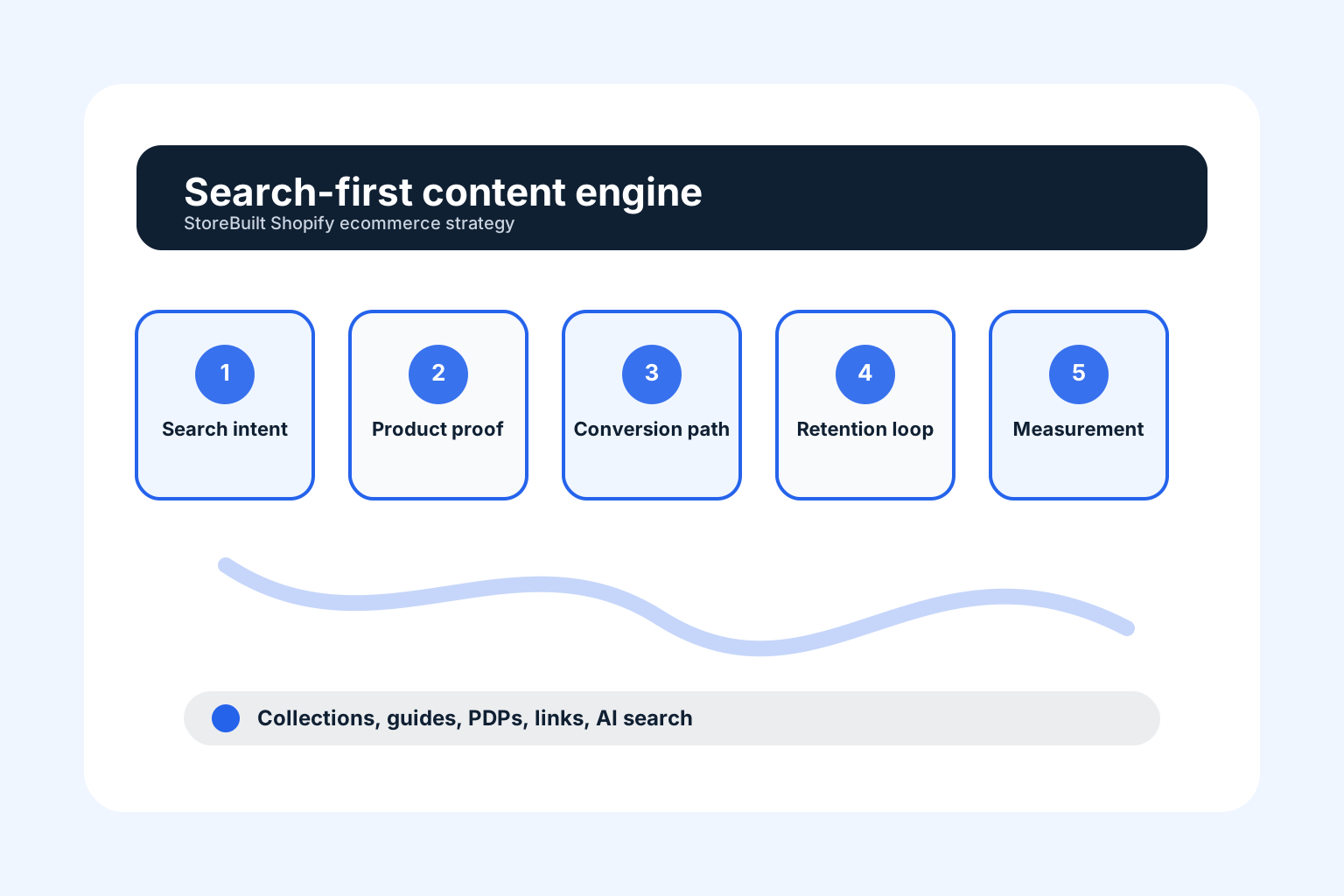
- The content engine model
- AI search readiness
- StoreBuilt example
- Governance cadence
- What Google and shoppers need to see
- Commercial page mapping
- Final StoreBuilt point of view
Keyword decision and research inputs
Primary keyword: ecommerce SEO content strategy UK. Secondary keywords include Shopify content strategy, Shopify collection SEO, ecommerce buying guides, AI search readiness, and ecommerce SEO UK. Intent is practical and commercial: the reader wants content that ranks, helps shoppers decide, and supports sales. Funnel stage is middle funnel. Page type is an operating playbook.
Competitor research showed UK Shopify agencies increasingly publishing search-first guides across migration, mobile SEO, schema, platform comparisons, and automation. StoreBuilt already has technical SEO content, so this article focuses on the content engine: how to decide what to write, where it should live, and how it should link to commercial pages.
The post supports Shopify SEO and AI search readiness and should help Google understand StoreBuilt’s expertise around ecommerce search systems.
Why ecommerce content fails
Most ecommerce content fails for one of three reasons. First, it targets traffic without a commercial path. Second, it is published as isolated blog content instead of supporting collections, products, and service journeys. Third, it answers a generic question but does not help a shopper choose.
For Shopify brands, useful content usually sits in five places:
- collection pages that explain choice;
- product pages that answer objections;
- buying guides that compare options;
- support content that reduces friction;
- editorial guides that build authority around a category.
A search-first content engine connects those places. It does not treat the blog as the only content surface.
The content engine model
| Content type | Search job | Commercial job | Internal link target |
|---|---|---|---|
| Collection copy | Rank for category and modifier terms | Help shoppers narrow products | Subcollections, bestsellers, buying guide |
| Buying guide | Capture research intent | Move buyer toward a category or product set | Collection and PDP |
| Comparison page | Capture decision intent | Explain tradeoffs | Product, collection, or enquiry path |
| Product FAQ | Win long-tail and AI answer visibility | Remove objections | Cart, support, delivery, returns |
| Blog article | Build topical authority | Feed service, collection, or email capture | Service or category hub |
Internal links are not decoration. They tell shoppers and search engines which page should solve which intent.
AI search readiness
AI search does not remove the need for strong ecommerce content. It raises the standard. Product feeds, schema, headings, category copy, FAQs, and internal links all help systems understand what the store sells and who it is for.
A practical AI-readiness pass asks:
- Are product names, variants, and attributes clear?
- Do collections explain the difference between product types?
- Are FAQs specific enough to answer real buyer questions?
- Does schema match the visible content?
- Are reviews, delivery, returns, and sizing details easy to parse?
- Is the brand publishing useful category expertise rather than generic posts?
This is why content strategy and technical SEO cannot be separated on Shopify.
StoreBuilt example
In one StoreBuilt SEO review, a brand had strong products but weak category explanation. Product pages carried most of the burden, while collections gave shoppers little help choosing. Blog posts existed, but they were not linked back to the commercial journeys that mattered.
The useful work was to map keywords to page types. Category terms belonged on collections. Research terms became buying guides. Product objections were answered on PDPs. Broader educational posts linked back into category hubs. The result was a clearer content system that a trading team could maintain.
Governance cadence
A search-first content engine needs governance or it becomes another disconnected publishing calendar. StoreBuilt usually recommends a monthly review with four inputs: Search Console queries, Shopify collection and product performance, customer support themes, and competitor SERP movement. These inputs keep content tied to real demand.
The monthly review should decide which pages need refreshing, which guides should link into which collections, which PDP questions keep appearing, and which new article is actually worth publishing. It should also remove weak ideas. A content calendar is only useful if it says no to topics that would create cannibalisation or add generic advice.
For small ecommerce teams, the cadence can be simple: one collection improvement, one product-page proof improvement, one guide or article, and one internal-link pass each month. That rhythm compounds because it strengthens the store, not just the blog.
What Google and shoppers need to see
Google needs clear page purpose, crawlable content, structured signals, and internal links that show hierarchy. Shoppers need plain explanations, proof, comparison help, and confidence that the product fits their situation. AI search systems need consistent product attributes, unambiguous entity information, and content that answers real questions.
The same work often serves all three. Clear collection copy helps shoppers and search engines. Product FAQs reduce support pressure and support long-tail visibility. Buying guides improve internal links and help hesitant customers. Good ecommerce SEO is not separate from good merchandising; it is merchandising made easier to find and understand.
Commercial page mapping
Every content idea should have a canonical destination. If the keyword is clearly transactional, it may belong on a collection, product, service, or landing page rather than in the blog. If the keyword is comparative, it may need a guide that links into the right commercial page. If the keyword is informational but close to purchase, it should still help the shopper choose a category, product, or next action.
A simple mapping exercise prevents cannibalisation. Write the keyword, search intent, best page type, internal link target, and conversion path before drafting. If two planned articles share the same intent, merge them or change the angle. This matters on StoreBuilt’s own site too: broad Shopify agency terms should support the homepage and services pages, while blog posts should handle specific questions and link upward.
For ecommerce brands, the same discipline protects category performance. Do not let a blog article outrank the collection page for a high-intent category term unless the blog exists to guide users back into that collection. Content should strengthen the commercial architecture, not compete with it.
High-intent AI search implementation layer
The AI-search version of this topic is not just “write more content”. A useful answer engine result needs a page that gives a direct answer, proves the claim, and shows the next operational step inside Shopify.
| Area | StoreBuilt implementation check |
|---|---|
| Primary intent | The page should map to ecommerce SEO UK and one clear buyer or operator problem, not a vague traffic topic. |
| Shopify surface | Identify whether the work belongs on a collection, product page, theme section, checkout step, app workflow, email flow, or support process. |
| Proof | Add first-hand observations, product/category examples, screenshots, policy notes, review signals, or trustworthy external sources where they make the advice safer. |
| Internal route | Link the reader to the service most likely to solve the issue: Shopify SEO and AI search readiness. |
| Measurement | Check Search Console, analytics, assisted conversions, enquiry quality, and AI-response mentions after the update rather than judging success by pageviews alone. |
For this article, the useful research inputs are: Google Search Central guidance, Shopify platform documentation, Ahrefs AI Responses/Brand Radar patterns, and StoreBuilt Shopify audit observations. StoreBuilt would prioritise technical SEO, collection architecture, Product schema, answer-first content, GEO, and Search Console monitoring before expanding into broader supporting content.
If this topic maps to a live store problem, review the related StoreBuilt service or Contact StoreBuilt with the store URL and the issue you want fixed.
Final StoreBuilt point of view
A Shopify content engine should make the store easier to understand, easier to crawl, and easier to buy from. StoreBuilt’s view is that ecommerce content is only valuable when it clarifies a real buying decision.
If your content is growing but revenue paths are not clearer, Contact StoreBuilt.