
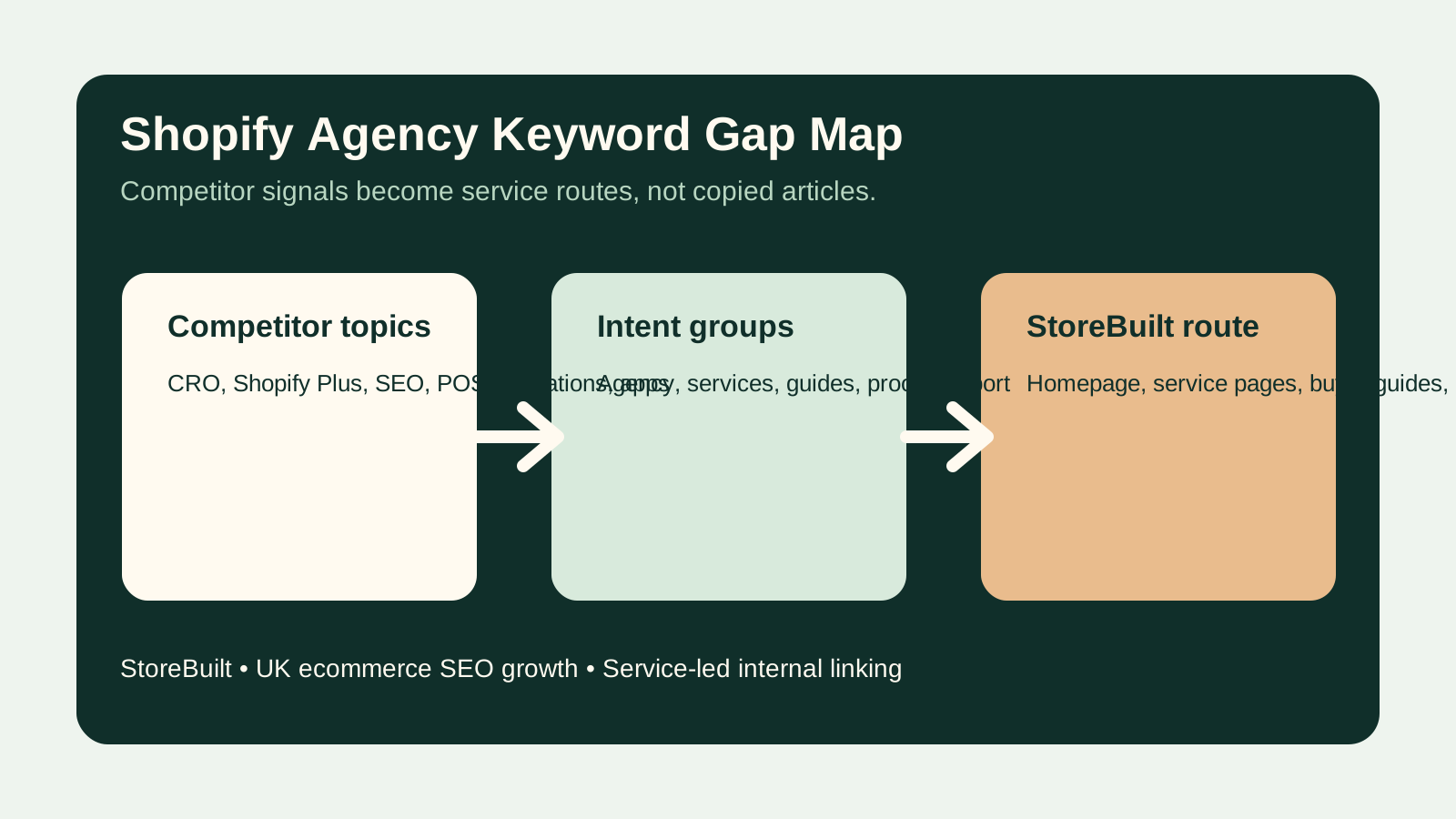
What we have seen in Shopify agency keyword reviews is this: competitor content is useful, but only when it is treated as a map of search intent rather than a script to copy. Charle, Swanky, Eastside Co, We Make Websites, Underwaterpistol, Noughts & Ones, and other UK Shopify agencies all signal what the market cares about. The job for StoreBuilt is to find the gaps that match its own proof, services, and delivery strengths.
Charle’s current article library is especially useful because it covers Shopify Plus, marketing automation, Online Store 2.0, CRO, A/B testing, POS, migrations, speed, SEO statistics, platform comparisons, and agency-selection topics. That tells us UK ecommerce teams are searching across platform choice, growth systems, and implementation confidence. StoreBuilt should not clone those titles. It should build sharper buyer-side content and link it into the right service routes.
If you want StoreBuilt to review your Shopify content and competitor gaps, Contact StoreBuilt.
Table of contents
- Keyword decision and research inputs
- How to read competitor content
- UK Shopify agency keyword groups
- Competitor gap table
- StoreBuilt example
- 90-day keyword plan
- Final StoreBuilt point of view
Keyword decision and research inputs
Primary keyword: Shopify agency competitor keyword gap
Secondary keywords: Shopify agency UK, Shopify agency London, ecommerce UK market, Shopify keywords, best Shopify agency UK.
Search intent: commercial research. The reader wants to understand how agencies win visibility and how to build a stronger content plan.
Funnel stage: middle funnel for marketing leads, founders, ecommerce managers, and teams comparing agencies.
Page type: competitor-led SEO strategy guide.
Why StoreBuilt can realistically win this topic:
- The article supports the StoreBuilt homepage, Shopify agency services, Shopify SEO and AI search readiness, and free Shopify audit.
- It provides strategic transparency without trying to rank a blog post over the homepage for the main agency term.
- StoreBuilt can use competitor signals to strengthen service-page internal links and lead capture.
Research inputs used on July 2, 2026:
- Current SERP review for Shopify agency UK, Shopify agency London, best Shopify agency UK, Shopify Plus agency UK, and Shopify SEO agency.
- Charle article hub review at
charle.co.uk/articles/and competitor agency positioning patterns across UK Shopify agencies. - StoreBuilt blog inventory and preferred canonical page mapping from local SEO growth rules.
How to read competitor content
Competitor research should answer four questions.
First, what does Google believe the searcher wants? For broad terms such as Shopify agency UK, the SERP usually mixes agency homepages, lists of agencies, review-style articles, partner directories, and commercial service pages. That means a blog post alone is unlikely to be the best canonical asset for StoreBuilt’s main agency query. The homepage and service pages need to carry that commercial intent.
Second, what content formats are competitors using? Charle uses a broad article hub with practical guides, platform explainers, SEO and CRO topics, Shopify Plus content, marketing automation, and list-style agency content. Other agencies often lean into case studies, partner pages, service hubs, or opinion-led ecommerce strategy.
Third, what proof signals appear repeatedly? Shopify Plus partner status, case studies, client logos, launch counts, live-store examples, CRO process, SEO capability, and app partner ecosystems all appear because buyers need confidence before contacting an agency.
Fourth, where is the gap for StoreBuilt? A smaller specialist agency should not fight only on volume claims. It can win by being clearer, more practical, more buyer-side, and more honest about implementation trade-offs.
UK Shopify agency keyword groups
Commercial agency terms
These include Shopify agency London, Shopify agency UK, London Shopify agency, Shopify Plus agency UK, Shopify development agency UK, and Shopify design agency UK. They should map primarily to the homepage and service pages, not dozens of similar blog posts.
Buyer evaluation terms
These include best Shopify agency UK, how to choose a Shopify agency, Shopify agency pricing UK, Shopify agency proposal, agency vs freelancer, and Shopify agency retainer. Blog content can support these queries because the reader is still comparing options.
Capability terms
These include Shopify SEO agency, Shopify CRO agency, Shopify migration agency, Shopify Plus B2B agency, Shopify support retainer, Klaviyo Shopify agency, and Shopify app integration. These should support specific service pages.
Platform education terms
These include Shopify Plus benefits, Online Store 2.0, Shopify POS, checkout extensibility, headless Shopify, Shopify Markets, and Shopify app stack. These work well as long-form blog posts that internally link into services.
Operational pain terms
These include migration risk, app bloat, poor conversion rate, slow Shopify store, lost SEO traffic after migration, checkout abandonment, and poor retention. These topics can generate qualified leads because they name a current business problem.
Competitor gap table
| Keyword group | Competitor pattern | StoreBuilt opportunity | Canonical route |
|---|---|---|---|
| Shopify agency London | Homepages and agency lists | Keep homepage strongest; avoid blog cannibalisation | Homepage |
| Best Shopify agency UK | List posts and scoring guides | Buyer-side scorecards with practical due diligence | Best Shopify agency guide |
| Shopify Plus benefits | Feature explainers | Operating model and readiness view | Shopify Plus service |
| Shopify SEO agency | Service pages and guides | Technical SEO, AI search, and migration continuity | SEO service |
| Shopify migration agency | Migration checklists | Risk, redirect, data, launch, and recovery content | Migration service |
| CRO and growth | CRO articles and A/B testing guides | Prioritised UK ecommerce CRO operating system | CRO service |
StoreBuilt example
In a competitor review, a Shopify brand had been reading several agency websites before approaching StoreBuilt. The team was not only comparing design style. They were trying to understand whether the agency could handle SEO continuity, app decisions, speed, CRO, and post-launch support.
That changed the content recommendation. The store did not need one generic “why hire us” article. It needed a set of buyer-side resources linked to service pages: migration risk, app stack governance, SEO migration monitoring, support retainer scope, CRO prioritisation, and agency selection. Those topics answer questions that serious buyers ask before they fill in a contact form.
The same logic applies to StoreBuilt’s own content plan. Competitor topics can reveal market demand, but StoreBuilt should write from the point of view of an implementation partner that cares about the store after launch, not only the pitch.
90-day keyword plan
| Period | Work | Output |
|---|---|---|
| Days 1-15 | Competitor SERP map | Agency, service, guide, and proof page inventory |
| Days 16-30 | Canonical route mapping | One StoreBuilt route per commercial keyword group |
| Days 31-50 | Service-page reinforcement | Stronger internal links, proof blocks, and buyer language |
| Days 51-70 | Supporting content | Practical guides for migration, SEO, CRO, app stack, and support |
| Days 71-90 | Measurement | Search Console query tracking, CTR review, and page-level lead quality |
High-intent AI search implementation layer
The AI-search version of this topic is not just “write more content”. A useful answer engine result needs a page that gives a direct answer, proves the claim, and shows the next operational step inside Shopify.
| Area | StoreBuilt implementation check |
|---|---|
| Primary intent | The page should map to Shopify agency UK and one clear buyer or operator problem, not a vague traffic topic. |
| Shopify surface | Identify whether the work belongs on a collection, product page, theme section, checkout step, app workflow, email flow, or support process. |
| Proof | Add first-hand observations, product/category examples, screenshots, policy notes, review signals, or trustworthy external sources where they make the advice safer. |
| Internal route | Link the reader to the service most likely to solve the issue: Shopify SEO and AI search readiness. |
| Measurement | Check Search Console, analytics, assisted conversions, enquiry quality, and AI-response mentions after the update rather than judging success by pageviews alone. |
For this article, the useful research inputs are: Google Search Central guidance, Shopify platform documentation, Ahrefs AI Responses/Brand Radar patterns, and StoreBuilt Shopify audit observations. StoreBuilt would prioritise technical SEO, collection architecture, Product schema, answer-first content, GEO, and Search Console monitoring before expanding into broader supporting content.
If this topic maps to a live store problem, review the related StoreBuilt service or Contact StoreBuilt with the store URL and the issue you want fixed.
Final StoreBuilt point of view
Competitor analysis is not about writing the same article with a different logo. It is about understanding what buyers need to believe before they trust an agency. StoreBuilt should use Charle and other UK Shopify agencies as market signals, then produce more grounded, implementation-led content that connects directly to service pages and enquiry paths.
For a keyword gap review that turns competitor research into a practical Shopify roadmap, Contact StoreBuilt.