
What we have seen in Shopify SEO audits is this: brands lose growth because they compare domain-level metrics but miss page-type and intent gaps that directly affect revenue categories.
If you want StoreBuilt to audit your competitor gap model against conversion intent, Contact StoreBuilt.
Table of contents
- Keyword decision and research inputs
- What a useful competitor gap analysis includes
- Page-type gap framework
- UK Shopify agency content signal references
- Implementation sequence for 12 weeks
- StoreBuilt example
- Final StoreBuilt point of view
Keyword decision and research inputs
Primary keyword: shopify seo competitor gap analysis
Secondary keywords:
- shopify seo uk
- ecommerce uk market seo
- competitor content gap ecommerce
- shopify category seo strategy
- technical seo audit shopify
Search intent: practical implementation guide for SEO growth teams.
Funnel stage: middle.
Page type: strategic SEO execution guide.
Why StoreBuilt can win this topic:
- We execute SEO in Shopify environments where UX and conversion quality matter equally.
- We see common gap-analysis mistakes during migrations and architecture redesigns.
- We connect SEO gap decisions to commercial category priorities.
Research inputs used in angle selection:
- SERP review across Shopify SEO audit and competitor gap queries.
- UK agency resource-page scan to identify common title and structure patterns.
- Keyword-style cluster mapping around category SEO, technical SEO, and content governance.
What a useful competitor gap analysis includes
Most teams over-focus on authority proxies and under-focus on conversion-intent page coverage. A useful gap analysis should answer:
- Which high-intent category and product-intent themes are missing?
- Which competitor pages rank because their structure is better, not because their domain is bigger?
- Which existing pages have intent mismatch (informational page trying to rank for transactional query)?
- Which technical issues are suppressing indexability and internal-link flow?
A strong model compares intent + page type + conversion pathway instead of keyword volume alone.
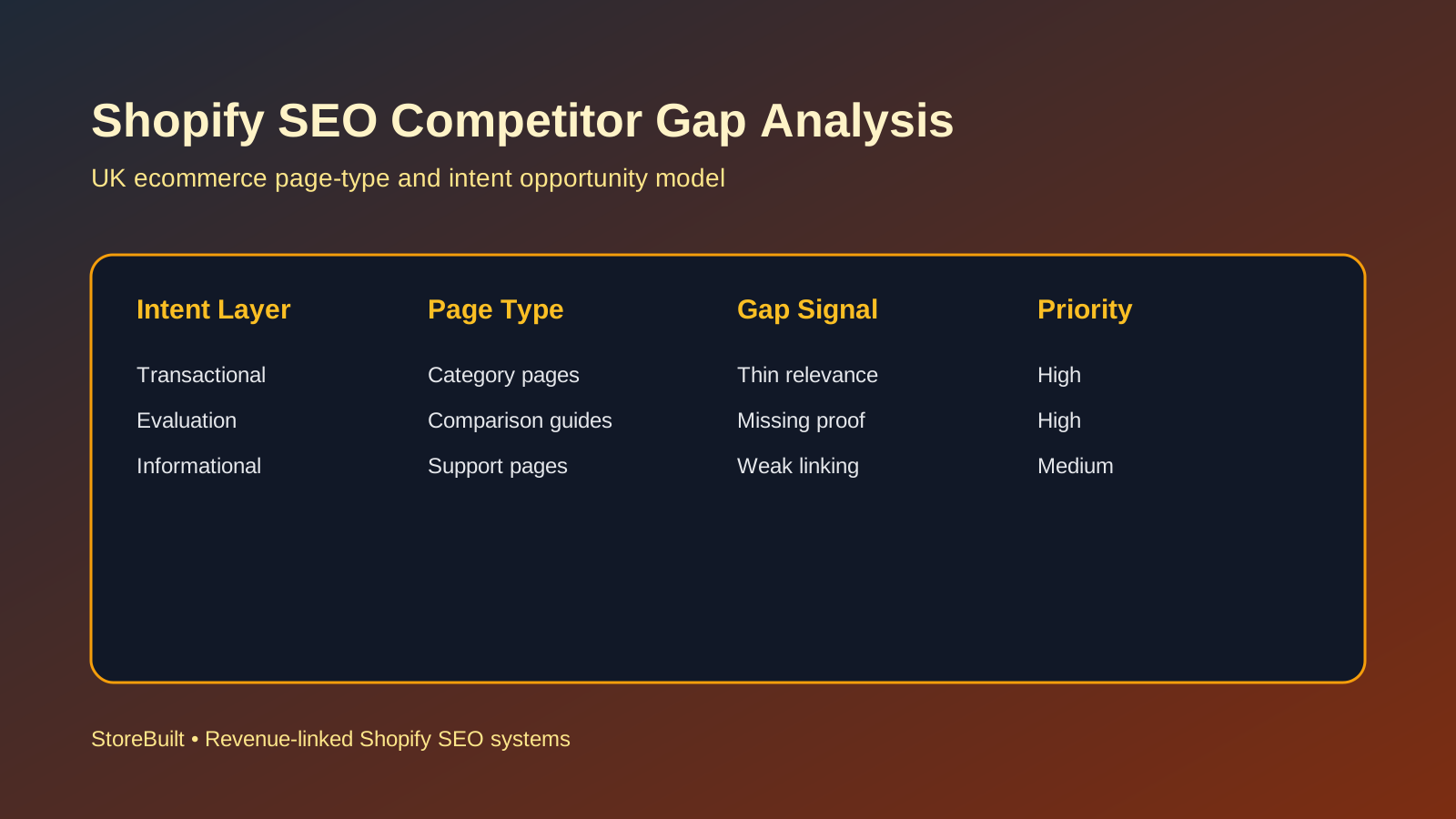
Page-type gap framework
| Page type | Intent cluster | Typical gap | Commercial impact |
|---|---|---|---|
| Category pages | Mid-to-high commercial | Weak filtering language and thin supporting copy | Lost transactional visibility |
| Comparison/buying guides | Evaluation intent | Missing “why choose” proof and internal links to categories | Weak assisted conversion |
| Policy and trust pages | Risk-reduction intent | Unclear delivery/returns/payment information | Checkout hesitation |
| Technical templates | Crawl/index intent | Canonical, facet, and pagination handling gaps | Index bloat and diluted ranking |
| Support-led SEO pages | Post-purchase + pre-purchase questions | FAQ topics disconnected from category journeys | Missed long-tail demand |
If your content team publishes articles but category pages remain structurally weak, growth usually plateaus.
UK Shopify agency content signal references
In UK agency ecosystems, competitor content often signals intent concentration:
| Public content pattern | What it usually targets | Your response strategy |
|---|---|---|
| Shopify pricing and platform comparisons | Bottom-funnel research traffic | Build stronger commercial decision pages tied to service CTAs |
| “Best agency” and selection frameworks | High-buying-intent leads | Publish differentiated qualification frameworks with execution detail |
| Broad “trends” content | Awareness-stage demand | Convert trend pages into category opportunity maps |
Charle and other UK agencies publish strong commercial-intent content regularly. Treat this as a signal to increase your precision, not to clone headings.
Implementation sequence for 12 weeks
| Weeks | Focus | Output |
|---|---|---|
| 1-2 | Intent and page-type mapping | Gap matrix by category and revenue priority |
| 3-4 | Technical crawlability and internal-link remediation | Indexation and architecture fix list |
| 5-8 | Category and comparison page redevelopment | Commercial-intent content cluster |
| 9-10 | On-page proof and UX conversion alignment | Improved trust and decision signals |
| 11-12 | Performance review and reprioritisation | Updated SEO roadmap tied to revenue categories |
For teams running Shopify SEO in competitive UK categories, this sequence prevents random publishing and keeps execution revenue-linked.
If you want this model implemented by a Shopify-specialist team, StoreBuilt can help.
StoreBuilt example
A UK brand had steady publishing output but limited growth in high-value category traffic. The root issue was not content volume. It was architecture mismatch: informational articles were ranking, while key commercial page types remained under-developed.
After a gap-analysis reset, the team rebuilt category pathways, added comparison support pages linked to revenue categories, and cleaned internal-link structures. The content programme then supported category growth instead of competing with it.
High-intent AI search implementation layer
The AI-search version of this topic is not just “write more content”. A useful answer engine result needs a page that gives a direct answer, proves the claim, and shows the next operational step inside Shopify.
| Area | StoreBuilt implementation check |
|---|---|
| Primary intent | The page should map to shopify seo and one clear buyer or operator problem, not a vague traffic topic. |
| Shopify surface | Identify whether the work belongs on a collection, product page, theme section, checkout step, app workflow, email flow, or support process. |
| Proof | Add first-hand observations, product/category examples, screenshots, policy notes, review signals, or trustworthy external sources where they make the advice safer. |
| Internal route | Link the reader to the service most likely to solve the issue: Shopify SEO and AI search readiness. |
| Measurement | Check Search Console, analytics, assisted conversions, enquiry quality, and AI-response mentions after the update rather than judging success by pageviews alone. |
For this article, the useful research inputs are: Google Search Central guidance, Shopify platform documentation, Ahrefs AI Responses/Brand Radar patterns, and StoreBuilt Shopify audit observations. StoreBuilt would prioritise technical SEO, collection architecture, Product schema, answer-first content, GEO, and Search Console monitoring before expanding into broader supporting content.
If this topic maps to a live store problem, review the related StoreBuilt service or Contact StoreBuilt with the store URL and the issue you want fixed.
Final StoreBuilt point of view
Shopify SEO competitor analysis should be a conversion-path exercise, not a vanity benchmarking exercise. In the ecommerce UK market, brands that win are the ones that map intent to page type, then execute with technical and commercial discipline.