
What we have seen in Shopify content audits is this: teams are adding AI-search language to briefs without first fixing the basics that help Google, customers, and internal teams understand the page.
AI search readiness is not a separate content style. It is the result of clear entities, useful structure, proof, internal links, and answers that match the buyer’s stage.
If your Shopify content library has grown quickly but enquiries have not followed, Contact StoreBuilt.
Table of contents
- Keyword decision and research inputs
- Why AI-search briefs need ecommerce discipline
- The StoreBuilt content brief model
- Brief table for Shopify ecommerce teams
- What UK Shopify agency content often misses
- Anonymous StoreBuilt example
- Final StoreBuilt point of view
Keyword decision and research inputs
Primary keyword: Shopify AI search content briefs
Secondary keywords:
- ecommerce UK market content strategy
- Shopify AI search readiness
- ecommerce content brief template
- Shopify SEO content framework
Search intent: informational-commercial. The reader is usually an ecommerce lead, founder, or SEO manager trying to brief content that can rank, convert, and appear in AI-assisted discovery.
Funnel stage: middle funnel.
Page type: long-form implementation guide.
Why StoreBuilt can realistically win this topic:
- We work at the point where Shopify SEO, content architecture, and commercial user journeys meet.
- Competitor agency articles often cover SEO tactics or AI search trends separately, while ecommerce teams need a usable brief.
- StoreBuilt can connect article structure to product, collection, service, and enquiry pathways.
Research inputs used on June 19, 2026:
- Current SERP and competitor-library review across UK Shopify agency articles, including Charle-style long guides with TOCs, FAQs, service CTAs, and visual explainers.
- Official Google Search Central guidance that structured data helps Google understand ecommerce content and product information.
- Shopify documentation patterns around Markets, B2B, redirects, and international content, used as a platform-specific constraint check rather than copied article material.
Why AI-search briefs need ecommerce discipline
A weak AI-search brief usually asks for the wrong output. It asks the writer to mention entities, answer questions, add schema language, and produce a long article. That can create a page that looks substantial but still fails the commercial job.
For Shopify ecommerce, the brief needs to answer five questions before drafting starts:
- Which buying or operating problem is the reader trying to solve?
- Which StoreBuilt service route should the content support?
- Which product, collection, or platform entity must the page explain clearly?
- Which existing StoreBuilt post could this overlap with?
- What should a qualified reader do next?
The fifth question matters most. Content that wins attention but gives no next step is not a growth asset. It is a publishing cost.
AI search systems also reward clarity indirectly because they need reliable, well-structured information. But the same clarity helps human buyers. A strong Shopify content brief should therefore avoid chasing AI visibility as a separate trick and instead create pages that are specific, structured, and easy to cite.
The StoreBuilt content brief model
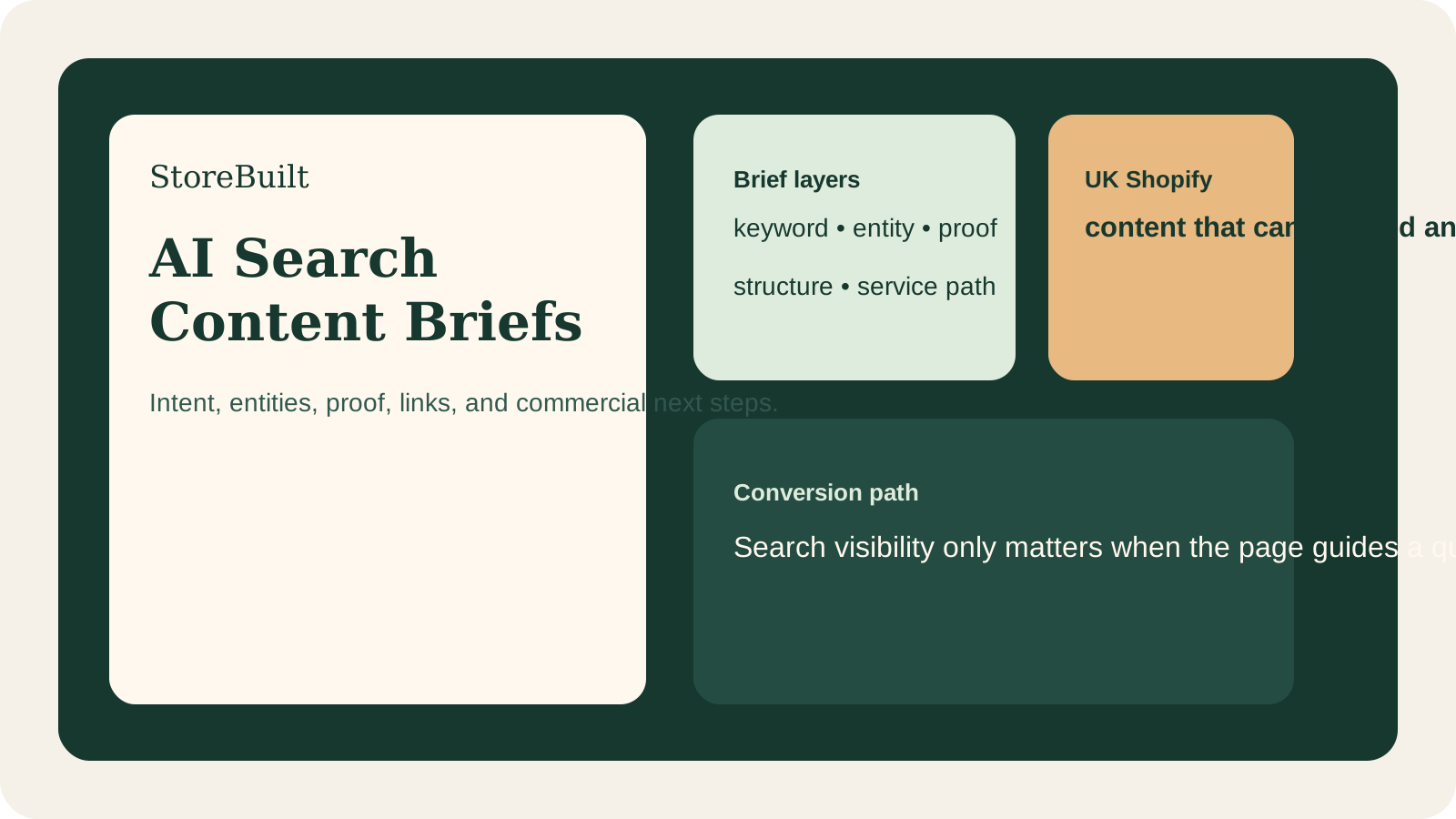
A useful brief has seven parts:
- primary keyword and secondary intent
- search stage and likely reader role
- page type decision
- entity map
- internal-link plan
- evidence and first-hand signal
- conversion path
This is different from a generic SEO outline. Generic outlines often start with headings and word count. StoreBuilt briefs start with intent and page assignment.
For example, the query “Shopify SEO agency UK” should usually support a service page or a high-intent agency evaluation guide. The query “how to add schema markup to Shopify” can support a practical technical article. The query “ecommerce UK market trends” may work as a strategic article, but only if it connects trends to decisions around SEO, CRO, retention, merchandising, or platform architecture.
If everything becomes a blog post, the site loses commercial hierarchy.
Brief table for Shopify ecommerce teams
| Brief layer | What to define | Why it matters |
|---|---|---|
| Search intent | Research, comparison, implementation, or buying | Prevents service-page cannibalisation |
| Entity coverage | Shopify feature, ecommerce problem, UK market constraint, tool, platform, product type | Helps humans and search systems understand relevance |
| Proof | Live-store observation, audit pattern, official guidance, or anonymised example | Avoids generic AI-style content |
| Internal links | Service route, related article, audit or contact path | Turns education into qualified enquiry flow |
| Differentiation | What the article says that competitor posts do not | Protects against copycat topics |
| Maintenance | Refresh trigger and owner | Keeps content useful after Shopify or Google changes |
That final row is usually ignored. AI and search guidance changes. Shopify features change. UK ecommerce behaviour changes. A brief should say when the page needs revisiting, not just when it should be published.
What UK Shopify agency content often misses
Competitor articles from agencies such as Charle, We Make Websites, and other UK Shopify specialists are useful research inputs because they show which topics buyers already expect: agency selection, Shopify Plus, SEO migration, A/B testing, customer retention, and app recommendations.
The gap is not always topic choice. It is execution specificity.
Many articles still under-cover:
- which page type should own the keyword
- how the recommendation changes by team size
- what internal link should come next
- how Shopify constraints affect implementation
- how to avoid creating several similar posts that target the same buyer
That is why StoreBuilt briefs should include a duplicate-risk check. Before publishing, compare the new article against the latest 10 to 15 posts. If the same title structure, problem, and CTA could be reused with only small word changes, the draft is not differentiated enough.
If you need a content system that supports SEO and lead generation together, review StoreBuilt Shopify SEO and AI Search Readiness.
Anonymous StoreBuilt example
One ecommerce team had a growing article library with respectable publishing volume but weak commercial movement. The content team was briefing topics around broad Shopify and ecommerce keywords, while the commercial team expected the posts to support enquiries.
The issue was not writing quality. The issue was brief quality.
We mapped the library by intent, service route, and duplicate risk. Several articles were trying to own similar ecommerce UK market themes, but few explained the actual operating decision the reader needed to make. We rebuilt the brief template so every new page had a page-type decision, internal-link plan, proof requirement, and contact route before drafting.
The immediate improvement was editorial clarity. Writers stopped producing interchangeable posts. Stakeholders could see why each article existed. The site gained a cleaner path from education into service discovery.
High-intent AI search implementation layer
The AI-search version of this topic is not just “write more content”. A useful answer engine result needs a page that gives a direct answer, proves the claim, and shows the next operational step inside Shopify.
| Area | StoreBuilt implementation check |
|---|---|
| Primary intent | The page should map to ai search and one clear buyer or operator problem, not a vague traffic topic. |
| Shopify surface | Identify whether the work belongs on a collection, product page, theme section, checkout step, app workflow, email flow, or support process. |
| Proof | Add first-hand observations, product/category examples, screenshots, policy notes, review signals, or trustworthy external sources where they make the advice safer. |
| Internal route | Link the reader to the service most likely to solve the issue: Shopify SEO and AI search readiness. |
| Measurement | Check Search Console, analytics, assisted conversions, enquiry quality, and AI-response mentions after the update rather than judging success by pageviews alone. |
For this article, the useful research inputs are: Google Search Central guidance, Shopify platform documentation, Ahrefs AI Responses/Brand Radar patterns, and StoreBuilt Shopify audit observations. StoreBuilt would prioritise technical SEO, collection architecture, Product schema, answer-first content, GEO, and Search Console monitoring before expanding into broader supporting content.
If this topic maps to a live store problem, review the related StoreBuilt service or Contact StoreBuilt with the store URL and the issue you want fixed.
Final StoreBuilt point of view
AI search content for Shopify should not become another layer of vague optimisation. The strongest briefs still start with the real ecommerce problem, the right page type, the proof needed to make the advice credible, and the next action a buyer should take.
For UK Shopify teams, the goal is not to sound AI-ready. The goal is to build a content system that search engines can understand, customers can trust, and commercial teams can actually use.