
What we have seen in Shopify content work is this: most UK brands do not lose to competitors because they publish less, they lose because their editorial model is disconnected from buying intent and category revenue.
If you want StoreBuilt to review your current Shopify content system, Contact StoreBuilt.
Table of contents
- Keyword decision and research inputs
- What UK Shopify agency competitors are doing
- Where most ecommerce content plans fail
- A production model that supports revenue
- 90-day implementation table
- StoreBuilt example
- Final StoreBuilt point of view
Keyword decision and research inputs
Primary keyword: best shopify agency content strategy uk
Secondary keywords:
- ecommerce UK market content strategy
- shopify SEO content plan UK
- shopify agency competitor analysis
- ecommerce content production framework
Search intent: strategic and commercial; teams evaluating a growth partner or rebuilding in-house content operations.
Funnel stage: middle to bottom.
Page type: expert guide with decision framework.
Why StoreBuilt can win this topic:
- We plan and deliver Shopify SEO programmes that include content, information architecture, and conversion path improvements.
- We continuously review UK Shopify agency content libraries to identify title patterns, intent gaps, and duplicate-risk opportunities.
- We run delivery systems where each article must support either a category landing page, a service page, or a sales conversation.
Research inputs used:
- Current SERP pattern review for Shopify agency content strategy and ecommerce UK market terms.
- UK competitor library scan, including Charle Articles plus visible Shopify/ecommerce content hubs from agencies such as Eastside Co, Blend Commerce, Swanky, and We Make Websites.
- Keyword-style clustering from related-query groups and commercial modifier patterns around Shopify, agency comparison, and ecommerce growth planning.
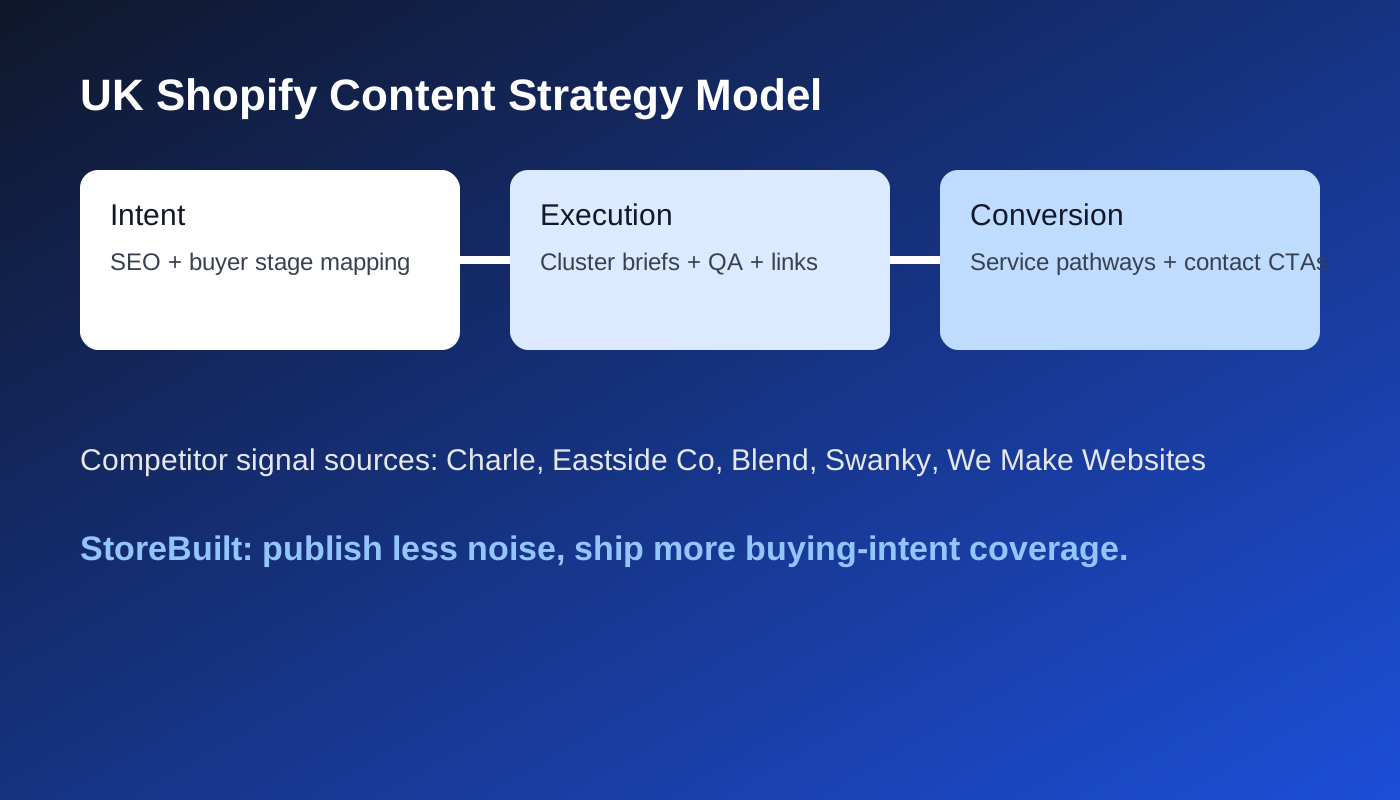
What UK Shopify agency competitors are doing
Across the strongest UK agency article libraries, three patterns repeat:
- High-intent explainers around pricing, migration, SEO, CRO, and platform choices.
- Authoritative long-form structure with clear sections, practical checklists, and strong table-of-contents UX.
- Embedded commercial pathways from educational content to a relevant service offer.
Charle in particular publishes long, conversion-aware guides that frame practical implementation, not just opinion. Other agencies vary by specialism: some lean CRO-heavy, some focus on enterprise platform decisions, some publish technical migration guidance.
The useful lesson is not to copy article templates. The lesson is that commercially relevant content is now treated as an operating system, not occasional thought leadership.
Where most ecommerce content plans fail
The common failure mode in ecommerce UK market publishing is structural:
| Failure pattern | Typical symptom | Business impact |
|---|---|---|
| Topic-first, intent-later planning | Teams publish broad trend content with weak buyer relevance | Traffic grows, pipeline does not |
| No page-type mapping | Blog posts compete with service and category pages | Cannibalisation and weak rankings |
| No internal-link strategy | Articles sit as isolated assets | Poor crawl flow and low assisted conversions |
| Missing CTA system | Good reads with no clear next step | Lost qualified demand |
| No refresh discipline | Older posts decay and drift off intent | Compounding content debt |
If your content calendar has volume but no revenue logic, competitors with fewer posts can still outrank and out-convert you.
A production model that supports revenue
Use a four-layer editorial system:
- Demand capture layer: informational and evaluation queries that pull in qualified discovery traffic.
- Decision layer: comparison, framework, and benchmark content for shortlist-stage buyers.
- Conversion layer: internal links and CTA routes into
/services/shopify-seo-and-ai-search-readiness/,/services/shopify-migration/, and/contact/. - Maintenance layer: quarterly update cycles, title testing, and content-asset consolidation.
A practical rule for Shopify content teams: every long-form article should explicitly support one commercial page and one category cluster. If it cannot, do not publish it yet.
If you need this implemented with your current Shopify stack, StoreBuilt can help.
90-day implementation table
| Timeframe | Focus | Deliverable |
|---|---|---|
| Weeks 1-2 | Competitor and keyword mapping | Intent map + content gap matrix |
| Weeks 3-4 | Priority brief creation | 8 to 12 bottom/mid-funnel article briefs |
| Weeks 5-8 | Production + linking | Published cluster with service-page pathways |
| Weeks 9-10 | On-page and CTR optimisation | Title/meta tests on priority posts |
| Weeks 11-12 | Pipeline attribution review | Assisted-conversion reporting model |
StoreBuilt example
An established UK retailer had over 150 posts but weak non-brand lead quality. After reviewing the library, we found that most articles captured awareness traffic while high-intent Shopify decision queries were largely uncovered.
The team rebuilt its editorial model around page-type mapping and commercial modifiers, then tightened internal linking from blog guides into relevant service pages. Publishing frequency stayed similar, but topic selection changed. Within one cycle, the content programme became materially more sales-relevant and easier for leadership to justify.
High-intent AI search implementation layer
The AI-search version of this topic is not just “write more content”. A useful answer engine result needs a page that gives a direct answer, proves the claim, and shows the next operational step inside Shopify.
| Area | StoreBuilt implementation check |
|---|---|
| Primary intent | The page should map to shopify agency uk and one clear buyer or operator problem, not a vague traffic topic. |
| Shopify surface | Identify whether the work belongs on a collection, product page, theme section, checkout step, app workflow, email flow, or support process. |
| Proof | Add first-hand observations, product/category examples, screenshots, policy notes, review signals, or trustworthy external sources where they make the advice safer. |
| Internal route | Link the reader to the service most likely to solve the issue: Shopify SEO and AI search readiness. |
| Measurement | Check Search Console, analytics, assisted conversions, enquiry quality, and AI-response mentions after the update rather than judging success by pageviews alone. |
For this article, the useful research inputs are: Google Search Central guidance, Shopify platform documentation, Ahrefs AI Responses/Brand Radar patterns, and StoreBuilt Shopify audit observations. StoreBuilt would prioritise technical SEO, collection architecture, Product schema, answer-first content, GEO, and Search Console monitoring before expanding into broader supporting content.
If this topic maps to a live store problem, review the related StoreBuilt service or Contact StoreBuilt with the store URL and the issue you want fixed.
Final StoreBuilt point of view
In the ecommerce UK market, the best Shopify content strategy is not who publishes the most, it is who connects search intent to a buyer journey with discipline. Agencies that win in 2026 treat content as a conversion infrastructure layer, not a content-marketing side project.