
What we have seen in search results is this: format mismatch is a hidden reason Shopify content underperforms, even when topics and keywords look correct on paper.
If your current articles are not aligning with what UK SERPs reward, Contact StoreBuilt.
Table of contents
- Keyword decision and research inputs
- How UK Shopify competitor formats are evolving
- Format mismatch patterns that hurt rankings
- SERP format benchmark table
- Implementation checklist table
- StoreBuilt example
- Final StoreBuilt point of view
Keyword decision and research inputs
Primary keyword: shopify agency uk ecommerce content format
Secondary keywords:
- ecommerce UK market serp content benchmark
- shopify seo article structure
- uk shopify competitor content format
- intent matched ecommerce guides
Search intent: evaluative; teams want to understand what structure to use for better rankings and engagement.
Funnel stage: middle.
Page type: benchmark and implementation guide.
Why StoreBuilt can win this topic:
- We test article structure choices against live Shopify category and service-content performance.
- We benchmark UK agency format patterns before launching new content clusters.
- We pair format decisions with conversion UX, not only SEO metrics.
Research inputs used:
- SERP pattern checks for Shopify and ecommerce UK market strategic terms.
- Competitor format review from UK agency article libraries including Charle-style long-form templates.
- Internal StoreBuilt content-performance observations by format and CTA placement.
How UK Shopify competitor formats are evolving
The visible shift in stronger UK agency content is toward practical formats that reduce ambiguity:
- Framework guides with defined process steps.
- Cost and decision explainers with scenario tables.
- Operational playbooks with timelines and role ownership.
Generic listicles still appear, but they are less likely to dominate decision-stage SERPs unless backed by deep, implementation-level detail.
This is one reason Charle-like content patterns are effective: they are often direct, practical, and commercially contextualised.
Format mismatch patterns that hurt rankings
| Mismatch | Example | Likely impact |
|---|---|---|
| Listicle for a decision query | ”10 tips” for a pricing decision term | Lower relevance signals |
| Thin explainer for high-stakes topic | 600-word migration guide | Reduced trust and dwell quality |
| No scannable structure | Long blocks without tables/TOC | Poor usability and retention |
| No conversion path | Strong information, weak next step | Low lead capture from qualified traffic |
Most fixes are structural, not purely copy edits.
SERP format benchmark table
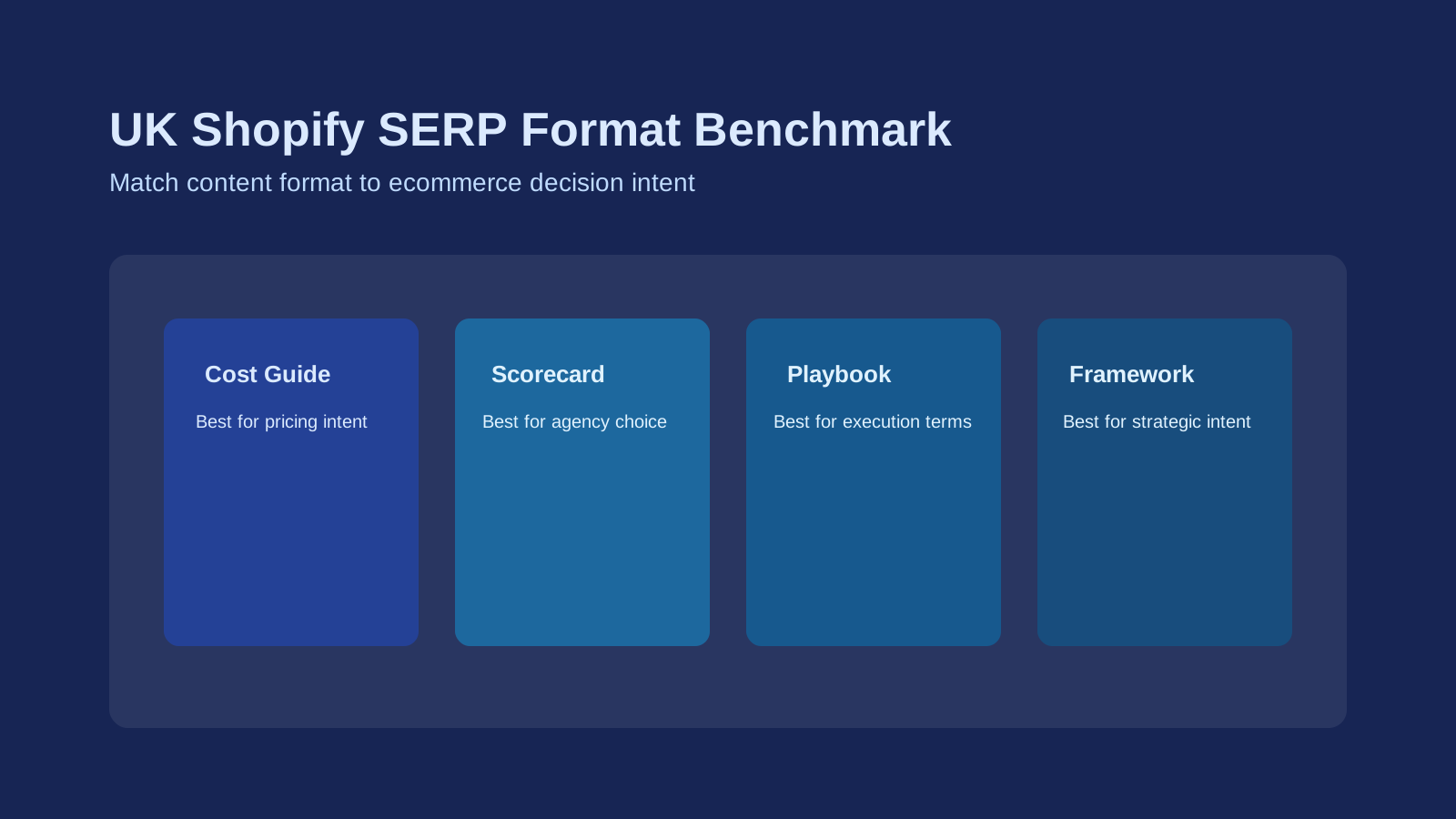
| Query intent type | Format most often rewarded | Recommended Shopify execution |
|---|---|---|
| Cost and budgeting | Cost breakdown with scenario table | Include assumptions and constraints |
| Agency selection | Comparison/scorecard guide | Add evaluation criteria and trade-offs |
| Technical implementation | Playbook or runbook | Use staged timeline and ownership |
| Strategic planning | Framework article | Include decision model and prioritisation |
One practical rule: choose format first, then write the article. Not the other way around.
If you need support redesigning your highest-value Shopify content formats, StoreBuilt can help.
Implementation checklist table
| Step | Action | Outcome |
|---|---|---|
| 1 | Map query intent by cluster | Clear page-type selection |
| 2 | Benchmark top-format competitors | Reduced guesswork |
| 3 | Build reusable templates | Faster production consistency |
| 4 | Add internal links and CTA hierarchy | Stronger commercial progression |
| 5 | Review engagement + lead quality | Format refinement by evidence |
This workflow is simple enough for small teams and robust enough for larger Shopify operations.
Quick SERP-format sanity check before publishing
Before publishing any new article, run a short preflight check:
- Compare the top five results and classify their dominant format.
- Confirm your heading structure answers the same decision in a clearer way.
- Validate that tables, examples, and CTA placements support the expected reader action.
This check takes minutes but prevents weeks of underperformance from format mismatch.
StoreBuilt example
A UK brand had solid keyword targets but weak results on strategic terms. Our audit found repeated format mismatches: decision-stage keywords were mostly assigned to generic list posts.
After restructuring those pages into framework and playbook formats with better tables, TOCs, and contextual CTAs, ranking stability and lead relevance improved. The topic targets stayed mostly the same; the format changed.
That is the important lesson for 2026 planning.
High-intent AI search implementation layer
The AI-search version of this topic is not just “write more content”. A useful answer engine result needs a page that gives a direct answer, proves the claim, and shows the next operational step inside Shopify.
| Area | StoreBuilt implementation check |
|---|---|
| Primary intent | The page should map to shopify agency uk and one clear buyer or operator problem, not a vague traffic topic. |
| Shopify surface | Identify whether the work belongs on a collection, product page, theme section, checkout step, app workflow, email flow, or support process. |
| Proof | Add first-hand observations, product/category examples, screenshots, policy notes, review signals, or trustworthy external sources where they make the advice safer. |
| Internal route | Link the reader to the service most likely to solve the issue: Shopify SEO and AI search readiness. |
| Measurement | Check Search Console, analytics, assisted conversions, enquiry quality, and AI-response mentions after the update rather than judging success by pageviews alone. |
For this article, the useful research inputs are: Google Search Central guidance, Shopify platform documentation, Ahrefs AI Responses/Brand Radar patterns, and StoreBuilt Shopify audit observations. StoreBuilt would prioritise technical SEO, collection architecture, Product schema, answer-first content, GEO, and Search Console monitoring before expanding into broader supporting content.
If this topic maps to a live store problem, review the related StoreBuilt service or Contact StoreBuilt with the store URL and the issue you want fixed.
Final StoreBuilt point of view
In the ecommerce UK market, winning Shopify content is often a format decision before it is a writing decision. If structure does not match intent, even strong copy can underperform. Teams that benchmark SERP formats rigorously will publish fewer weak pages and more commercially useful assets.