
What we have seen in many Shopify programmes is this: content performance problems often start before writing begins, because briefs are vague, non-commercial, or disconnected from SERP intent.
If you want us to audit your current article brief process, Contact StoreBuilt.
Table of contents
- Keyword decision and research inputs
- Why briefs fail even with good writers
- The StoreBuilt brief scorecard
- Brief QA table for ecommerce UK market teams
- Execution workflow table
- StoreBuilt example
- Final StoreBuilt point of view
Keyword decision and research inputs
Primary keyword: shopify agency uk content brief template
Secondary keywords:
- ecommerce UK market content brief
- shopify seo content planning framework
- agency content QA checklist
- commercial intent article brief
Search intent: practical and commercial; teams want a repeatable way to brief content that can rank and convert.
Funnel stage: middle.
Page type: implementation guide with checklist.
Why StoreBuilt can win this topic:
- We run brief QA as a standard gate before article production.
- We align briefs to service pages and cluster-level strategy, not isolated keywords.
- We validate brief quality using live ecommerce delivery constraints.
Research inputs used:
- SERP review on Shopify content briefing and SEO planning terms.
- Competitor content structure checks across UK Shopify agency blogs, including Charle and peers.
- StoreBuilt duplicate-risk checks against existing internal post inventory.
Why briefs fail even with good writers
The most common brief weaknesses are predictable:
- Keyword-only briefs with no intent context.
- Unclear page role in the funnel.
- No competitor differentiation notes.
- No required internal links or CTA path.
- No definition of what first-hand insight should be included.
When these fields are missing, writers produce content that reads fine but does not move business outcomes. Editing then becomes expensive because strategic clarity is being added too late.
The StoreBuilt brief scorecard
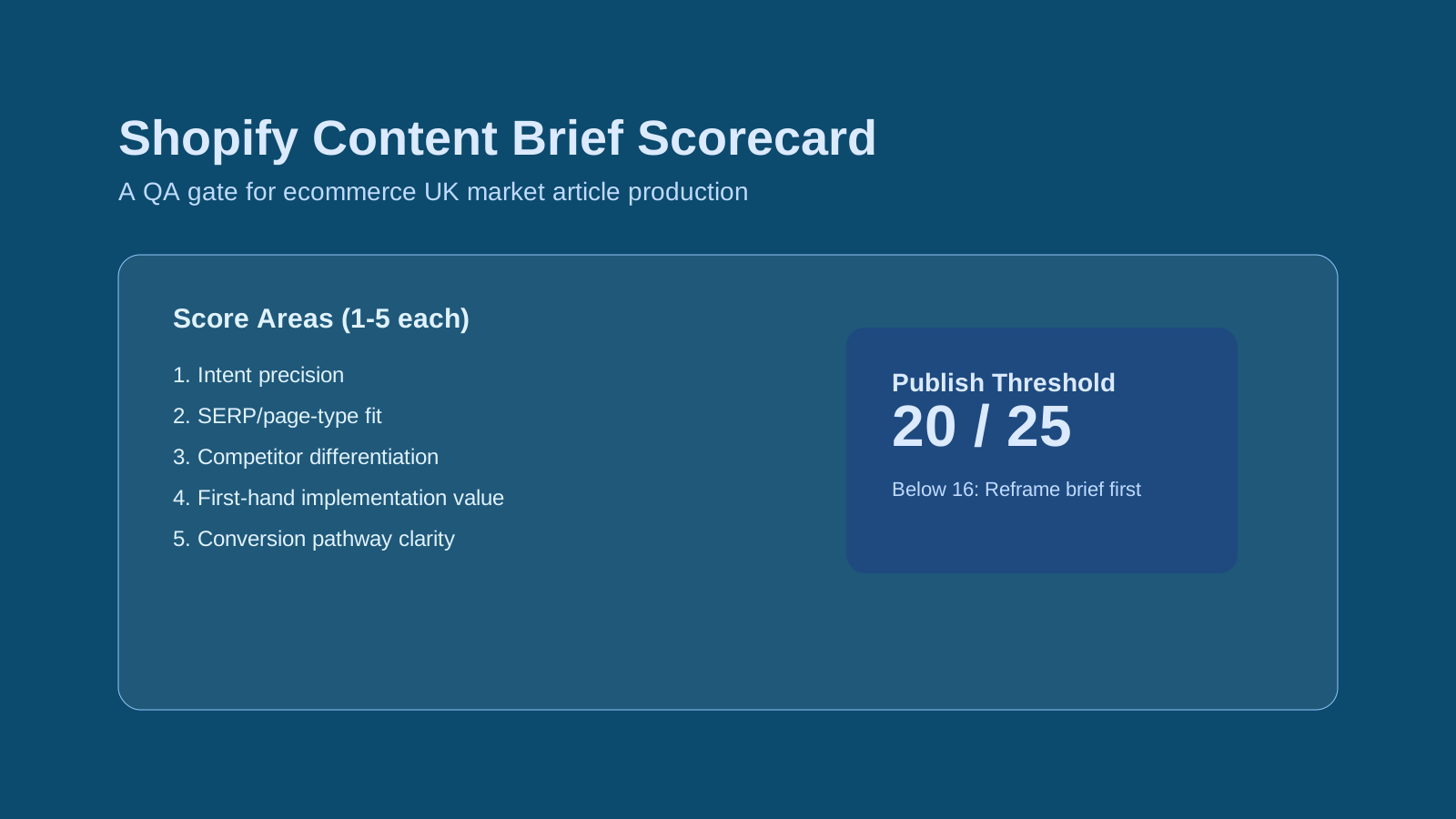
Before green-lighting a brief, score each criterion from 1 to 5:
- Intent precision: does the brief clearly define what the reader needs to decide?
- Page-type fit: should this be a blog guide, service page, or comparison page?
- Differentiation: what angle is under-served by competitors?
- Evidence quality: what real observations can we include credibly?
- Conversion path: where should qualified readers go next?
Target: minimum 20/25 before drafting.
A score under 16 usually indicates the topic should be reframed, merged, or deprioritised.
Brief QA table for ecommerce UK market teams
| Section | Required field | Why it matters |
|---|---|---|
| Keyword block | Primary + secondary terms with intent | Prevents generic keyword stuffing |
| Audience block | Buyer profile and role | Improves relevance and examples |
| Competitor block | 3 to 5 pattern notes | Forces strategic differentiation |
| Outline block | Mandatory headings and TOC | Preserves structure and scannability |
| Conversion block | Internal links + CTA placement | Connects traffic to pipeline |
| Evidence block | First-hand implementation signals | Increases trust and originality |
If your briefs do not include these sections, article quality will depend too much on individual writer judgment.
If you need a full brief template adapted to your Shopify category, StoreBuilt can help.
Execution workflow table
| Stage | Owner | Output |
|---|---|---|
| Research | SEO lead | Intent map + competitor notes |
| Brief drafting | Content strategist | Structured brief with scorecard |
| QA gate | SEO + commercial reviewer | Approved brief score + revisions |
| Production | Writer + editor | Long-form article draft |
| Publish readiness | SEO + CRO reviewer | Final links, metadata, CTA checks |
This workflow keeps strategy decisions early and editing costs lower.
Common briefing mistakes to remove this quarter
Three recurring issues still appear in otherwise strong ecommerce teams:
- Briefs that describe the topic but do not define the reader’s decision at the end of the article.
- Competitor references that list URLs but do not extract clear structural lessons.
- CTA instructions that are added at publishing time instead of being designed into the outline.
The fix is operational: add mandatory fields and fail briefs that leave them blank. Strong briefing is not an editorial preference; it is quality control for commercial SEO.
StoreBuilt example
One UK merchant had a content team shipping consistently but with uneven outcomes. Some posts ranked; few generated meaningful sales conversations.
We introduced a brief scorecard and a mandatory conversion block for each article. Within a quarter, production became slower at first but far more predictable. The business gained better lead quality and fewer rewrites because every piece had clearer strategic intent before writing started.
The biggest improvement came from brief discipline, not bigger budgets.
High-intent AI search implementation layer
The AI-search version of this topic is not just “write more content”. A useful answer engine result needs a page that gives a direct answer, proves the claim, and shows the next operational step inside Shopify.
| Area | StoreBuilt implementation check |
|---|---|
| Primary intent | The page should map to shopify agency uk and one clear buyer or operator problem, not a vague traffic topic. |
| Shopify surface | Identify whether the work belongs on a collection, product page, theme section, checkout step, app workflow, email flow, or support process. |
| Proof | Add first-hand observations, product/category examples, screenshots, policy notes, review signals, or trustworthy external sources where they make the advice safer. |
| Internal route | Link the reader to the service most likely to solve the issue: Shopify SEO and AI search readiness. |
| Measurement | Check Search Console, analytics, assisted conversions, enquiry quality, and AI-response mentions after the update rather than judging success by pageviews alone. |
For this article, the useful research inputs are: Google Search Central guidance, Shopify platform documentation, Ahrefs AI Responses/Brand Radar patterns, and StoreBuilt Shopify audit observations. StoreBuilt would prioritise technical SEO, collection architecture, Product schema, answer-first content, GEO, and Search Console monitoring before expanding into broader supporting content.
If this topic maps to a live store problem, review the related StoreBuilt service or Contact StoreBuilt with the store URL and the issue you want fixed.
Final StoreBuilt point of view
In Shopify content programmes, briefing quality is a competitive advantage. In the ecommerce UK market, the teams that win are rarely the teams with the most writers. They are the teams with the clearest strategic briefs and the strictest QA gates.