
What we have seen in live Shopify SEO work is this: UK ecommerce teams usually do not have a traffic problem first, they have a keyword-positioning problem where high-intent searches are either missing or handled with weak page types.
If you want us to map your current content gaps against your Shopify competitors, Contact StoreBuilt.
Table of contents
- Keyword decision and research inputs
- What competitor libraries in the UK are signalling
- The 5 keyword-gap zones most brands miss
- Gap-to-content model for Shopify teams
- 90-day keyword execution table
- StoreBuilt example
- Final StoreBuilt point of view
Keyword decision and research inputs
Primary keyword: shopify agency uk competitor keyword gap
Secondary keywords:
- ecommerce UK market keyword gap analysis
- shopify seo competitor content map
- uk shopify agency content strategy
- ecommerce content clusters for conversion
Search intent: strategic and commercial; ecommerce leads deciding what content to publish next and where to invest agency support.
Funnel stage: middle to bottom.
Page type: long-form benchmark guide with practical prioritisation.
Why StoreBuilt can win this topic:
- We audit UK Shopify content libraries continuously while building delivery plans for active merchants.
- We track where informational coverage exists but commercial coverage is still thin.
- We link keyword strategy to conversion pathways, not only rankings.
Research inputs used:
- Current SERP pattern review for competitor gap terms around Shopify agency UK and ecommerce UK market planning.
- UK competitor article hub review, including Charle’s article model and visible content from Eastside Co, Swanky, Blend Commerce, and We Make Websites.
- Commercial modifier clustering using patterns around cost, migration, agency choice, support, and platform decision terms.
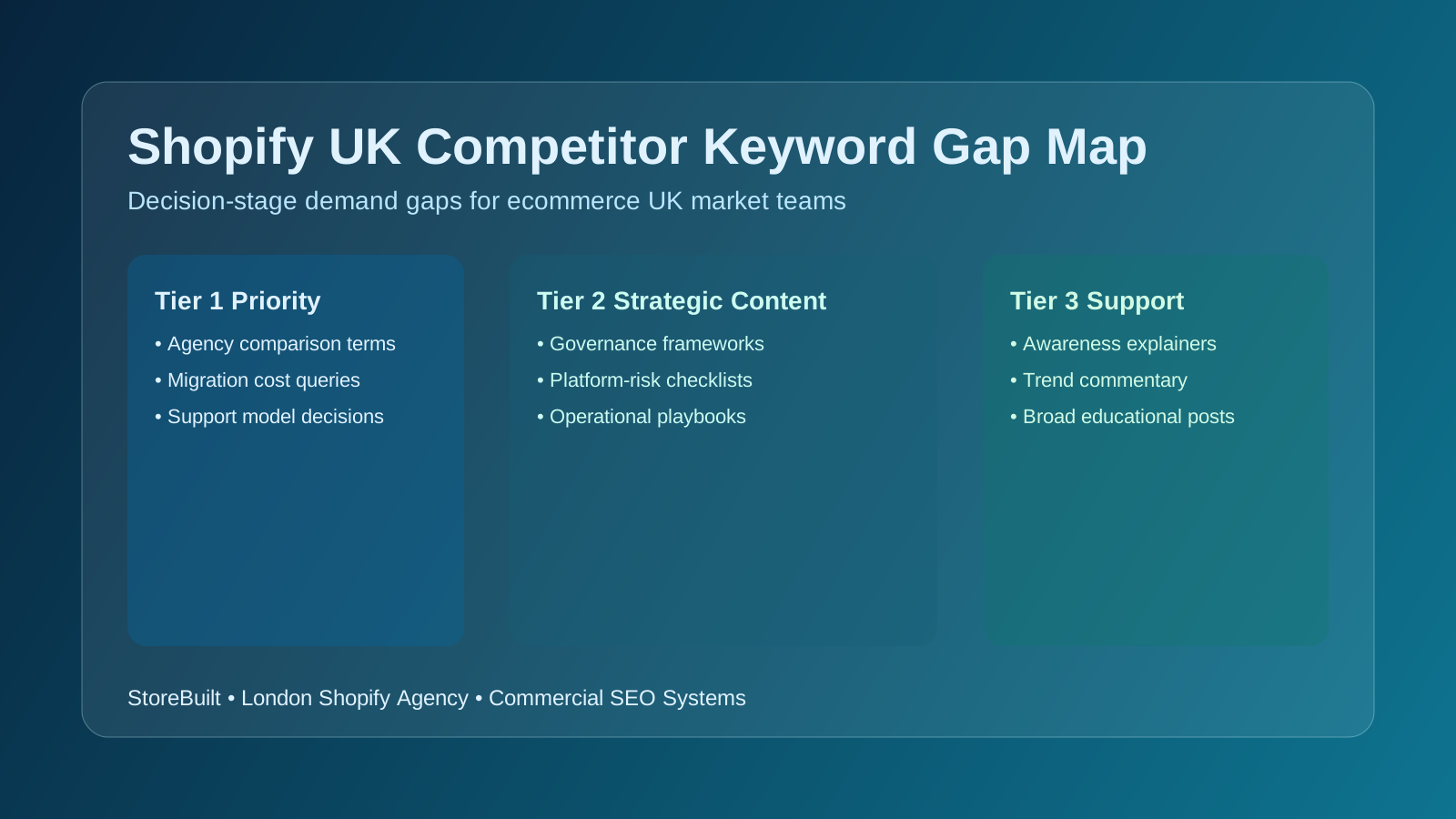
What competitor libraries in the UK are signalling
Across leading UK Shopify agencies, the most consistent signal is not just volume. It is precision around high-intent terms that buyers use when budget conversations are already active.
Charle-style content patterns often include practical cost, partner-selection, and implementation guides written in plain commercial language. Other agencies vary by positioning, but the stronger libraries tend to repeat three traits:
- They publish pages that match decision-stage queries, not just educational awareness terms.
- They structure long guides with clear headings, TOCs, and practical implementation detail.
- They use content as a route into service conversations instead of treating blog posts as isolated assets.
For StoreBuilt, the key takeaway is simple: competitor content should be treated as intent evidence. It should not be copied, but it should sharpen your topic prioritisation.
The 5 keyword-gap zones most brands miss
| Gap zone | Typical missing query pattern | Why it matters |
|---|---|---|
| Commercial comparisons | ”shopify agency uk vs in-house” | Captures shortlist-stage buyers |
| Cost clarity | ”shopify migration cost uk” | Reduces buying friction early |
| Execution frameworks | ”shopify seo roadmap uk” | Positions operational authority |
| Risk and governance | ”ecommerce platform risk checklist uk” | Attracts leadership stakeholders |
| Post-launch optimisation | ”shopify conversion optimisation plan” | Supports retainers and recurring demand |
Most content calendars over-index on trend explainers and under-invest in these decision-heavy query families. That creates a visible revenue gap even when sessions look healthy.
Gap-to-content model for Shopify teams
Use a three-layer build system:
- Capture layer: publish high-fit educational pages that answer pre-decision problems.
- Decision layer: create comparison, cost, and framework pages that support vendor shortlisting.
- Conversion layer: route readers into
/services/shopify-seo-and-ai-search-readiness/,/services/shopify-migration/, and/contact/with context-specific CTA placement.
Every new article should pass a commercial-fit test:
- Does the topic map to an active budget conversation?
- Is the page type aligned with SERP intent?
- Can we link this article to a service page without forcing it?
If the answer is no on all three, the topic is probably not priority content for this quarter.
If you want this framework implemented in your existing Shopify stack, StoreBuilt can help.
90-day keyword execution table
| Window | Focus | Output |
|---|---|---|
| Weeks 1-2 | Competitor and SERP mapping | UK keyword gap matrix by intent and funnel stage |
| Weeks 3-4 | Prioritisation workshop | 12-topic commercial content backlog |
| Weeks 5-8 | Production sprint | Decision-focused Shopify content cluster |
| Weeks 9-10 | Internal-link and CTA pass | Updated conversion pathways across top articles |
| Weeks 11-12 | Performance review | Query movement + assisted lead analysis |
StoreBuilt example
A UK merchant in a crowded category had a large content library but very few leads from non-brand organic traffic. The content mostly targeted broad educational terms.
We mapped their library against competitor decision-stage coverage and found multiple gaps in cost, migration, and execution-framework topics. After publishing a focused cluster and strengthening internal links to service pages, lead quality improved because readers arriving from search were closer to action.
No dramatic increase in publishing frequency was needed. The shift came from intent quality, clearer page types, and better conversion pathways.
High-intent AI search implementation layer
The AI-search version of this topic is not just “write more content”. A useful answer engine result needs a page that gives a direct answer, proves the claim, and shows the next operational step inside Shopify.
| Area | StoreBuilt implementation check |
|---|---|
| Primary intent | The page should map to shopify agency uk and one clear buyer or operator problem, not a vague traffic topic. |
| Shopify surface | Identify whether the work belongs on a collection, product page, theme section, checkout step, app workflow, email flow, or support process. |
| Proof | Add first-hand observations, product/category examples, screenshots, policy notes, review signals, or trustworthy external sources where they make the advice safer. |
| Internal route | Link the reader to the service most likely to solve the issue: Shopify SEO and AI search readiness. |
| Measurement | Check Search Console, analytics, assisted conversions, enquiry quality, and AI-response mentions after the update rather than judging success by pageviews alone. |
For this article, the useful research inputs are: Google Search Central guidance, Shopify platform documentation, Ahrefs AI Responses/Brand Radar patterns, and StoreBuilt Shopify audit observations. StoreBuilt would prioritise technical SEO, collection architecture, Product schema, answer-first content, GEO, and Search Console monitoring before expanding into broader supporting content.
If this topic maps to a live store problem, review the related StoreBuilt service or Contact StoreBuilt with the store URL and the issue you want fixed.
Final StoreBuilt point of view
In the ecommerce UK market, the keyword gap that matters is not where competitors rank higher on vanity terms. It is where they own decision-stage language and you do not. Shopify brands that win in 2026 will treat competitor content analysis as a commercial planning tool, then publish with discipline around buyer intent.