
What we have seen repeatedly is this: ecommerce teams publish a lot of Shopify content, but too many articles are interchangeable, so rankings stall and conversion impact stays low.
If you need a practical editorial system that avoids duplicate-topic drift, Contact StoreBuilt.
Table of contents
- Keyword decision and research inputs
- Why generic Shopify content fails in the UK market
- The content angle engine model
- Angle quality scorecard table
- 90-day publishing operating table
- StoreBuilt example
- Final StoreBuilt point of view
Keyword decision and research inputs
Primary keyword: ecommerce uk market shopify content strategy
Secondary keywords:
- shopify content angle framework
- ecommerce UK market seo planning
- shopify agency content process
- commercial intent content clusters
Search intent: strategic; ecommerce managers and founders looking for a method to produce higher-quality, conversion-relevant content.
Funnel stage: middle.
Page type: framework guide.
Why StoreBuilt can win this topic:
- We build Shopify content workflows where every article is scored before writing.
- We compare UK competitor publishing patterns to identify overused topic templates.
- We optimise both ranking potential and lead progression pathways.
Research inputs used:
- SERP review for content strategy and Shopify SEO workflow terms in UK contexts.
- Competitor article pattern scan across Charle and peer UK Shopify agency content hubs.
- Internal content-library overlap checks against current StoreBuilt blog inventory.
Why generic Shopify content fails in the UK market
The UK ecommerce search landscape is crowded with competent baseline content. Generic explainers no longer create enough strategic distance.
The recurring failure patterns are:
- Topic duplication: multiple posts target almost the same query intent.
- Weak differentiation: titles sound similar to competitor templates with only minor wording changes.
- Low commercial progression: articles answer questions but do not guide readers toward the next decision.
In short, teams ship content volume but not content advantage.
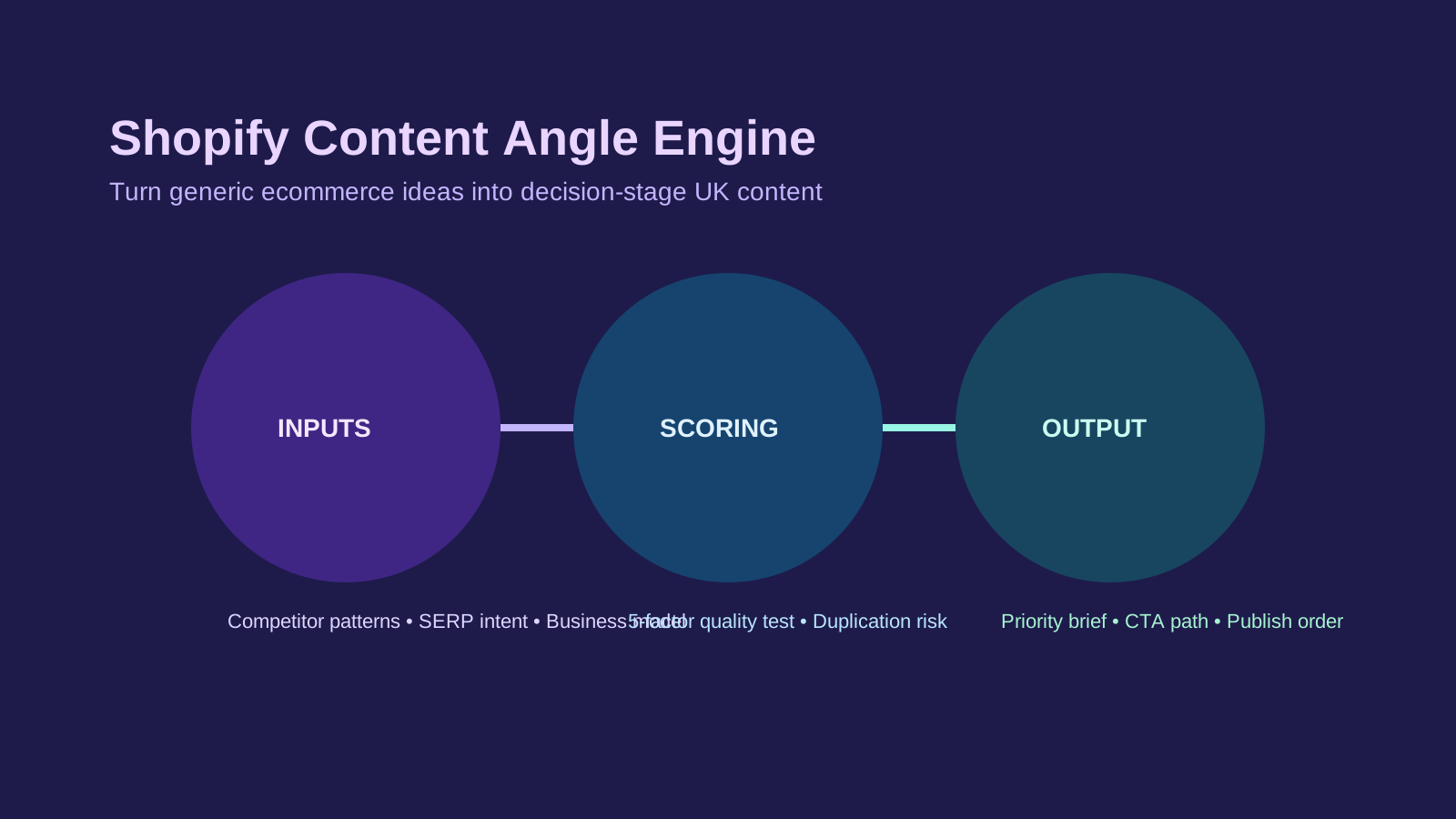
The content angle engine model
StoreBuilt uses five angle lenses before approving a topic brief:
- Business model lens: does the angle match DTC, wholesale, hybrid, or subscription realities?
- Decision severity lens: does it solve a costly or urgent problem?
- Stakeholder lens: is it useful for founders, ecommerce leads, or operations owners?
- Implementation lens: can the article include practical actions instead of generic advice?
- Conversion lens: can the page naturally route to a relevant service path?
If a topic cannot pass at least four of five lenses, it is usually not worth publishing this quarter.
To avoid duplication, we also enforce one deliberate variation per article batch:
- Different funnel stage, or
- Different problem severity, or
- Different business model context.
This keeps the blog feed strategically diverse while staying centred on Shopify and ecommerce UK market priorities.
Angle quality scorecard table
| Score factor | Question | Pass threshold |
|---|---|---|
| Intent precision | Is the primary keyword commercially clear? | Yes, explicit buyer relevance |
| SERP fit | Does page type match top-ranking formats? | Yes, no major mismatch |
| Competitor gap | Is there a visible weak point in current coverage? | Yes, at least one clear gap |
| First-hand value | Can we include observed implementation insights? | Yes, concrete operational detail |
| Conversion route | Is there a natural CTA and internal link path? | Yes, contextual and useful |
A practical rule: if score is below 4/5, rewrite the angle before briefing writers.
If you want us to operationalise this scorecard across your current backlog, StoreBuilt can help.
90-day publishing operating table
| Window | Focus | Deliverable |
|---|---|---|
| Month 1 | Topic reclassification | Existing library mapped by intent and overlap risk |
| Month 2 | Angle-led production | 8 to 10 differentiated articles with clear funnel roles |
| Month 3 | Optimisation | CTA, internal links, and title refinements by page performance |
This cadence is intentionally simple. Most teams fail from complexity, not lack of tactical ideas.
StoreBuilt example
A fast-growing UK brand had good writers and consistent output, but organic-assisted leads remained flat. We reviewed their article map and found that most posts used similar top-funnel angles with little decision-stage depth.
The team shifted to an angle-engine process and reduced article count slightly while increasing strategic quality. Within one planning cycle, non-brand content started driving better enquiry intent because each post had a clearer role in the buyer journey.
The outcome came from sharper angle selection, not from publishing more often.
High-intent AI search implementation layer
The AI-search version of this topic is not just “write more content”. A useful answer engine result needs a page that gives a direct answer, proves the claim, and shows the next operational step inside Shopify.
| Area | StoreBuilt implementation check |
|---|---|
| Primary intent | The page should map to content strategy and one clear buyer or operator problem, not a vague traffic topic. |
| Shopify surface | Identify whether the work belongs on a collection, product page, theme section, checkout step, app workflow, email flow, or support process. |
| Proof | Add first-hand observations, product/category examples, screenshots, policy notes, review signals, or trustworthy external sources where they make the advice safer. |
| Internal route | Link the reader to the service most likely to solve the issue: Shopify SEO and AI search readiness. |
| Measurement | Check Search Console, analytics, assisted conversions, enquiry quality, and AI-response mentions after the update rather than judging success by pageviews alone. |
For this article, the useful research inputs are: Google Search Central guidance, Shopify platform documentation, Ahrefs AI Responses/Brand Radar patterns, and StoreBuilt Shopify audit observations. StoreBuilt would prioritise technical SEO, collection architecture, Product schema, answer-first content, GEO, and Search Console monitoring before expanding into broader supporting content.
If this topic maps to a live store problem, review the related StoreBuilt service or Contact StoreBuilt with the store URL and the issue you want fixed.
Final StoreBuilt point of view
For Shopify brands in the ecommerce UK market, content quality in 2026 is not about prose style alone. It is about decision architecture. If your content angles are generic, your rankings and pipeline will be generic too.