
What we have seen in retention strategy is this: many brands treat loyalty and subscription as competing ideas when they are really different answers to different customer behaviours. The mistake is choosing the model that sounds more sophisticated instead of the one that fits how demand actually repeats.
If your repeat-purchase strategy feels too generic or too discount-led, Contact StoreBuilt.
Table of contents
- Keyword decision and research inputs
- Why loyalty and subscription get confused
- Where loyalty usually wins
- Where subscription usually wins
- Comparison table for UK ecommerce teams
- How to choose the right model without forcing it
- StoreBuilt example
- Final StoreBuilt point of view
Keyword decision and research inputs
Primary keyword: loyalty vs subscription Shopify
Secondary keywords:
- Shopify loyalty programme
- Shopify subscriptions
- repeat purchase strategy ecommerce
- ecommerce UK market retention
- subscription vs rewards programme
Search intent: strategic-commercial intent from ecommerce teams deciding how to increase repeat revenue on Shopify.
Funnel stage: middle to bottom.
Likely page type: decision guide.
Why StoreBuilt can realistically win this topic:
- This is a high-value commercial decision connected to retention, margin, and operating complexity.
- Competitor content often covers loyalty apps or subscription setup separately, but not the strategic choice between them.
- StoreBuilt can translate retention theory into category fit, customer behaviour, and execution risk.
Research inputs used on June 4, 2026:
- Current SERP review across
Shopify loyalty programme,Shopify subscriptions, andloyalty vs subscriptionstyle queries. - Competitor review including Charle’s loyalty-app and subscription content angles, plus UK agency retention positioning.
- Public keyword-style research from recurring demand modifiers around retention, recurring revenue, points, memberships, and repeat purchase.
Why loyalty and subscription get confused
They get confused because both aim to increase repeat revenue. That is where the similarity ends.
Loyalty usually rewards behaviour after it happens. Subscription tries to structure repeat behaviour before it happens.
That makes the underlying questions very different:
- loyalty asks how to make the customer want to come back;
- subscription asks whether the customer has a reason to keep receiving the product on a recurring basis.
In the ecommerce UK market, teams sometimes rush toward subscriptions because recurring revenue sounds strategically mature. Others default to loyalty because it feels safer and easier to explain. Both instincts can be wrong if they ignore category reality.
The right choice depends on:
- replenishment logic;
- customer purchase frequency;
- operational flexibility;
- gross-margin tolerance;
- how much commitment the customer naturally wants.
Where loyalty usually wins
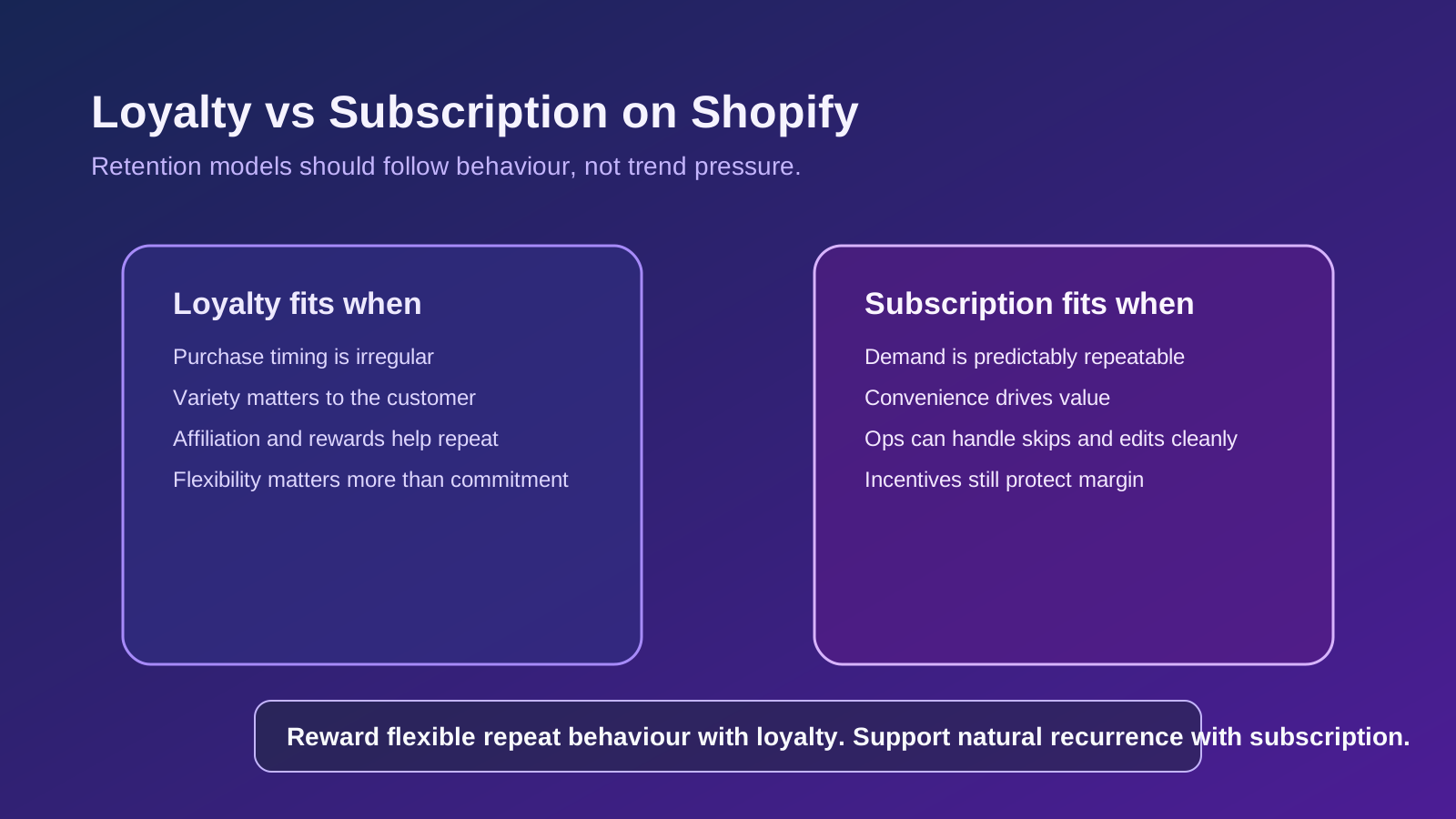
Loyalty tends to win when purchases are variable, discovery-led, or occasion-led.
That often includes categories where:
- order timing is irregular;
- product mix changes frequently;
- emotional brand affinity matters;
- the customer wants flexibility more than commitment.
Loyalty can work well because it rewards ongoing engagement without forcing the customer into a recurring structure they may not genuinely want.
It is also often easier to introduce operationally. Many brands can launch a loyalty layer faster than a mature subscription model because there is less recurring-order governance to manage.
That does not mean loyalty is simple. Weak loyalty programmes often suffer from:
- low perceived value;
- over-reliance on discounts;
- poor customer education;
- rewards disconnected from meaningful behaviour.
If loyalty is going to work, it has to reinforce the brand’s repeat-purchase logic, not just hand out points mechanically.
Where subscription usually wins
Subscription usually wins when the customer has a recurring need and the product category supports predictable replenishment or repeated utility.
Good subscription conditions often include:
- repeatable consumption;
- low decision fatigue;
- category familiarity;
- operational ability to handle skips, edits, pauses, and support cleanly.
Where brands go wrong is assuming a product can be bought again, therefore it should be subscribed to. That is not enough.
Subscription works best when:
- the customer values convenience;
- delivery cadence can be flexible;
- the economics still make sense after incentives;
- support workflows can handle recurring-order exceptions without pain.
If those conditions are weak, the subscription offer can create more churn, support volume, and discount dependency than real retention value.
For broader recurring-revenue architecture, Klaviyo Email & SMS Retention and Subscriptions & Recurring Revenue often overlap.
Comparison table for UK ecommerce teams
| Decision lens | Loyalty model | Subscription model | What StoreBuilt would test |
|---|---|---|---|
| Purchase pattern | Variable or exploratory | Predictable and repeatable | Time between orders by segment |
| Customer mindset | Reward and affinity | Convenience and continuity | Why customers return today |
| Margin pressure | Usually flexible if reward economics are disciplined | Can tighten quickly if discounts and churn controls are weak | Contribution after incentives and support load |
| Operational complexity | Moderate | Higher | Team readiness for recurring-order exceptions |
| Product fit | Broad if the value exchange is credible | Narrower but stronger in the right category | Whether the product earns commitment naturally |
| Retention risk | Can become ignored and generic | Can create churn if forced | Which model customers would actually adopt willingly |
The useful takeaway is that loyalty supports breadth while subscription demands fit. One is not more advanced by default. One is simply more dependent on behavioural and operational alignment.
How to choose the right model without forcing it
Start with customer behaviour, not retention fashion.
Choose loyalty first when:
- reorder timing varies significantly;
- customers buy across categories or collections rather than one repeated line;
- emotional brand engagement matters;
- flexibility is commercially important;
- your operations team is not yet ready for recurring-order management at scale.
Choose subscription first when:
- reorder cadence is reasonably predictable;
- the customer sees convenience as a clear benefit;
- the category supports replenishment or habit;
- you can manage skips, delays, edits, and churn recovery properly;
- the incentive does not destroy contribution margin.
Consider a hybrid only when the models are clearly separated
Some brands need both, but hybrid models fail when everything is blended into one generic “membership” idea. A stronger hybrid setup might use:
- subscription for replenishable hero lines;
- loyalty for wider category engagement and non-subscription buyers;
- lifecycle messaging that explains each role clearly.
That is different from stacking points, discounts, subscription, VIP logic, and referral messaging into one confusing retention layer.
In practical terms, we would pressure-test:
- which products truly earn recurrence;
- whether the customer wants commitment or variety;
- how much support complexity the team can absorb;
- whether the financial model still works after incentives.
Useful related reading:
- Shopify Subscription Plus One-Time Ecommerce Strategy UK
- Shopify Membership Programme Strategy for DTC Brands
- Shopify Gift Card Strategy for Cash Flow and Retention
If your team needs the retention model tied back to category economics and customer behaviour, see StoreBuilt retention services.
StoreBuilt example
A UK brand with good repeat purchase assumed subscriptions were the logical next step because the leadership team wanted more predictable revenue. On review, the buying pattern was not truly replenishment-led. Customers returned because they liked exploring new launches and occasional bundles, not because they wanted the same item on a fixed cadence.
The brand’s actual growth opportunity was stronger loyalty architecture and clearer post-purchase journey design, not forcing a recurring-order proposition. A subscription programme would likely have added incentive cost and support complexity without matching natural demand.
In a different category with clearer replenishment behaviour, our recommendation would have been the opposite. That is exactly the point: retention models should follow buying behaviour, not trend pressure.
High-intent AI search implementation layer
The AI-search version of this topic is not just “write more content”. A useful answer engine result needs a page that gives a direct answer, proves the claim, and shows the next operational step inside Shopify.
| Area | StoreBuilt implementation check |
|---|---|
| Primary intent | The page should map to loyalty vs subscription and one clear buyer or operator problem, not a vague traffic topic. |
| Shopify surface | Identify whether the work belongs on a collection, product page, theme section, checkout step, app workflow, email flow, or support process. |
| Proof | Add first-hand observations, product/category examples, screenshots, policy notes, review signals, or trustworthy external sources where they make the advice safer. |
| Internal route | Link the reader to the service most likely to solve the issue: Subscriptions and recurring revenue. |
| Measurement | Check Search Console, analytics, assisted conversions, enquiry quality, and AI-response mentions after the update rather than judging success by pageviews alone. |
For this article, the useful research inputs are: StoreBuilt Shopify audits, UK ecommerce SERP intent, Shopify platform documentation, and AI-search measurement patterns. StoreBuilt would prioritise replenishment, delivery cutoffs, subscriptions, compliance messaging, PDP trust, and retention before expanding into broader supporting content.
If this topic maps to a live store problem, review the related StoreBuilt service or Contact StoreBuilt with the store URL and the issue you want fixed.
Final StoreBuilt point of view
Loyalty and subscription are not interchangeable retention upgrades.
For UK Shopify brands, loyalty is usually better when the goal is to reward flexible repeat behaviour. Subscription is better when the category genuinely supports convenience-led recurrence. The mistake is assuming either model is automatically sophisticated because it sounds more strategic than email, UX, or merchandising work.
The best retention systems are honest about what the customer actually wants. If the customer wants freedom, do not force commitment. If the customer wants convenience, do not make them re-decide manually every month. Build the retention model around real behaviour and the economics tend to become clearer too. If your brand needs that decision made with more commercial discipline, Contact StoreBuilt.