
What we have seen in StoreBuilt retention work is this: most UK ecommerce brands do not need more campaigns first. They need a clearer lifecycle system so email stops behaving like a weekly promotion tool and starts behaving like a revenue engine.
If your Shopify email setup feels busy but commercially underpowered, Contact StoreBuilt.
Table of contents
- Keyword decision and research inputs
- Why email strategy still compounds faster than most channels
- The 90-day lifecycle build for UK Shopify brands
- The core flows that should exist before you scale campaigns
- How to plan campaigns without fatiguing the list
- StoreBuilt example
- Final StoreBuilt point of view
Keyword decision and research inputs
Primary keyword: ecommerce email marketing strategy
Secondary keywords:
- email marketing for shopify
- shopify email marketing strategy uk
- ecommerce retention strategy
- klaviyo strategy for ecommerce brands
Search intent: informational with strong commercial follow-through from teams improving retention revenue.
Funnel stage: middle of funnel.
Page type: long-form strategy guide with implementation tables and planning framework.
Why StoreBuilt can win this topic:
- We regularly see email underperform because lifecycle structure and onsite capture are disconnected.
- We can translate retention theory into concrete Shopify operating decisions.
- We treat campaign planning, segmentation, and merchandising timing as one system.
Research inputs used:
- Current SERP review for
ecommerce email marketing strategy,shopify email marketing strategy, and related UK-focused retention queries. - UK competitor article and service pattern checks across Charle, Swanky, Eastside Co, and We Make Websites.
- StoreBuilt observations from lifecycle planning, Shopify support, and conversion work with ecommerce teams.
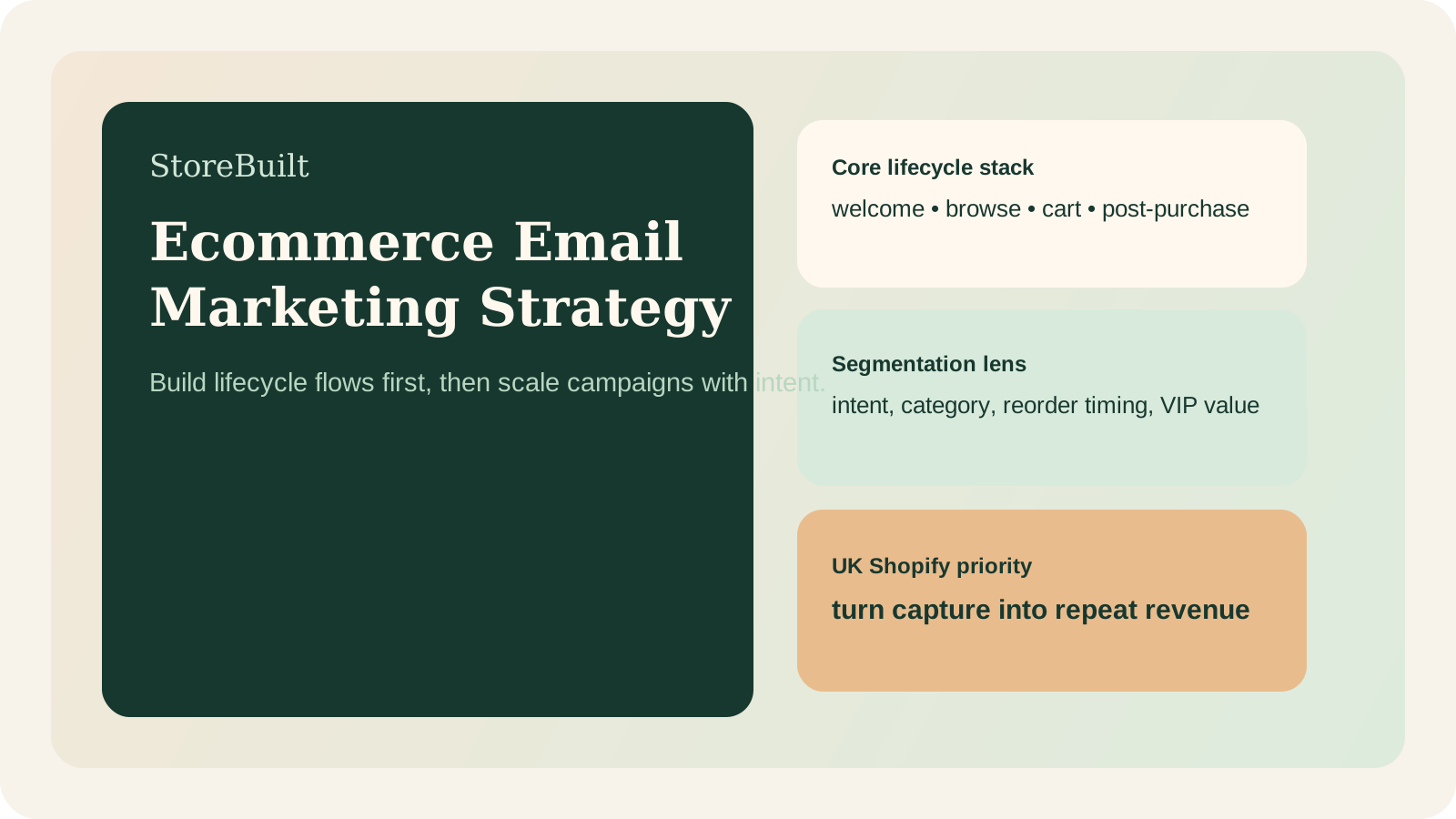
Why email strategy still compounds faster than most channels
In the ecommerce UK market, email still has one structural advantage that paid acquisition never gets: you already own the audience relationship once the customer opts in.
That matters because most growth teams are operating under tighter margin pressure than they were two years ago. Rising acquisition costs, discount dependency, and platform fees make it harder to grow profitably through traffic alone. Email helps because it improves revenue from traffic you have already paid to win.
The mistake is thinking email strategy means “send more campaigns.” Strong programmes usually have three characteristics:
- the signup journey captures useful intent, not just an address
- automated flows handle the most predictable buying moments
- campaign planning follows range launches, seasonality, and merchandising priorities rather than random send slots
This is also where Shopify matters. When the store, forms, product catalogue, customer tags, and post-purchase events are connected properly, email becomes easier to segment and easier to trust. When the stack is fragmented, reporting becomes noisy and teams start optimising for open rate theatre instead of revenue quality.
If your lifecycle setup is still light, StoreBuilt’s retention work usually starts by fixing structure before chasing fancy segmentation.
The 90-day lifecycle build for UK Shopify brands
The fastest useful model is a staged build, not a giant one-off retention project.
| Window | Priority | What good looks like |
|---|---|---|
| Weeks 1-2 | Data and capture foundation | Forms, source tagging, consent logic, branded templates, list hygiene rules |
| Weeks 3-4 | Revenue-critical flows live | Welcome, browse abandonment, cart abandonment, post-purchase flows working cleanly |
| Weeks 5-8 | Segmentation and campaign rhythm | Repeat vs first-time logic, category interest segments, campaign calendar by trading priority |
| Weeks 9-12 | Optimisation layer | Subject-line testing, send-time reviews, suppression rules, holdout logic, creative refresh |
The real benefit of the 90-day structure is organisational. Internal teams stop debating every send from scratch. They start working from a repeatable model:
- Capture the right audience.
- Route that audience into relevant automation.
- Use campaigns to amplify launches, offers, and content.
- Review performance by segment, not just total revenue.
For UK brands, there is also a practical compliance angle. Consent handling, suppression logic, and frequency governance all need to be explicit. That is not just a legal hygiene issue. It protects deliverability and keeps the list commercially usable.
The core flows that should exist before you scale campaigns
The strongest email programmes usually earn a disproportionate share of revenue from a small number of automated flows. That is why flows deserve attention before campaign volume.
| Flow | Why it matters | Common weakness |
|---|---|---|
| Welcome series | Converts new signup intent while brand interest is fresh | Over-focus on discount with no category discovery or proof |
| Browse abandonment | Recovers product interest before it decays | Weak trigger timing or poor product context |
| Cart abandonment | Protects near-conversion demand | Generic copy, no objection handling, weak mobile rendering |
| Post-purchase onboarding | Reduces buyer anxiety and prepares repeat purchase | Stops at receipt-style comms |
| Replenishment or reorder | Useful for consumables and routine-purchase products | Timing not matched to real usage window |
| Review request | Builds proof and feedback loops | Sent too early or without logic for delayed-delivery categories |
| Win-back | Re-engages lapsing customers | One-size-fits-all discounting that hurts margin |
The stronger question is not “Which flows do we have?” It is “Which flows are designed around actual customer behaviour?”
For example, fashion, beauty, supplements, and home categories all need different sequencing. A low-AOV beauty brand can often run a faster repeat-purchase cadence than a furniture merchant. A gifting-led brand may need more seasonal campaign pressure and less replenishment logic. A B2B-plus-DTC brand may need account-based segmentation that separates wholesale conversations from consumer retention completely.
One StoreBuilt pattern we keep seeing is that brands over-invest in the welcome sequence and under-invest in post-purchase communication. That is backwards. The post-purchase window is where trust, reorder probability, and review capture all intersect.
If you need a cleaner flow architecture before your next growth push, StoreBuilt can help.
How to plan campaigns without fatiguing the list
Campaign planning should follow the trading calendar, not team anxiety.
That means mapping sends against:
- product launches
- hero category pushes
- seasonal events
- stock return and back-in-stock moments
- editorial content or buying guides
- operational moments like delivery cutoff deadlines
A practical campaign structure for many Shopify brands is one to three broadcasts per week, but frequency is not the goal. The goal is message relevance by segment.
Use this simple planning table:
| Campaign type | Best use | KPI lens |
|---|---|---|
| Launch campaign | New product, collection, or range drop | revenue per recipient, click depth, assisted conversion |
| Trading campaign | Sale, payday, gifting, peak event | margin-aware revenue, unsubscribe rate, list fatigue |
| Editorial campaign | Buying guide, comparison, education | click quality, product-view lift, assisted PDP sessions |
| Retention campaign | VIP, reorder, loyalty, early access | repeat purchase rate, segment-level AOV, churn risk |
The easiest way to damage performance is to send the same commercial message to the whole database. That usually inflates short-term send revenue while quietly reducing future responsiveness.
A better rule is this: segmentation should change at least one of audience, offer, creative, product mix, or send timing. If segmentation changes nothing about the execution, it is just reporting decoration.
StoreBuilt example
A UK lifestyle brand had decent campaign revenue but weak repeat-purchase efficiency. Their team was sending regularly, yet the underlying system was shallow: no proper browse abandonment logic, no category-based post-purchase sequencing, and only very broad segments.
The first improvement was not more volume. It was structure. We reframed the programme around three layers:
- stronger signup capture with category intent
- clearer flow ownership across welcome, cart, and post-purchase journeys
- campaign planning tied to actual merchandising priorities
Once those layers were clearer, the team could judge campaign performance more honestly. Some “good” campaign results turned out to be masking lifecycle gaps that should have been handled automatically. That shift gave them a cleaner retention roadmap and a more rational view of where manual effort should go.
If your current programme feels reactive rather than strategic, Contact StoreBuilt.
High-intent AI search implementation layer
The AI-search version of this topic is not just “write more content”. A useful answer engine result needs a page that gives a direct answer, proves the claim, and shows the next operational step inside Shopify.
| Area | StoreBuilt implementation check |
|---|---|
| Primary intent | The page should map to email marketing strategy and one clear buyer or operator problem, not a vague traffic topic. |
| Shopify surface | Identify whether the work belongs on a collection, product page, theme section, checkout step, app workflow, email flow, or support process. |
| Proof | Add first-hand observations, product/category examples, screenshots, policy notes, review signals, or trustworthy external sources where they make the advice safer. |
| Internal route | Link the reader to the service most likely to solve the issue: Klaviyo email and SMS retention. |
| Measurement | Check Search Console, analytics, assisted conversions, enquiry quality, and AI-response mentions after the update rather than judging success by pageviews alone. |
For this article, the useful research inputs are: StoreBuilt Shopify audits, UK ecommerce SERP intent, Shopify platform documentation, and AI-search measurement patterns. StoreBuilt would prioritise Klaviyo flows, segmentation, subscription retention, post-purchase journeys, and lifecycle reporting before expanding into broader supporting content.
If this topic maps to a live store problem, review the related StoreBuilt service or Contact StoreBuilt with the store URL and the issue you want fixed.
Final StoreBuilt point of view
The best ecommerce email marketing strategy is not the one with the most flows, the fanciest segmentation, or the busiest calendar.
It is the one that makes customer intent easier to capture, easier to route, and easier to convert into repeat revenue on Shopify. In the ecommerce UK market, the brands that win here usually treat retention as an operating system, not a side channel.