
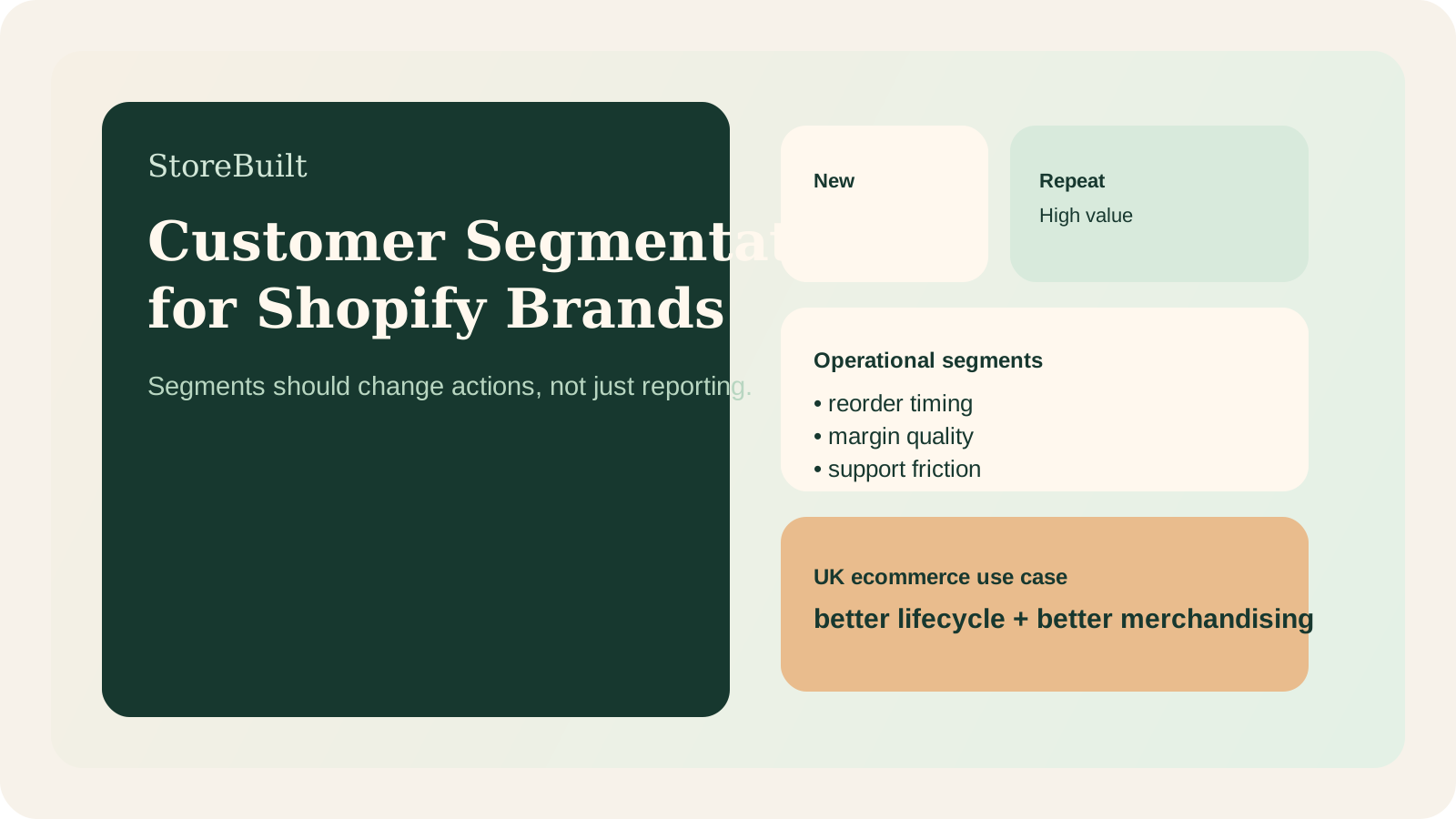
What we have seen in Shopify retention work is this: most segmentation projects fail because they start with marketing software capability instead of commercial usefulness. Teams build clever audiences they never activate, while the segments that could improve merchandising, lifecycle messaging, and paid efficiency stay underdeveloped.
If your Shopify customer data is growing faster than your ability to use it, Contact StoreBuilt.
Table of contents
- Keyword decision and research inputs
- What customer segmentation should actually do
- The segments UK Shopify brands should prioritise first
- Operational segmentation table
- Why segmentation often breaks in execution
- StoreBuilt example
- Final StoreBuilt point of view
Keyword decision and research inputs
Primary keyword: customer segmentation for shopify
Secondary keywords:
- ecommerce customer segmentation
- shopify customer segments
- customer segmentation UK ecommerce
- shopify retention strategy
Search intent: strategic and practical. The reader usually wants to improve retention, personalisation, merchandising, or paid efficiency on an existing Shopify store.
Funnel stage: middle.
Page type: operational playbook.
Why StoreBuilt can win this topic:
- We see segmentation issues inside Shopify growth work, not only inside email tools.
- We understand how segmentation affects onsite journeys, merchandising logic, retention performance, and support load.
- We can frame customer segments in ways that ecommerce teams can actually maintain.
Research inputs used:
- Current SERP review around Shopify customer segmentation and ecommerce customer segmentation queries.
- Competitor content review across UK agencies and ecommerce operators, including Charle-style practical articles and broader Shopify/ecommerce strategy content.
- Public keyword-style clustering around segmentation, retention, personalisation, first-party data, and Shopify lifecycle strategy.
What customer segmentation should actually do
Segmentation is not a reporting hobby.
For a Shopify brand in the ecommerce UK market, useful segmentation should improve one or more of these:
- product discovery
- lifecycle relevance
- repeat purchase timing
- margin protection
- support efficiency
- campaign targeting
If a segment does not influence a real decision, it is probably not a priority segment.
That is why demographic-only models often disappoint. They can describe customers, but they do not always tell the team what to do next.
The more valuable segments usually come from behaviour:
- first order vs repeat
- high AOV vs low margin
- frequent replenishment vs long-cycle purchase
- discount dependent vs full-price comfortable
- high support need vs self-serve friendly
These are commercially active groups, not just audience labels.
The segments UK Shopify brands should prioritise first
1. New customer vs repeat customer
This is basic, but many stores still underuse it.
The first question is not whether someone bought. It is whether they are early in trust formation or already in a repeat relationship with the brand. Messaging, offer logic, and onsite reinforcement should reflect that difference.
2. Replenishment-speed segments
For consumable or repeat-purchase categories, this is often more valuable than broad interest segments.
If a shopper typically reorders at 25 days, 50-day flows are late. If they reorder quarterly, aggressive reminders create fatigue. Replenishment cadence should shape timing far more than generic campaign calendars.
3. Margin-aware segments
Not every customer is equally valuable after costs.
Brands often celebrate AOV growth without checking whether those customers are discount-heavy, return-heavy, or support-heavy. A more useful view looks at commercial quality, not only revenue.
4. Category or preference segments
This is where merchandising and lifecycle teams should meet.
If the store sells across clearly different product uses, needs, or routines, content and follow-up should reflect that. The point is not to collect every possible preference. It is to collect enough signal to reduce irrelevance.
5. Support-friction segments
This one is underused.
Some customers create predictable support load because the product is complex, the fulfilment expectation is sensitive, or product selection confidence is weaker. Those customers may need stronger onboarding, clearer FAQ architecture, or more explicit order communication.
That is why segmentation should connect to CRO and UX optimisation, not only to campaigns.
Operational segmentation table
| Segment type | What it helps improve | Typical trigger or signal |
|---|---|---|
| New vs repeat | Messaging, trust, offer logic | Order count |
| Replenishment cadence | Timing of reorder flows | Days between purchases |
| Margin quality | Discount and incentive control | Gross margin by order or segment |
| Category preference | Product recommendations and education | Product family, quiz answer, browse behaviour |
| Support-risk cohort | Onboarding and service workload | Return rate, ticket pattern, product complexity |
| VIP or high-LTV | Priority access and retention investment | Revenue, repeat frequency, recency |
The important point is that each segment should trigger an action. If the team cannot explain that action, the segment is not mature enough yet.
Why segmentation often breaks in execution
Too many segments too early
Teams build twenty audiences when they only have workflows for four.
Weak data discipline
If events, tags, or product categorisation are inconsistent, segmentation becomes unreliable. The model looks sophisticated in the CRM and messy everywhere else.
No owner across onsite and lifecycle
A common problem is that the lifecycle team owns audience logic while the onsite experience stays generic. That wastes the insight.
No review cadence
Customer segments are not set once and forgotten. Segment usefulness changes with seasonality, stock mix, acquisition strategy, and category expansion.
If your current data capture and segmentation model needs stronger commercial structure, StoreBuilt’s retention and lifecycle support is the most relevant next step.
StoreBuilt example
One UK Shopify brand had solid list growth and plenty of campaign activity, but repeat performance stayed inconsistent. The issue was not channel effort. It was audience logic.
Customers were broadly grouped by acquisition source and discount usage, but not by actual product rhythm, preference, or post-purchase need. That meant useful differences between cohorts were flattened into one general lifecycle approach.
Once the segmentation model was simplified around reorder speed, product context, and customer maturity, the team could make better decisions across email timing, onsite prompts, and support messaging. The improvement came less from “more automation” and more from clearer audience meaning.
High-intent AI search implementation layer
The AI-search version of this topic is not just “write more content”. A useful answer engine result needs a page that gives a direct answer, proves the claim, and shows the next operational step inside Shopify.
| Area | StoreBuilt implementation check |
|---|---|
| Primary intent | The page should map to customer segmentation and one clear buyer or operator problem, not a vague traffic topic. |
| Shopify surface | Identify whether the work belongs on a collection, product page, theme section, checkout step, app workflow, email flow, or support process. |
| Proof | Add first-hand observations, product/category examples, screenshots, policy notes, review signals, or trustworthy external sources where they make the advice safer. |
| Internal route | Link the reader to the service most likely to solve the issue: Klaviyo email and SMS retention. |
| Measurement | Check Search Console, analytics, assisted conversions, enquiry quality, and AI-response mentions after the update rather than judging success by pageviews alone. |
For this article, the useful research inputs are: StoreBuilt Shopify audits, UK ecommerce SERP intent, Shopify platform documentation, and AI-search measurement patterns. StoreBuilt would prioritise Klaviyo flows, segmentation, subscription retention, post-purchase journeys, and lifecycle reporting before expanding into broader supporting content.
If this topic maps to a live store problem, review the related StoreBuilt service or Contact StoreBuilt with the store URL and the issue you want fixed.
Final StoreBuilt point of view
For Shopify brands in the UK, customer segmentation works when it behaves like operating infrastructure rather than dashboard decoration. The best segments are not the most advanced. They are the ones that change what the team does next across merchandising, lifecycle, CRO, and service. In 2026, the winning segmentation models will be the simplest ones that are actually used with discipline.