
What we have seen in StoreBuilt retention projects is this: many ecommerce teams treat subscription and one-time buying as separate projects. On Shopify, that usually creates UX conflict, discount leakage, and weak lifecycle clarity.
If you are trying to scale repeat revenue in the UK ecommerce market without damaging first-order conversion, Contact StoreBuilt.
Table of contents
- Keyword decision and research inputs
- Why hybrid purchase models break
- Shopify hybrid model architecture
- Pricing, offer, and margin control framework
- Retention operating model for UK ecommerce teams
- StoreBuilt example
- Final StoreBuilt point of view
Keyword decision and research inputs
Primary keyword: shopify subscription strategy uk
Secondary keywords:
- ecommerce UK market subscription model
- one-time and subscription Shopify
- Shopify retention strategy ecommerce
- recurring revenue ecommerce UK
- Shopify lifecycle optimisation
Search intent: commercial implementation guidance for operators balancing acquisition and repeat revenue.
Funnel stage: middle to bottom funnel.
Page type: strategic playbook.
Why StoreBuilt can realistically win this topic:
- We work on lifecycle systems where offer logic and operational constraints need to align.
- We translate retention goals into practical Shopify implementation choices.
- We integrate UX, pricing, and reporting decisions into one operating model.
Research inputs used in angle selection:
- SERP intent review on Shopify subscription and retention queries.
- Competitor angle scan among UK ecommerce agencies.
- Keyword-cluster and autosuggest research for commercial demand.
Why hybrid purchase models break
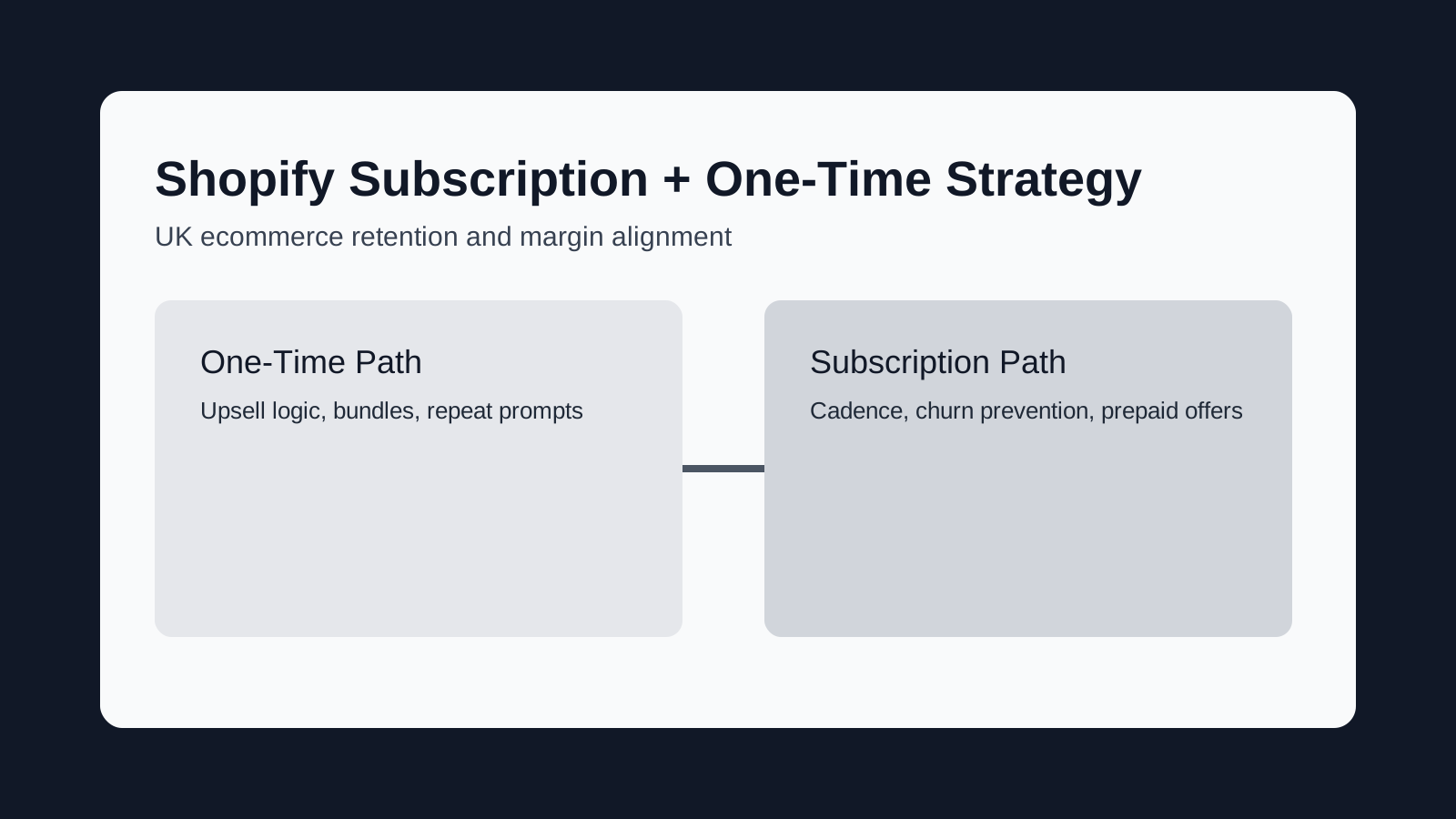
In principle, hybrid models look simple: let buyers choose one-time purchase or subscribe. In practice, many stores break because these choices are not governed commercially.
Common failure patterns:
- Subscription discounts set without contribution-margin guardrails.
- Checkout experience where buyers are confused about commitment terms.
- Lifecycle messaging that treats all customers as if they joined the same route.
- Promotions that cannibalise high-quality recurring cohorts.
The result is a retention strategy that increases operational complexity without delivering durable profitability.
Shopify hybrid model architecture
Design the model around customer intent segments, not app settings alone.
| Segment | Typical buying intent | Recommended route |
|---|---|---|
| Trial-first shoppers | Low commitment, discovery mode | One-time path with repeat trigger |
| Value-stability shoppers | Predictable replenishment | Subscription path with clear cadence |
| Promotion-led shoppers | High offer sensitivity | Controlled one-time offers with churn safeguards |
| High-LTV category users | Habit and convenience priority | Subscription with flexible self-serve controls |
Then align PDP and checkout messaging so shoppers understand value and commitment before payment.
Pricing, offer, and margin control framework
Use a margin-aware offer system.
| Decision area | Risk if unmanaged | Practical control |
|---|---|---|
| Subscription discount depth | Contribution erosion | Set discount bands by category margin |
| Frequency options | Churn due to mismatch | Offer realistic cadence based on usage patterns |
| Skip/pause policy | Support burden and involuntary churn | Provide clear self-serve controls |
| Bundle and add-on logic | AOV suppression | Configure cross-sell specifically by route |
| Promo stacking | Discount leakage | Define strict rules and exceptions |
A useful principle: subscription should improve customer value and business resilience, not become a permanent discount engine.
For implementation support across Shopify retention UX and offer governance, see StoreBuilt services.
Retention operating model for UK ecommerce teams
The model needs weekly ownership.
| Cadence | Review topic | Owner |
|---|---|---|
| Weekly | Cohort retention and churn triggers | CRM + ecommerce lead |
| Weekly | Offer performance and margin impact | Commercial + finance |
| Fortnightly | Subscription UX friction and support reasons | CX + product |
| Monthly | Lifecycle experimentation roadmap | Growth + delivery |
Track at least these metrics by route:
- First-to-second order conversion.
- Subscription activation rate from eligible products.
- Churn within first three renewal cycles.
- Net contribution per cohort after incentives.
If these are only reviewed monthly, you are usually reacting too late.
StoreBuilt example
A UK Shopify brand had strong first-order growth but volatile repeat purchase economics. Subscription uptake looked promising, but net contribution lagged because discounts and promotions were not coordinated across one-time and recurring routes.
We helped redesign the offer architecture, tighten route-specific messaging, and align lifecycle automations with segment intent. The biggest gain came from governance: once the team established weekly margin-and-retention reviews, decision quality improved quickly and churn interventions became proactive.
If your retention strategy feels busy but underpowered, Contact StoreBuilt.
High-intent AI search implementation layer
The AI-search version of this topic is not just “write more content”. A useful answer engine result needs a page that gives a direct answer, proves the claim, and shows the next operational step inside Shopify.
| Area | StoreBuilt implementation check |
|---|---|
| Primary intent | The page should map to shopify subscription strategy and one clear buyer or operator problem, not a vague traffic topic. |
| Shopify surface | Identify whether the work belongs on a collection, product page, theme section, checkout step, app workflow, email flow, or support process. |
| Proof | Add first-hand observations, product/category examples, screenshots, policy notes, review signals, or trustworthy external sources where they make the advice safer. |
| Internal route | Link the reader to the service most likely to solve the issue: Shopify Plus and B2B. |
| Measurement | Check Search Console, analytics, assisted conversions, enquiry quality, and AI-response mentions after the update rather than judging success by pageviews alone. |
For this article, the useful research inputs are: Shopify Help documentation, StoreBuilt implementation patterns, UK ecommerce SERP intent, and common founder/operator questions. StoreBuilt would prioritise company accounts, price lists, catalogues, net terms, wholesale UX, and B2B operating controls before expanding into broader supporting content.
If this topic maps to a live store problem, review the related StoreBuilt service or Contact StoreBuilt with the store URL and the issue you want fixed.
Final StoreBuilt point of view
For UK ecommerce brands on Shopify, hybrid purchasing can be a major growth lever, but only when one-time and subscription journeys are governed as one commercial system. Treating them as separate experiments usually creates hidden leakage and noisy reporting.
If you want a practical hybrid strategy tied to real margin and lifecycle constraints, Contact StoreBuilt.