
What we have seen across UK growth audits is this: many brands chase channel growth before fixing on-site conversion quality and retention efficiency.
If your team wants a quarterly growth system rather than isolated tactics, Contact StoreBuilt.
Table of contents
- Keyword decision and research inputs
- What “market share” actually means for Shopify teams
- Quarterly growth operating model
- Channel-to-store economics table
- UK competitor content signals to monitor
- StoreBuilt example
- Final StoreBuilt point of view
Keyword decision and research inputs
Primary keyword: ecommerce UK market
Secondary keywords:
- ecommerce market share growth UK
- shopify ecommerce growth strategy
- ecommerce UK market trends
- shopify growth playbook
- ecommerce strategy uk
Search intent: strategic-commercial growth planning.
Funnel stage: middle.
Page type: long-form execution playbook.
Why StoreBuilt can win this topic:
- We combine SEO, CRO, and retention into one operating model.
- We see where growth breaks between channel reporting and storefront performance.
- We focus on implementable sequencing for in-house ecommerce teams.
Research inputs used in angle selection:
- Current SERP review for “ecommerce UK market” and Shopify growth intent clusters.
- UK agency content review (including Charle article patterns) to identify strategy-to-execution gaps.
- Keyword-style clustering around market growth, Shopify execution, and retention economics.
What “market share” actually means for Shopify teams
For most Shopify brands, market share is not a single metric. It is an outcome of four linked systems:
- demand capture quality (search + paid + referral)
- conversion quality (PDP trust, checkout, delivery confidence)
- repeat purchase and lifecycle retention
- operational reliability (stock, delivery, support quality)
If one system is weak, spend efficiency deteriorates. Teams then increase acquisition budgets to compensate, which often compresses margin.
Quarterly growth operating model
Use one growth board per quarter with clear stage priorities.
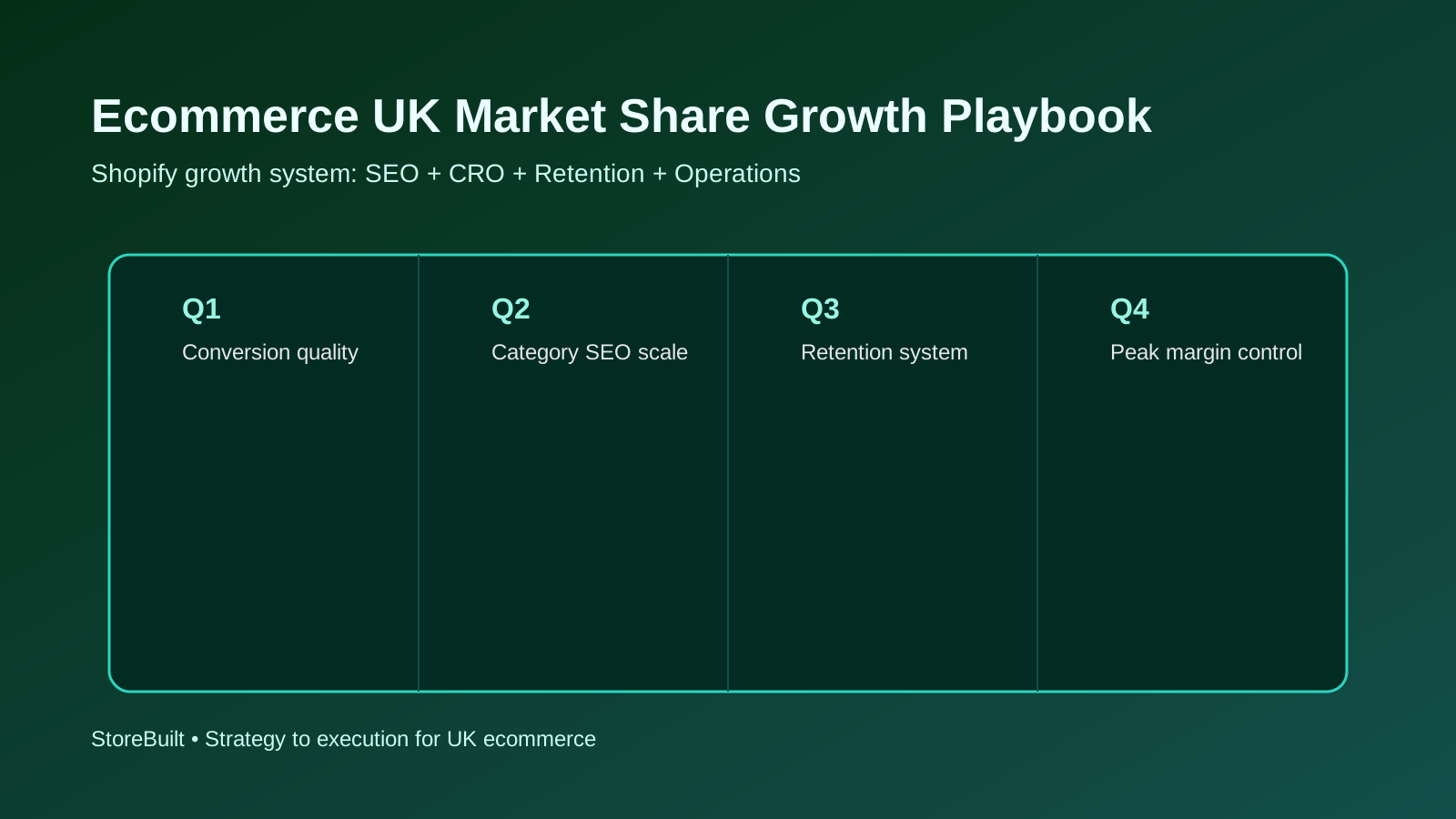
| Quarter focus | Primary objective | Secondary objective | Main risk |
|---|---|---|---|
| Q1 | Fix conversion leaks in high-intent categories | Improve product page proof depth | Over-investing in traffic before on-site quality is fixed |
| Q2 | Expand organic demand through category-cluster SEO | Build stronger merchandising pages | Publishing content without internal-link and category governance |
| Q3 | Increase repeat revenue from lifecycle automation | Improve post-purchase and account journeys | Running campaigns without retention segmentation clarity |
| Q4 | Protect margin during peak trading | Improve checkout and returns policy clarity | Discount-heavy growth that harms repeat economics |
A practical rule: each quarter should have one primary growth bottleneck and one supporting initiative. When teams run too many “priorities,” execution quality drops.
Channel-to-store economics table
| Layer | KPI | Good decision question |
|---|---|---|
| Demand | New sessions by intent cluster | Are we attracting qualified discovery, not only cheap clicks? |
| Conversion | Add-to-cart and checkout completion by device | Which experience friction is suppressing paid and organic ROI? |
| Margin quality | Net revenue after returns by category | Which categories grow headline revenue but dilute contribution? |
| Retention | 60-day and 90-day repeat rate | Is lifecycle execution compounding or just discounting? |
| Operations | Delivery success + support-ticket trend | Are fulfilment frictions undermining conversion trust? |
If your reporting stack cannot answer these questions weekly, growth decisions will remain reactive.
For teams needing this connected reporting and implementation model, StoreBuilt can help build the system.
UK competitor content signals to monitor
Competitor libraries in the UK Shopify space usually cluster around three patterns:
| Pattern | What it signals | How to use it safely |
|---|---|---|
| Pricing and platform comparison guides | High commercial-intent demand | Build your own POV with category-level execution details |
| “Best agency” shortlist pages | Bottom-funnel enquiry capture strategy | Publish differentiated decision frameworks, not listicles |
| Broad trend roundups | Top-funnel traffic capture | Connect trends to practical implementation sequences |
This is where many content programmes fail: they imitate title formats without adding operational depth. Use signal patterns, but publish from first-hand delivery perspective.
StoreBuilt example
A UK DTC merchant had stable acquisition volume but slow revenue growth. Channel teams were optimising spend, yet category conversion and repeat performance were inconsistent.
We restructured the roadmap into one quarterly board: first conversion quality, then category SEO architecture, then retention automation. The key shift was governance. Teams moved from “campaign output reporting” to “commercial outcome reporting,” and prioritisation improved significantly.
If your team is active but not compounding, Contact StoreBuilt.
High-intent AI search implementation layer
The AI-search version of this topic is not just “write more content”. A useful answer engine result needs a page that gives a direct answer, proves the claim, and shows the next operational step inside Shopify.
| Area | StoreBuilt implementation check |
|---|---|
| Primary intent | The page should map to shopify growth and one clear buyer or operator problem, not a vague traffic topic. |
| Shopify surface | Identify whether the work belongs on a collection, product page, theme section, checkout step, app workflow, email flow, or support process. |
| Proof | Add first-hand observations, product/category examples, screenshots, policy notes, review signals, or trustworthy external sources where they make the advice safer. |
| Internal route | Link the reader to the service most likely to solve the issue: Shopify store design and development. |
| Measurement | Check Search Console, analytics, assisted conversions, enquiry quality, and AI-response mentions after the update rather than judging success by pageviews alone. |
For this article, the useful research inputs are: Shopify Help documentation, StoreBuilt implementation patterns, UK ecommerce SERP intent, and common founder/operator questions. StoreBuilt would prioritise practical Shopify setup, theme structure, page hierarchy, product data, and launch-ready implementation before expanding into broader supporting content.
If this topic maps to a live store problem, review the related StoreBuilt service or Contact StoreBuilt with the store URL and the issue you want fixed.
Final StoreBuilt point of view
In the ecommerce UK market, market-share growth for Shopify brands comes from system quality, not tactic volume. The winning model is a disciplined quarterly sequence where SEO, CRO, retention, and operations are managed as one commercial engine.