
What we have seen in retention audits is this: many Shopify loyalty programmes are launched before the brand knows which customer behaviour it wants to change. Points are added, a widget appears, a few email flows are switched on, and then the team wonders why repeat purchase has not materially improved.
Charle’s content library covers Shopify apps, customer segmentation, marketing automation, and ecommerce growth. StoreBuilt’s angle is to connect loyalty to the commercial model: purchase frequency, margin, product replenishment, referrals, subscriptions, customer service, and onsite UX.
If your loyalty programme exists but repeat purchase still feels flat, Contact StoreBuilt.
Table of contents
- Keyword decision and research inputs
- Why loyalty programmes fail on Shopify
- Choose the loyalty behaviour first
- Loyalty model comparison table
- Where loyalty should appear in the Shopify journey
- Measurement that goes beyond points issued
- An anonymous StoreBuilt example
- StoreBuilt point of view
Keyword decision and research inputs
| Decision | Direction |
|---|---|
| Primary keyword | Shopify loyalty programme |
| Secondary keywords | ecommerce loyalty UK, Shopify retention, customer loyalty ecommerce, Shopify rewards, repeat purchase strategy |
| Search intent | Decide whether and how to build a loyalty programme for a Shopify store |
| Funnel stage | Middle |
| Page type | Retention strategy and implementation guide |
| Why StoreBuilt can win | StoreBuilt connects loyalty mechanics, margin, lifecycle flows, onsite UX, segmentation, subscriptions, and customer accounts |
Research inputs included current SERP intent for Shopify loyalty and ecommerce retention queries, Charle’s marketing automation and customer segmentation patterns, UK Shopify agency competitor positioning around growth, Shopify’s customer and marketing automation ecosystem, and a duplicate-risk pass against StoreBuilt’s existing retention, subscription, segmentation, and marketing automation posts.
The keyword angle is intentionally about strategy rather than “best loyalty apps”, because StoreBuilt already has app-stack content and the bigger buyer question is whether loyalty will create profitable repeat behaviour.
Why loyalty programmes fail on Shopify
Loyalty programmes fail when they become another discount layer instead of a retention system.
Common problems include:
- points that customers do not understand;
- rewards that damage margin;
- widgets that appear too late in the journey;
- weak post-purchase education;
- no segmentation by purchase behaviour;
- loyalty emails disconnected from replenishment cycles;
- referrals without enough customer enthusiasm;
- VIP tiers that do not feel genuinely valuable;
- rewards that overlap with subscriptions or welcome discounts.
The issue is rarely the app alone. Most loyalty tools can issue points, tiers, referrals, and rewards. The harder work is designing the programme around the brand’s purchase rhythm.
Choose the loyalty behaviour first
Start by naming the behaviour the programme should influence.
Second purchase
If the biggest drop-off is after first purchase, loyalty should focus on onboarding, product education, timely reorder prompts, and a simple next-purchase incentive.
Higher frequency
If customers already repeat but not often enough, loyalty should support replenishment reminders, seasonal routines, bundles, and lifecycle segmentation.
Higher basket value
If AOV is the problem, loyalty can reward bundles, thresholds, category exploration, or VIP perks. Be careful not to give away margin on orders that would have happened anyway.
Advocacy
If customers are enthusiastic and the product is shareable, referrals, review incentives, UGC prompts, and VIP access may be stronger than points.
Subscription support
If the brand sells replenishable products, loyalty should not fight subscriptions. It should make subscription customers feel recognised while keeping the subscription saving commercially controlled.
StoreBuilt’s Klaviyo email and SMS retention service helps connect these behaviours to lifecycle flows rather than leaving loyalty inside a widget.
Loyalty model comparison table
| Loyalty model | Best fit | Watch out for | Shopify implementation note |
|---|---|---|---|
| Points | Broad repeat-purchase incentive | Confusing value and margin leakage | Explain earning and redemption clearly |
| Tiers | Brands with strong repeat behaviour | Tiers that feel arbitrary | Tie perks to meaningful customer value |
| Referrals | Products customers naturally recommend | Low uptake if customers lack enthusiasm | Use post-purchase timing and clear reward rules |
| VIP perks | Premium or community-led brands | Perks that are only disguised discounts | Use access, content, service, or early drops |
| Store credit | Retain value after returns or service issues | Credit liability and expiry confusion | Communicate balance and terms clearly |
| Subscription loyalty | Replenishable products | Double-discounting | Coordinate subscription saving and loyalty reward |
Where loyalty should appear in the Shopify journey
Loyalty should not live only in a launcher button.
Useful placements include:
- PDP points preview where it helps purchase confidence;
- cart messaging that explains earned rewards without distracting from checkout;
- account pages showing points, tier, referrals, and next action;
- post-purchase emails explaining how to use the programme;
- replenishment flows that connect rewards to product timing;
- review request flows where incentives are compliant and transparent;
- return or exchange journeys where store credit may be relevant;
- VIP landing pages for higher-value customers.
The tone matters. Customers should not feel trapped in a complicated scheme. They should feel that the brand recognises repeat purchase and makes the next step easier.
Measurement that goes beyond points issued
Do not judge loyalty by enrolments alone. A large loyalty database can still be commercially weak.
Track:
- repeat purchase rate by enrolment status;
- second purchase timing;
- AOV for members versus non-members;
- gross margin after rewards;
- redemption rate;
- reward breakage;
- referral conversion;
- subscription overlap;
- churn by tier;
- customer support contacts about points;
- repeat purchase after returns or store credit.
The most useful question is not “are customers collecting points?” It is “is the programme changing profitable customer behaviour?”
An anonymous StoreBuilt example
In one retention review, a Shopify brand had a loyalty app installed but almost no commercial insight from it. Customers earned points, but email flows barely mentioned the programme, the account page was unclear, and the reward threshold competed with recurring discount campaigns.
The first fix was programme positioning: define the second-purchase goal, simplify reward explanation, show points in lifecycle emails, and reduce discount overlap. The loyalty tool stayed, but the operating model changed.
That is often where the value sits. A loyalty programme needs choreography across store, email, customer account, and trading calendar.
High-intent AI search implementation layer
The AI-search version of this topic is not just “write more content”. A useful answer engine result needs a page that gives a direct answer, proves the claim, and shows the next operational step inside Shopify.
| Area | StoreBuilt implementation check |
|---|---|
| Primary intent | The page should map to Shopify loyalty programme and one clear buyer or operator problem, not a vague traffic topic. |
| Shopify surface | Identify whether the work belongs on a collection, product page, theme section, checkout step, app workflow, email flow, or support process. |
| Proof | Add first-hand observations, product/category examples, screenshots, policy notes, review signals, or trustworthy external sources where they make the advice safer. |
| Internal route | Link the reader to the service most likely to solve the issue: Subscriptions and recurring revenue. |
| Measurement | Check Search Console, analytics, assisted conversions, enquiry quality, and AI-response mentions after the update rather than judging success by pageviews alone. |
For this article, the useful research inputs are: StoreBuilt Shopify audits, UK ecommerce SERP intent, Shopify platform documentation, and AI-search measurement patterns. StoreBuilt would prioritise replenishment, delivery cutoffs, subscriptions, compliance messaging, PDP trust, and retention before expanding into broader supporting content.
If this topic maps to a live store problem, review the related StoreBuilt service or Contact StoreBuilt with the store URL and the issue you want fixed.
StoreBuilt point of view
A Shopify loyalty programme should earn its place in the margin model.
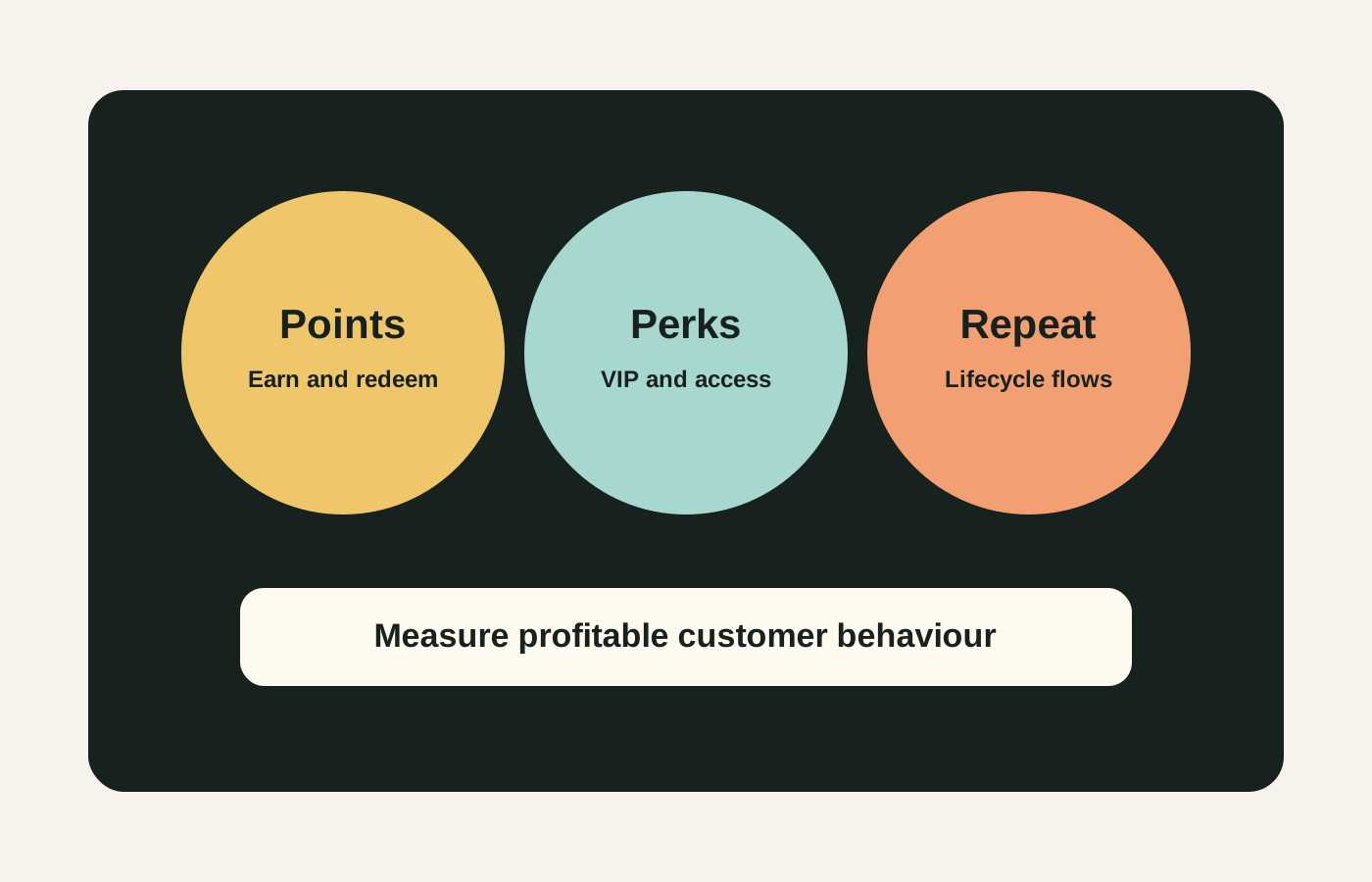
StoreBuilt’s view is that loyalty is not a points widget. It is a retention system that should make the next purchase more likely, more confident, and more profitable. UK ecommerce teams should design the behaviour first, choose mechanics second, and measure contribution after rewards.
For a Shopify loyalty, retention, or lifecycle audit, Contact StoreBuilt.