
What we have seen in StoreBuilt audits and planning workshops is this: ecommerce teams rarely lose momentum because they lack ideas. They lose it because search, platform, conversion, retention, and operating decisions are treated as separate projects. This guide turns that problem into a practical Shopify decision framework for UK brands.
The topic was chosen after reviewing current UK Shopify agency content patterns, including Charle’s article hub, and checking how ecommerce, ecommerce UK market, Shopify, and platform-comparison keywords are being served. StoreBuilt’s angle is deliberately operator-led: helpful enough for a team to use, commercial enough to support a qualified enquiry.
If you want StoreBuilt to review how this applies to your store, Contact StoreBuilt.
Table of contents
- Keyword decision and research inputs
- Retention is not one tool
- The architecture table
- Where segmentation belongs
- StoreBuilt example
- Measurement model
- What to avoid
- First purchase quality
- Final StoreBuilt point of view
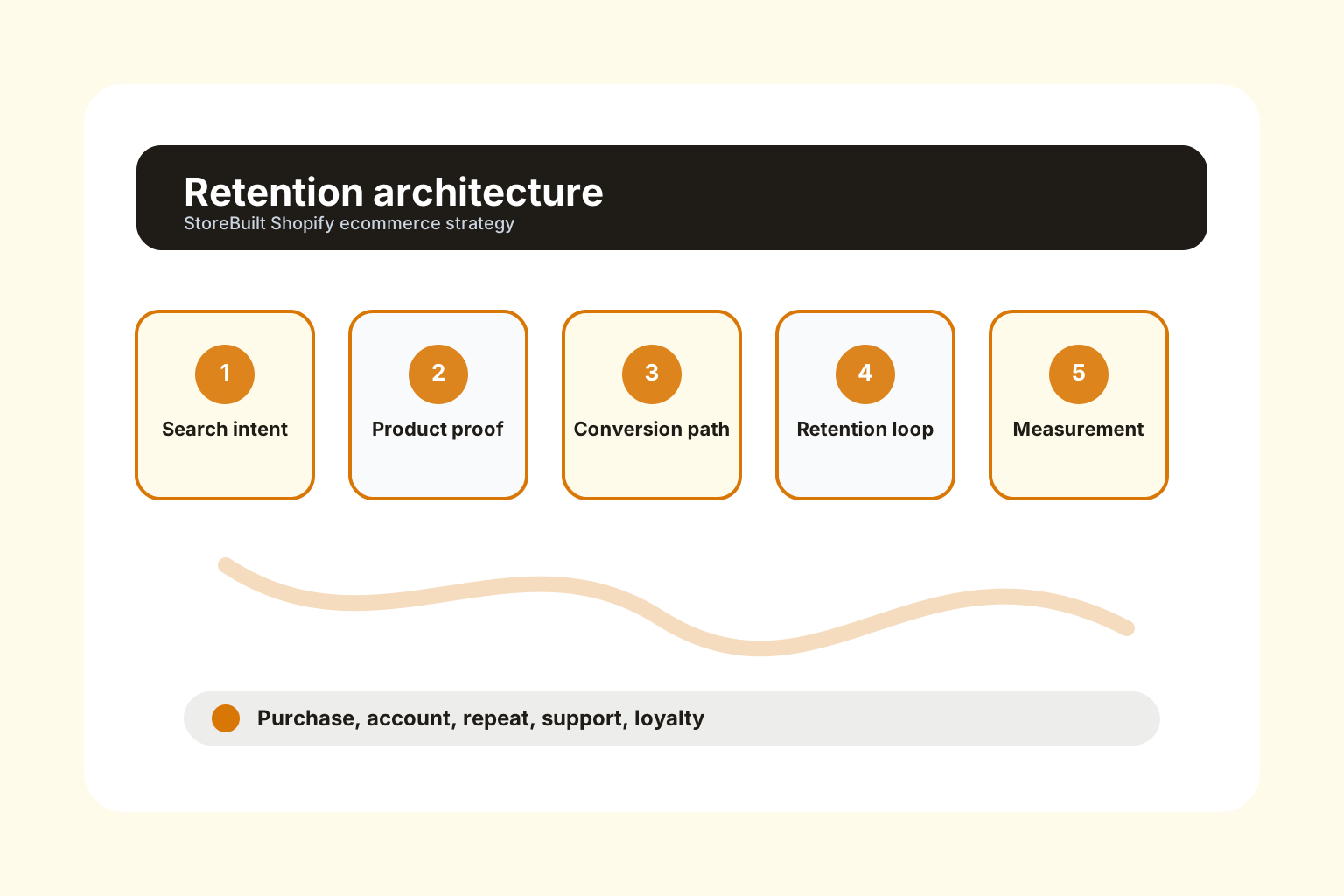
Keyword decision and research inputs
Primary keyword: ecommerce retention architecture. Secondary keywords include Shopify retention strategy, ecommerce retention UK, Shopify subscriptions, Klaviyo Shopify, replenishment flows, loyalty programme, and customer accounts. Intent is practical: the reader wants repeat purchase to become a system rather than a set of disconnected tactics. Funnel stage is middle to bottom funnel. Page type is an architecture guide.
Charle-style competitor content around automation and customer segmentation shows clear demand for retention topics. StoreBuilt already has automation and subscription content, so this article takes a wider architecture angle: how onsite UX, accounts, email, SMS, support, replenishment, and loyalty should connect.
The article supports Klaviyo email and SMS retention, subscriptions and recurring revenue, and CRO and UX optimisation.
Retention is not one tool
Retention is often reduced to email flows, loyalty points, or subscriptions. Those tools matter, but they cannot carry the whole customer relationship. A retention architecture includes every part of the Shopify experience that affects whether a customer buys again:
- product expectation setting before purchase;
- delivery and returns confidence;
- post-purchase education;
- customer account usefulness;
- replenishment timing;
- subscriptions or bundles where relevant;
- support themes and returns reasons;
- loyalty, referrals, and VIP treatment;
- email and SMS orchestration.
When these pieces are disconnected, the brand spends more effort reminding customers than helping them succeed.
The architecture table
| Layer | Purpose | Shopify implementation | Risk if missing |
|---|---|---|---|
| Product expectation | Reduce disappointment | PDP guidance, FAQs, images, reviews | Returns and low repeat rate |
| Post-purchase education | Help customer use the product | Email/SMS, order status, inserts, account content | Support pressure |
| Account value | Make returning easier | Customer accounts, order history, reordering | One-time buying behaviour |
| Replenishment | Time the next purchase | Klaviyo flows, subscriptions, reminders | Lost repeat demand |
| Loyalty/VIP | Recognise valuable behaviour | Points, tiers, perks, early access | Cosmetic loyalty with low adoption |
| Support loop | Feed insight back into store | Helpdesk tagging, returns reasons, reviews | Same objections keep repeating |
Retention improves when each layer has an owner and a measurement.
Where segmentation belongs
Segmentation is useful only when it changes the customer experience. A useful Shopify retention model segments by product category, purchase frequency, margin profile, subscription status, discount behaviour, support risk, and lifetime value.
The point is not to create dozens of tiny audiences. The point is to avoid treating a first-time buyer, a replenishment customer, a high-value repeat customer, and a discount-only shopper as if they need the same message.
For UK brands with small teams, start with four segments: new buyers, likely replenishment buyers, high-value repeat customers, and at-risk lapsed customers. Build useful journeys for those before adding complexity.
StoreBuilt example
One Shopify store had a loyalty app, email flows, and subscription options, but the pieces did not reinforce each other. Customers could buy once, join a programme, receive generic emails, and still have no clear reason to create an account or reorder at the right time.
The better architecture was simpler. Product pages set expectations more clearly. Post-purchase messages educated customers by category. Replenishment timing was linked to actual product usage. Loyalty messages were reserved for behaviour worth recognising. Support themes were reviewed so the storefront could answer common doubts earlier.
The work was less about adding another app and more about making each touchpoint useful.
Measurement model
Retention architecture should be measured with a balanced view. Repeat purchase rate matters, but it is not enough. Look at second-order rate, time between purchases, subscription active rate, replenishment conversion, account activation, support contact rate after purchase, returns reasons, review sentiment, and revenue from lifecycle journeys.
The useful question is not whether one flow generated revenue last week. The useful question is whether the customer journey is becoming easier to repeat. If post-purchase education reduces confusion, retention improves before it appears as revenue. If account pages make reordering easier, the benefit may show up in fewer support questions as well as more repeat orders.
A monthly retention review should combine numbers and customer evidence. Shopify reports, Klaviyo flows, helpdesk tags, reviews, and returns data all belong in the same conversation.
What to avoid
Avoid adding loyalty points before the core repeat journey is useful. Avoid subscription pushes when product usage cycles are unclear. Avoid sending winback discounts to every lapsed customer. Avoid building segments that the team cannot maintain.
The better move is to make the second purchase feel natural: clear product expectations, useful post-purchase content, sensible account features, timely replenishment reminders, and support insight fed back into the storefront. Retention gets stronger when every touchpoint earns its place.
First purchase quality
Retention starts with the first purchase experience. If a customer feels unsure before buying, surprised after delivery, confused by the product, or unsupported when something goes wrong, the second purchase becomes harder. That is why StoreBuilt looks at product-page expectation setting, delivery promises, returns language, support access, order updates, and post-purchase education before recommending more retention technology.
For Shopify brands, first purchase quality can often be improved with practical changes: clearer product imagery, usage guidance, size and compatibility notes, delivery cutoffs, returns reassurance, review prompts by product type, and order-status content that answers the next question. These changes do not feel like retention work, but they influence whether customers trust the brand enough to come back.
The strongest retention systems make the customer feel that the brand understands the whole ownership journey, not just the checkout. Email, SMS, accounts, subscriptions, and loyalty then reinforce an already useful experience instead of trying to repair a weak one.
High-intent AI search implementation layer
The AI-search version of this topic is not just “write more content”. A useful answer engine result needs a page that gives a direct answer, proves the claim, and shows the next operational step inside Shopify.
| Area | StoreBuilt implementation check |
|---|---|
| Primary intent | The page should map to ecommerce retention and one clear buyer or operator problem, not a vague traffic topic. |
| Shopify surface | Identify whether the work belongs on a collection, product page, theme section, checkout step, app workflow, email flow, or support process. |
| Proof | Add first-hand observations, product/category examples, screenshots, policy notes, review signals, or trustworthy external sources where they make the advice safer. |
| Internal route | Link the reader to the service most likely to solve the issue: Subscriptions and recurring revenue. |
| Measurement | Check Search Console, analytics, assisted conversions, enquiry quality, and AI-response mentions after the update rather than judging success by pageviews alone. |
For this article, the useful research inputs are: StoreBuilt Shopify audits, UK ecommerce SERP intent, Shopify platform documentation, and AI-search measurement patterns. StoreBuilt would prioritise replenishment, delivery cutoffs, subscriptions, compliance messaging, PDP trust, and retention before expanding into broader supporting content.
If this topic maps to a live store problem, review the related StoreBuilt service or Contact StoreBuilt with the store URL and the issue you want fixed.
Final StoreBuilt point of view
Retention is built before the second purchase. StoreBuilt’s view is that repeat revenue depends on product clarity, customer confidence, post-purchase usefulness, and timely reminders working together.
If your Shopify retention stack feels busy but not coherent, Contact StoreBuilt.