
What we have seen in Shopify projects is this: weak discovery creates expensive certainty theatre. Everyone feels aligned in week one, then the real disagreements appear during design review, integration scoping, or launch QA when they are much harder to fix.
If you want StoreBuilt to facilitate or review your next workshop, Contact StoreBuilt.
Table of contents
- Keyword decision and research inputs
- What competitor agencies imply about discovery
- What a Shopify discovery workshop should produce
- A practical agenda for UK ecommerce teams
- Workshop output table
- StoreBuilt client example
- Final StoreBuilt point of view
Keyword decision and research inputs
Primary keyword: shopify discovery workshop
Secondary keywords:
- shopify project discovery
- ecommerce uk market planning
- shopify redesign workshop
- ecommerce migration workshop
- shopify agency scoping process
Search intent: commercial investigation and practical planning from teams preparing a redesign, migration, or structured optimisation engagement.
Funnel stage: middle to bottom.
Why StoreBuilt can win this topic:
- Discovery is one of the least visible but most decisive parts of successful Shopify work.
- We regularly see what breaks later when discovery was shallow.
- We can explain which workshop outputs materially reduce delivery risk for UK ecommerce teams.
Research inputs used on June 3, 2026:
- Current SERP review for
shopify discovery workshop,shopify project discovery, and related scoping terms. - Competitor review across Charle articles and visible UK agency positioning where discovery, strategy, or planning language is used in project sales.
- StoreBuilt experience from audits, redesign scoping, migrations, and CRO planning sessions.
What competitor agencies imply about discovery
Most strong Shopify agencies imply that they run a meaningful discovery phase, even when the public page does not show the exact workshop agenda. That is a healthy sign, but it is not enough for a buyer.
Charle-style commercial content tends to make service decisions feel concrete. That same standard should apply to discovery. Buyers should know what the workshop is for, what decisions it must unlock, and what outputs they receive.
In the UK ecommerce market, discovery is especially important when one or more of these conditions exists:
- the brand is migrating from another platform
- internal stakeholders disagree on what success looks like
- catalogue structure or merchandising is complex
- integrations touch stock, fulfilment, or finance
- the project combines redesign with CRO, SEO, or retention work
If those realities exist, discovery cannot be a polite introduction call. It has to be a decision-making mechanism.
What a Shopify discovery workshop should produce
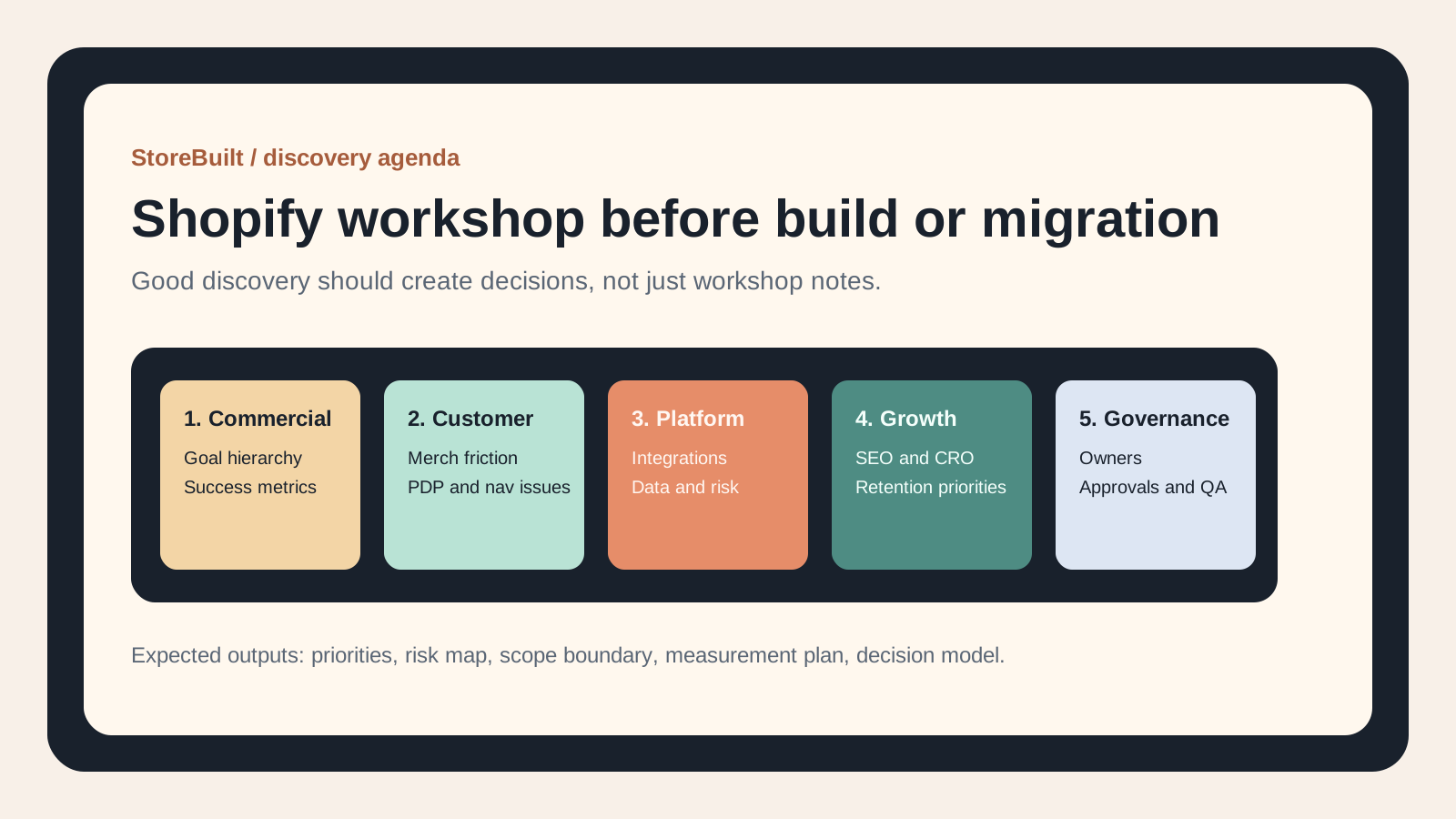
A strong discovery workshop should create usable answers in four areas:
- Commercial priorities.
- Operating constraints.
- Technical scope.
- Delivery governance.
That means the workshop should not end with abstract inspiration boards and a list of stakeholder opinions. It should end with enough clarity to make confident tradeoffs.
At a minimum, the team should leave with:
- a ranked list of business priorities
- a shared definition of launch or success metrics
- agreement on major constraints and non-negotiables
- initial view of integration and data dependencies
- a decision-making model for the project
If you cannot point to those outcomes, discovery probably did not do its job.
A practical agenda for UK ecommerce teams
The exact timing can vary, but this is the agenda structure we find most useful:
| Session block | Main objective | Example prompts |
|---|---|---|
| Commercial reality | Define what the business actually needs next | What is the growth bottleneck right now? What would make this project commercially successful? |
| Customer and merchandising | Clarify how customers discover, evaluate, and buy | Where does conversion friction appear? Which category or PDP issues are repeated? |
| Operations and platform | Map the systems that shape scope | Which tools own stock, fulfilment, reviews, CRM, and analytics? |
| SEO, CRO, and retention | Decide which growth layers must be built into scope | What must exist at launch versus after launch? |
| Governance and delivery | Set owners, decisions, and escalation paths | Who signs off what? What is the QA expectation? |
A good workshop is not just a list of questions. It is an enforced prioritisation exercise.
For example, many brands say all of these matter equally:
- premium UX
- fast launch
- no operational disruption
- lower ongoing costs
- improved conversion
In practice, tradeoffs appear immediately. If speed matters most, some customisation should wait. If operational risk is the main concern, migration sequencing may matter more than visual ambition. Discovery exists to make those tradeoffs explicit before the build starts.
That is also why the best workshops include the people who will live with the consequences, not only the people buying the project. Ecommerce leads, operations owners, merchandising voices, and technical stakeholders usually all need representation.
If your team needs this turned into a real scope and decision document, StoreBuilt can help run that process.
Workshop output table
By the end of discovery, you should expect these outputs.
| Output | Why it matters |
|---|---|
| Priority statement | Stops the project trying to solve ten problems at once |
| Delivery assumptions log | Makes hidden expectations visible early |
| Integration risk map | Prevents last-minute technical surprises |
| Launch-scope boundary | Separates critical work from later optimisation |
| Measurement plan | Confirms how success will be judged after launch |
| Governance model | Defines ownership, approvals, and escalation |
Buyers should be suspicious of discovery that produces only slideware. The output needs to be operationally useful. Your future design reviews, build tickets, QA scripts, and launch checklist should all trace back to it.
StoreBuilt client example
A UK retailer approached StoreBuilt for a redesign that initially sounded straightforward. Once we ran discovery, the real challenge became obvious: the visual refresh was not the core risk. The business had inconsistent merchandising logic, unclear migration priorities, and several unspoken assumptions about what the new theme would fix automatically.
Because those issues surfaced early, the project could be re-scoped around what mattered most. Some desirable features moved into phase two. Several launch-critical fixes moved up the list. That shift probably saved the team months of rework and frustration.
This is why good discovery feels more demanding than expected. It replaces comforting ambiguity with practical clarity.
High-intent AI search implementation layer
The AI-search version of this topic is not just “write more content”. A useful answer engine result needs a page that gives a direct answer, proves the claim, and shows the next operational step inside Shopify.
| Area | StoreBuilt implementation check |
|---|---|
| Primary intent | The page should map to shopify discovery workshop and one clear buyer or operator problem, not a vague traffic topic. |
| Shopify surface | Identify whether the work belongs on a collection, product page, theme section, checkout step, app workflow, email flow, or support process. |
| Proof | Add first-hand observations, product/category examples, screenshots, policy notes, review signals, or trustworthy external sources where they make the advice safer. |
| Internal route | Link the reader to the service most likely to solve the issue: Shopify migrations and replatforming. |
| Measurement | Check Search Console, analytics, assisted conversions, enquiry quality, and AI-response mentions after the update rather than judging success by pageviews alone. |
For this article, the useful research inputs are: Shopify Help documentation, StoreBuilt implementation patterns, UK ecommerce SERP intent, and common founder/operator questions. StoreBuilt would prioritise redirects, data migration, template parity, analytics continuity, launch QA, and post-launch monitoring before expanding into broader supporting content.
If this topic maps to a live store problem, review the related StoreBuilt service or Contact StoreBuilt with the store URL and the issue you want fixed.
Final StoreBuilt point of view
For UK ecommerce teams, a Shopify discovery workshop should not be treated as a pre-project nicety. It is part of the project. Done properly, it reduces delivery risk, speeds later decisions, and makes budget tradeoffs more defensible.
If an agency cannot explain exactly what discovery is meant to produce, the scoping risk is already visible. The best Shopify projects start with uncomfortable but useful clarity, because that is what makes the later work faster, safer, and more commercially relevant.