
What we have seen in Shopify CRO audits is this: cart abandonment is often treated as a messaging problem after it has already become a journey problem. The team asks whether the abandoned cart email needs a stronger discount. Usually, the better question is why the shopper reached cart without enough delivery confidence, product proof, payment trust, or urgency to complete.
Charle’s article library includes cart abandonment, CRO, customer segmentation, and ecommerce marketing topics because this is a live commercial problem for UK stores. StoreBuilt’s view is that recovery needs a system: reduce avoidable abandonment first, then recover the right customers without training everyone to wait for a discount.
If your Shopify store is losing high-intent sessions at cart or checkout, Contact StoreBuilt.
Table of contents
- Keyword decision and research inputs
- Why abandonment is not one problem
- The recovery system
- Abandonment diagnosis table
- StoreBuilt example
- 45-day recovery plan
- Final StoreBuilt point of view
Keyword decision and research inputs
Primary keyword: Shopify cart abandonment
Secondary keywords:
- cart abandonment recovery Shopify
- ecommerce cart abandonment UK
- Shopify checkout abandonment
- abandoned cart email Shopify
- Shopify CRO
Search intent: commercial problem-solving from store owners and ecommerce leads looking for conversion improvement.
Funnel stage: middle to bottom funnel.
Page type: CRO implementation guide.
Why StoreBuilt can realistically win this topic:
- The article connects abandonment to StoreBuilt’s CRO and UX optimisation, Klaviyo email and SMS retention, and Shopify support services.
- UK competitor content often explains abandonment causes but does not always connect prevention, recovery, margin, and measurement into one operating model.
- StoreBuilt can bring practical audit patterns from checkout, PDP, payment, delivery, and lifecycle work.
Research inputs used on July 1, 2026:
- Current SERP review for Shopify cart abandonment, ecommerce cart abandonment, and recovery-flow queries.
- Charle article hub review, including CRO, cart abandonment, segmentation, and ecommerce marketing content patterns.
- Official Shopify guidance around checkout, payments, automation, and commerce-channel direction.
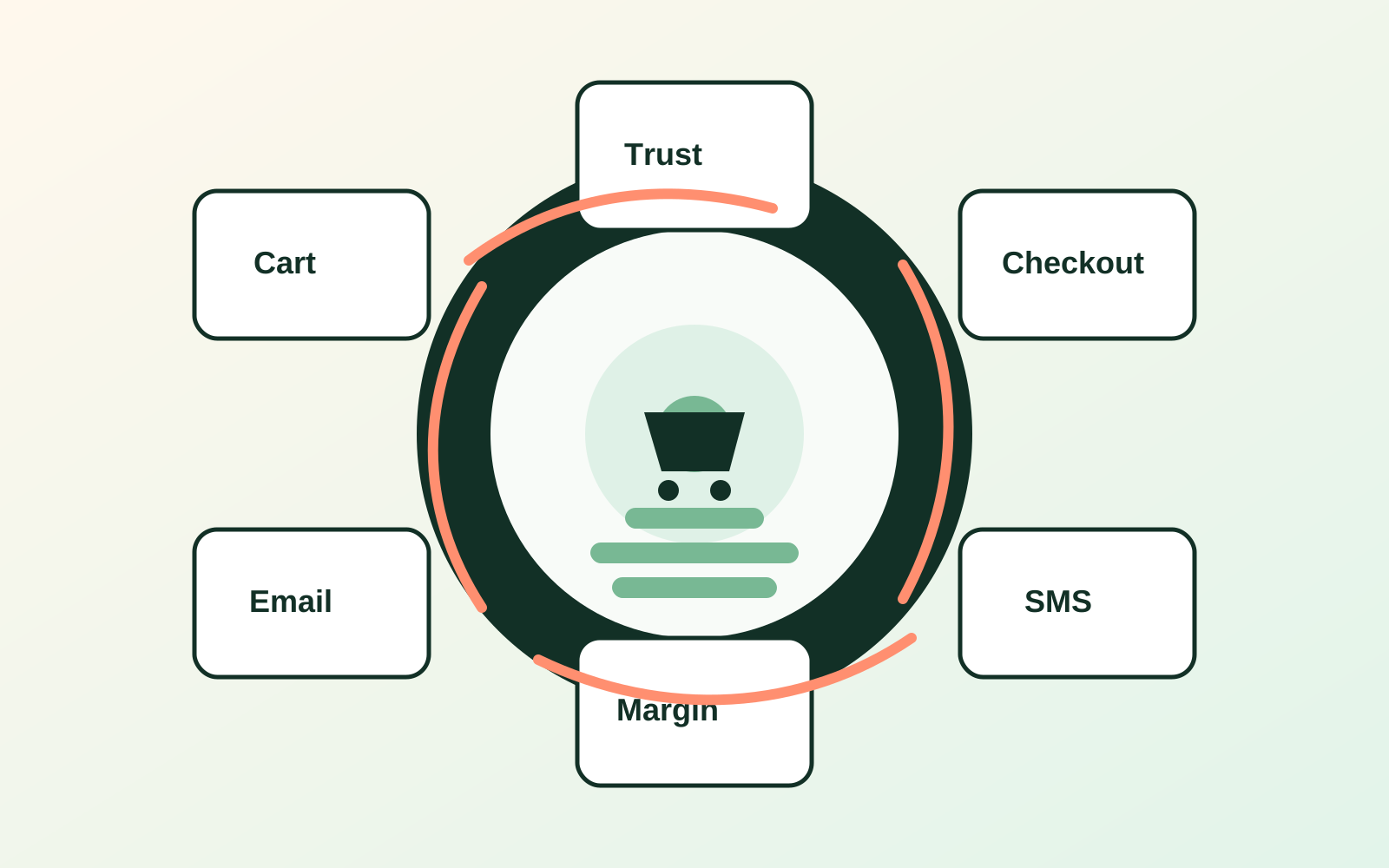
Why abandonment is not one problem
Cart abandonment can mean several different things:
- the shopper was browsing and never had strong purchase intent;
- delivery costs appeared too late;
- returns or sizing confidence was weak;
- payment options did not match the customer’s expectation;
- checkout asked for too much effort on mobile;
- a discount field triggered coupon hunting;
- stock, delivery, or subscription logic created uncertainty;
- the customer was interested but needed more time;
- a technical error blocked completion.
Those scenarios should not receive the same fix.
If the issue is delivery clarity, an email discount is a blunt instrument. If the issue is payment trust, a countdown timer will not help. If the issue is low-intent traffic, changing cart copy may only hide a media-quality problem.
The first job is diagnosis.
The recovery system
A stronger Shopify cart abandonment model has four layers.
1. Prevention before recovery
The highest-margin recovery is the abandonment that never happens.
Review the journey before cart:
- are delivery and returns clear on product pages?
- does the product page answer fit, sizing, compatibility, or usage questions?
- are reviews useful and close to the decision point?
- do collection pages help shoppers compare products?
- is the free shipping threshold visible before checkout?
- does the cart drawer confirm the right next action?
This is where CRO and SEO overlap. Better product data, clearer FAQs, and stronger comparison content can reduce hesitation before cart.
2. Checkout confidence
Shopify gives strong checkout foundations, but stores still create friction around it.
Check:
- wallet visibility;
- payment method fit for the UK audience;
- shipping method clarity;
- discount-code behaviour;
- address and form friction;
- delivery promise consistency;
- mobile layout and error handling;
- app or script conflicts near checkout entry.
For many brands, StoreBuilt would review checkout alongside Shopify checkout optimisation rather than treat abandonment as email-only work.
3. Recovery flow design
Abandoned cart flows should not be generic reminders.
A good flow uses:
- timing based on product consideration cycle;
- dynamic product context;
- delivery reassurance;
- returns or guarantee confidence;
- stock or deadline messaging only when truthful;
- margin-aware discount rules;
- clear exclusions for low-margin or already-discounted products;
- suppression when a customer has already bought.
Email and SMS should work together without becoming repetitive.
4. Measurement and margin control
Recovered revenue is not automatically profitable revenue.
Track:
- recovered revenue by channel;
- discount cost;
- unsubscribe rate;
- SMS cost;
- product category;
- customer segment;
- first-time versus returning customer;
- recovered order margin where possible;
- downstream repeat purchase.
The goal is not to maximise recovered orders at any cost. It is to recover the demand worth recovering.
Abandonment diagnosis table
| Signal | Likely issue | Better first action |
|---|---|---|
| High PDP exits before cart | Product doubts | Improve product proof, FAQs, size/fit, comparison, delivery clarity |
| High cart opens but low checkout starts | Cart confidence | Review shipping threshold, cart drawer, payment cues, promo logic |
| Checkout drop at payment | Payment mismatch or trust | Review wallets, BNPL fit, SCA messaging, error handling |
| Strong abandonment but weak email recovery | Flow quality | Improve timing, product context, objection handling, segmentation |
| High recovery only with discounts | Offer dependency | Test non-discount reassurance and margin-aware incentives |
| Abandonment spikes after releases | Technical issue | Review app changes, theme deployment, checkout-adjacent scripts |
StoreBuilt example
In one Shopify audit, the team expected abandoned cart email copy to be the problem because the flow generated little revenue. The emails were not excellent, but they were not the root cause.
The cart drawer showed a free shipping threshold, yet product pages did not explain delivery timing clearly. Customers were adding products, reaching cart, then opening shipping and returns pages in a separate tab. The issue was unresolved confidence before cart.
The more useful work was to move delivery reassurance upstream, improve product-page FAQs, tighten the cart drawer message, and then rewrite the recovery flow so it answered the remaining objections instead of simply reminding people to buy.
45-day recovery plan
| Period | Work | Output |
|---|---|---|
| Days 1-7 | Baseline review | Abandonment by device, source, product, cart value, and checkout step |
| Days 8-15 | Journey fixes | Product-page proof, delivery clarity, cart drawer, payment cues |
| Days 16-25 | Flow rebuild | Email/SMS timing, segmentation, copy, creative, discount rules |
| Days 26-35 | QA and launch | Event tracking, exclusions, mobile rendering, consent checks |
| Days 36-45 | Measure and refine | Recovery rate, margin, unsubscribe rate, repeat purchase impact |
This plan works best when it connects to wider Shopify CRO and retention work rather than a standalone email tweak.
High-intent AI search implementation layer
The AI-search version of this topic is not just “write more content”. A useful answer engine result needs a page that gives a direct answer, proves the claim, and shows the next operational step inside Shopify.
| Area | StoreBuilt implementation check |
|---|---|
| Primary intent | The page should map to Shopify cart abandonment and one clear buyer or operator problem, not a vague traffic topic. |
| Shopify surface | Identify whether the work belongs on a collection, product page, theme section, checkout step, app workflow, email flow, or support process. |
| Proof | Add first-hand observations, product/category examples, screenshots, policy notes, review signals, or trustworthy external sources where they make the advice safer. |
| Internal route | Link the reader to the service most likely to solve the issue: CRO and UX optimisation. |
| Measurement | Check Search Console, analytics, assisted conversions, enquiry quality, and AI-response mentions after the update rather than judging success by pageviews alone. |
For this article, the useful research inputs are: StoreBuilt CRO audit patterns, analytics QA checks, Shopify theme constraints, and buyer-intent SERP patterns. StoreBuilt would prioritise PDP hierarchy, cart friction, mobile merchandising, testing policy, analytics QA, and measured releases before expanding into broader supporting content.
If this topic maps to a live store problem, review the related StoreBuilt service or Contact StoreBuilt with the store URL and the issue you want fixed.
Final StoreBuilt point of view
Cart abandonment is not a single leak. It is a set of signals about trust, timing, product clarity, payment fit, and commercial intent.
StoreBuilt’s view is that UK Shopify teams should fix preventable hesitation before they increase recovery pressure. Then the abandoned cart system can do its real job: bring back high-intent customers with useful reassurance and sensible commercial rules.
If you want StoreBuilt to review your abandonment data and recovery journey, Contact StoreBuilt.