
What we have seen in early-stage discovery is this: teams often ask whether they need an ecommerce consultant or a Shopify agency when the real issue is sequencing. They might need both, but not at the same time and not for the same job.
If you want help deciding which model fits your stage, Contact StoreBuilt.
Table of contents
- Keyword decision and research inputs
- Quick answer: consultant vs agency
- What an ecommerce consultant is best for
- What a Shopify agency is best for
- When a hybrid model makes sense
- Decision table for UK ecommerce teams
- StoreBuilt example
- Final StoreBuilt point of view
Keyword decision and research inputs
Primary keyword: ecommerce consultant vs shopify agency
Secondary keywords:
- ecommerce consultant UK
- Shopify agency UK
- ecommerce strategy consultant
- Shopify migration partner
- ecommerce UK market agency choice
Search intent: evaluative and commercial.
Funnel stage: middle to bottom.
Page type: partner-choice guide.
Why StoreBuilt can realistically win this topic:
- The search intent maps closely to real shortlist conversations.
- Many buyers confuse strategic advisory work with execution capacity.
- StoreBuilt can frame the decision around workstreams, not vague role labels.
Research inputs used:
- Current SERP review around
ecommerce consultant,Shopify agency UK, and related selection queries. - Competitor content and service-page review across UK Shopify agencies and broader ecommerce consultancies.
- Public keyword-style modifier research around migration, strategy, CRO, support, and in-house vs external capacity.
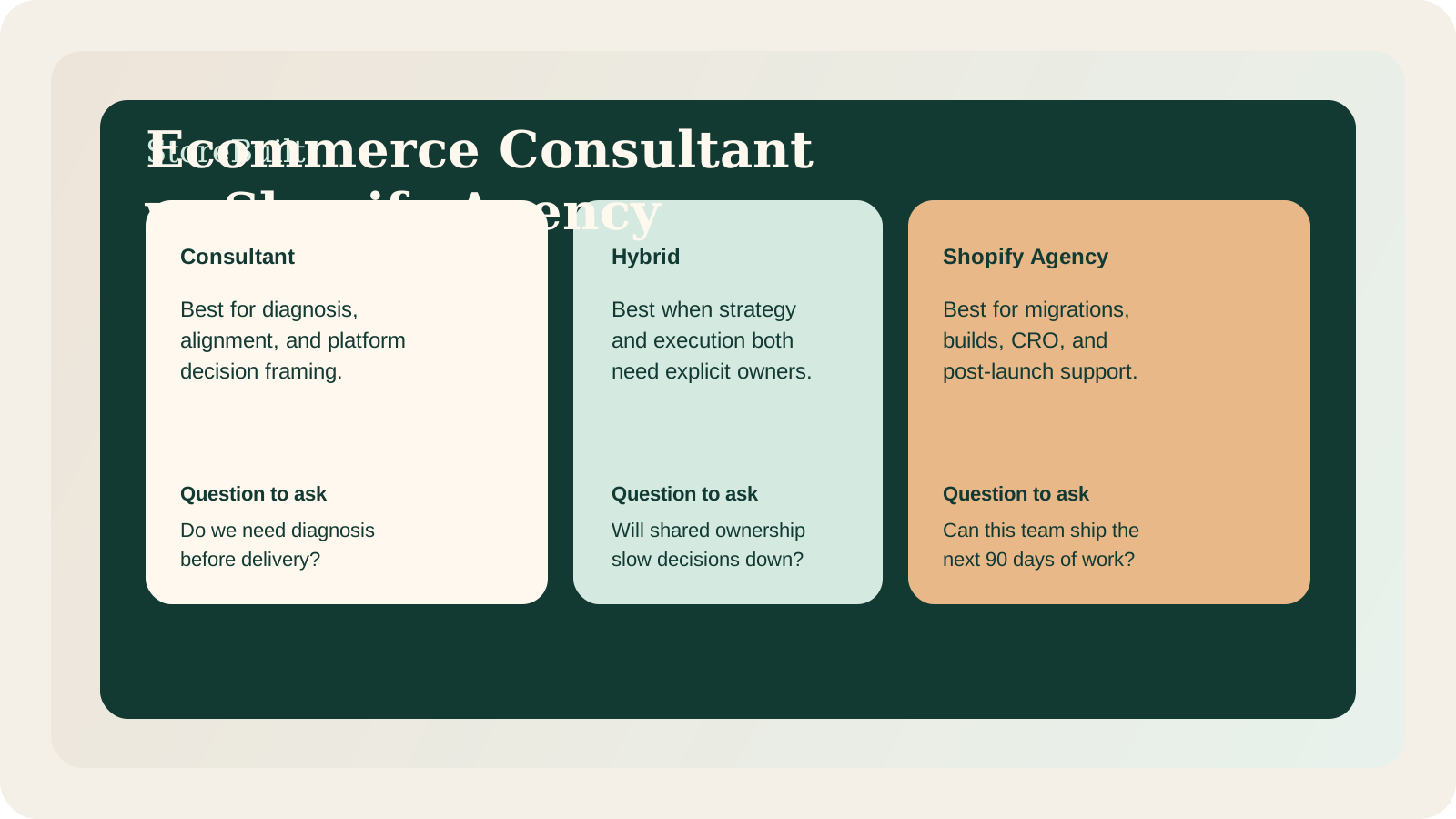
Quick answer: consultant vs agency
An ecommerce consultant is usually best when the first need is diagnosis, prioritisation, or stakeholder alignment.
A Shopify agency is usually best when the first need is execution across design, development, migration, CRO, SEO, or support.
The wrong choice is paying an agency to solve a strategy problem it has not properly diagnosed, or paying a consultant to define a roadmap with no credible path to delivery.
What an ecommerce consultant is best for
Consultants are typically strongest at framing decisions before large spend is committed.
Examples include:
- platform selection
- replatforming business case work
- ecommerce org design
- KPI and reporting structure
- tech-stack evaluation
- roadmap prioritisation before procurement
That work can be genuinely valuable, especially when leadership teams are not aligned yet.
But consultants are not always the best people to ship the work afterward.
| Consultant strength | Why it helps |
|---|---|
| Independent diagnosis | Reduces platform or vendor bias |
| Stakeholder alignment | Helps leadership make cleaner decisions |
| Roadmap prioritisation | Prevents budget from spreading too thin |
| Vendor selection support | Improves procurement quality |
If your core problem is that the business still does not agree on the problem, consulting is often the right first move.
What a Shopify agency is best for
A Shopify agency becomes more useful when decisions have already moved into delivery.
That usually means:
- migration planning
- theme and UX implementation
- app and systems integration
- SEO and redirect continuity
- CRO, retention, and post-launch support
- release management after go-live
This is where strategy-only advisory stops being enough. The project needs people who can make the storefront, systems, and team workflows function under real trading pressure.
In the ecommerce UK market, many brands do not need abstract digital transformation. They need a team that can stabilise the PDP, fix category structure, clean up the stack, and ship a better roadmap without derailing campaigns.
If that sounds closer to your reality, see StoreBuilt design and development support.
When a hybrid model makes sense
Hybrid is often the best answer when both of these are true:
- the business needs independent strategic clarity
- the business also needs strong Shopify execution fast
In that model, a consultant may help define scope, governance, and success criteria, while the Shopify agency handles implementation and ongoing optimisation.
The risk is duplication.
Hybrid only works when roles are explicit.
| Function | Better owner |
|---|---|
| Business-case and board-level framing | Consultant |
| Platform architecture and delivery scope | Shopify agency |
| Migration execution | Shopify agency |
| Ongoing CRO, SEO, and support | Shopify agency or internal hybrid |
| Quarterly governance review | Shared |
Without that separation, meetings multiply and accountability gets blurry.
Decision table for UK ecommerce teams
| Situation | Better fit |
|---|---|
| Leadership does not yet agree on the platform or growth problem | Consultant first |
| Platform choice is made and the store needs to ship | Shopify agency |
| Prior agency failed and the team needs recovery plus a rebuild | Shopify agency with diagnostic depth |
| Board wants independent challenge before committing six figures | Consultant or hybrid |
| Team needs long-term support after launch | Shopify agency or hybrid with clear owner |
That is the practical filter. Choose based on the first valuable job to be done, not the most impressive title.
Questions to ask before deciding
- Do we need diagnosis or execution first?
- Is there already internal alignment on the roadmap?
- Will someone own post-launch performance, not just launch?
- Are we buying specialist Shopify depth or broad advisory reassurance?
- Does the chosen model reduce decision friction or add another layer?
The cleaner the answers, the easier the vendor decision becomes.
StoreBuilt example
One UK ecommerce team initially believed they needed an external consultant because the board wanted more confidence before a platform move. After discovery, it became clear the main uncertainty sat in delivery risk, not board-level strategy.
The more useful answer was a Shopify specialist-led discovery and migration plan with enough commercial framing to align stakeholders. In other words, they did not need a separate strategic layer first. They needed sharper implementation clarity.
That distinction saved time and reduced procurement drag.
High-intent AI search implementation layer
The AI-search version of this topic is not just “write more content”. A useful answer engine result needs a page that gives a direct answer, proves the claim, and shows the next operational step inside Shopify.
| Area | StoreBuilt implementation check |
|---|---|
| Primary intent | The page should map to ecommerce consultant and one clear buyer or operator problem, not a vague traffic topic. |
| Shopify surface | Identify whether the work belongs on a collection, product page, theme section, checkout step, app workflow, email flow, or support process. |
| Proof | Add first-hand observations, product/category examples, screenshots, policy notes, review signals, or trustworthy external sources where they make the advice safer. |
| Internal route | Link the reader to the service most likely to solve the issue: Shopify store design and development. |
| Measurement | Check Search Console, analytics, assisted conversions, enquiry quality, and AI-response mentions after the update rather than judging success by pageviews alone. |
For this article, the useful research inputs are: Shopify Help documentation, StoreBuilt implementation patterns, UK ecommerce SERP intent, and common founder/operator questions. StoreBuilt would prioritise practical Shopify setup, theme structure, page hierarchy, product data, and launch-ready implementation before expanding into broader supporting content.
If this topic maps to a live store problem, review the related StoreBuilt service or Contact StoreBuilt with the store URL and the issue you want fixed.
Final StoreBuilt point of view
Consultants are valuable when the business needs diagnosis. Shopify agencies are valuable when the business needs execution. In the ecommerce UK market, the smartest teams separate those jobs clearly instead of paying one model to pretend it can do both equally well.