
What we have seen in B2B Shopify planning is this: wholesale projects fail when they are treated as a duplicate retail storefront with hidden prices. Trade buyers need faster reordering, account-specific clarity, payment confidence, stock visibility, and a buying journey that respects how their business purchases.
Charle and other UK Shopify agencies publish strong content around Shopify Plus, ecommerce growth, platform decisions, and agency selection. StoreBuilt’s useful angle is to make wholesale implementation concrete: accounts, price lists, trade content, operational ownership, and the reorder experience.
If wholesale is still being managed through email, spreadsheets, and manual invoice follow-up, Contact StoreBuilt.
Table of contents
- Keyword decision and research inputs
- Why Shopify wholesale is different from DTC
- The B2B operating model
- Wholesale feature priority table
- Trade content that helps buyers order
- Shopify Plus readiness
- An anonymous StoreBuilt example
- StoreBuilt point of view
Keyword decision and research inputs
| Decision | Direction |
|---|---|
| Primary keyword | Shopify wholesale ecommerce |
| Secondary keywords | Shopify B2B UK, Shopify Plus B2B, wholesale ecommerce UK, Shopify trade portal, B2B ecommerce pricing |
| Search intent | Understand how to run wholesale and B2B ecommerce on Shopify |
| Funnel stage | Bottom |
| Page type | Shopify B2B implementation guide |
| Why StoreBuilt can win | StoreBuilt connects account UX, pricing logic, reorder flows, trade content, Shopify Plus, integrations, and support workflows |
Research inputs included live SERP checks for Shopify wholesale and B2B ecommerce terms, Charle’s Shopify Plus and platform guide patterns, competitor signals from Swanky, Eastside Co, and UK Shopify agency comparison content, Shopify’s current positioning around commerce across online and offline sales, and a duplicate-risk pass against StoreBuilt’s existing B2B portal and Shopify Plus articles.
The chosen article supports the Shopify Plus and B2B service hub without cannibalising it. The blog answers the practical “how should we structure this?” question and links into the service page for delivery help.
Why Shopify wholesale is different from DTC
Retail customers usually buy for themselves. Wholesale buyers buy for a business. That changes the journey.
A trade buyer may need:
- account approval;
- negotiated pricing;
- VAT clarity;
- case packs or minimum order quantities;
- payment terms;
- purchase order references;
- fast reorder;
- downloadable product information;
- stock confidence;
- delivery scheduling;
- multiple staff users;
- invoice and fulfilment visibility.
If the wholesale journey copies DTC too closely, it creates friction. Trade buyers do not want to browse every campaign module or lifestyle story when they already know what they need. They want to place accurate orders quickly and understand exceptions clearly.
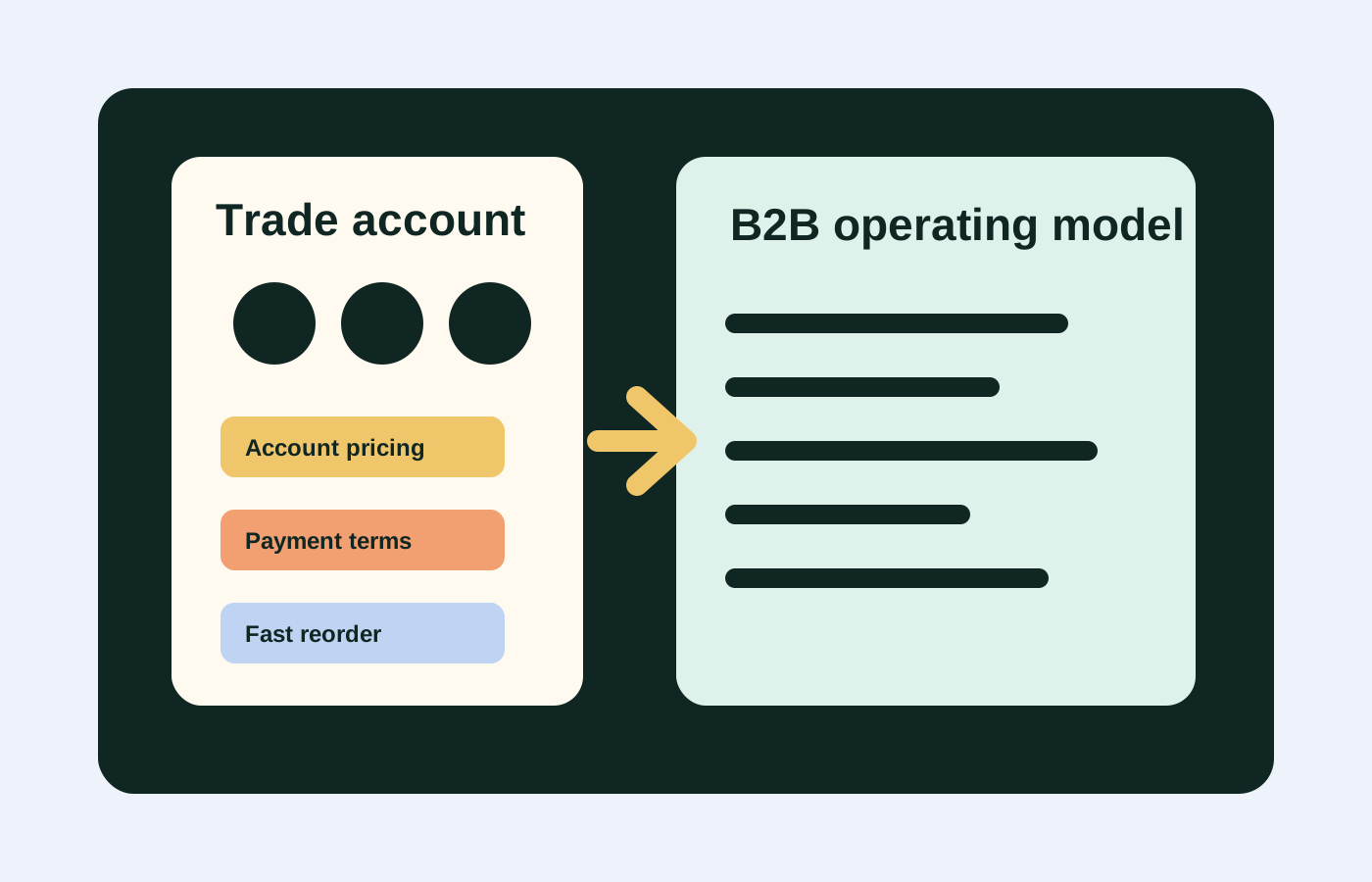
The B2B operating model
Before choosing apps or Shopify Plus features, define the operating model.
Customer groups
Not all trade customers are the same. Segment by retailer, distributor, hospitality, practitioner, salon, clinic, stockist, franchise, or international buyer where relevant.
Each group may need different pricing, minimums, payment rules, catalogue access, and content.
Catalogue access
Decide which products are available to trade buyers. Some products may be retail-only. Others may require case packs, trade descriptions, or restricted visibility.
Pricing logic
Pricing may be fixed trade discount, account-specific pricing, volume tiers, price lists, or negotiated terms. Keep it maintainable. If every customer needs a unique exception, the store becomes difficult to operate.
Payment terms
Some buyers pay by card. Others need invoice, net terms, bank transfer, or purchase order workflow. The payment experience should match the business risk and finance process.
Reorder journey
Wholesale success often depends on repeat ordering. Account pages, order history, saved lists, CSV upload, quick order forms, and back-in-stock flows can matter more than campaign design.
Operations
Wholesale ecommerce must connect to fulfilment, inventory, finance, customer service, and sales. A beautiful trade portal that creates manual back-office work is not a successful system.
StoreBuilt’s Shopify Plus and B2B service starts by mapping these commercial rules before implementation.
Wholesale feature priority table
| Feature | Why it matters | Priority signal |
|---|---|---|
| Company accounts | Lets multiple buyers operate under one business | Trade customers have staff or branches |
| Price lists | Shows correct trade pricing without manual quoting | Multiple customer tiers or negotiated rates |
| Minimum order rules | Protects margin and fulfilment efficiency | Low-value wholesale orders are common |
| Quick order | Speeds repeat purchasing | Buyers know SKUs or reorder frequently |
| Saved lists | Supports regular replenishment | Buyers repeat similar baskets |
| Payment terms | Matches business purchasing workflow | Invoices or PO references are required |
| Trade content | Reduces support and sales handholding | Buyers ask for specs, imagery, or guides |
| ERP handoff | Keeps orders, stock, and finance aligned | Manual processing is causing errors |
Trade content that helps buyers order
Wholesale content should be more functional than retail content. That does not mean ugly. It means useful.
Consider:
- product dimensions and pack information;
- case quantities;
- recommended retail price guidance where appropriate;
- merchandising notes;
- ingredients, materials, compliance, or safety data;
- downloadable line sheets;
- care instructions;
- product imagery access;
- stockist support;
- launch calendars;
- reorder recommendations;
- delivery and lead-time information.
Trade buyers are making commercial decisions. They need to know whether a product fits their customer base, storage, margin, merchandising, and replenishment model.
Shopify Plus readiness
Shopify Plus can be a strong fit for B2B and wholesale when the business needs more control over accounts, checkout, B2B features, integrations, and operational scale. But Plus should not be treated as the strategy by itself.
Before moving to Plus or expanding B2B features, ask:
- Are customer groups and pricing rules defined?
- Is product data good enough for trade buyers?
- Are payment terms approved by finance?
- Is fulfilment ready for wholesale order sizes?
- Do sales teams know how online orders affect their workflow?
- Is there a support process for account access and exceptions?
- Are integrations required now or in a later phase?
If those answers are unclear, fix the operating model first. Platform capability is only useful when the business rules are stable enough to implement.
An anonymous StoreBuilt example
In one wholesale planning review, the brand wanted a trade portal because manual ordering was slowing the team down. The deeper issue was that pricing rules lived across spreadsheets, account-manager memory, and email threads. Product information was also written for retail customers, not trade buyers.
The recommended first phase was commercial mapping: customer groups, price rules, minimums, payment terms, product data, and reorder journeys. Only after that did the technical scope become clear.
The lesson was simple: B2B ecommerce is not just a login wall. It is a clearer operating system for trade.
High-intent AI search implementation layer
The AI-search version of this topic is not just “write more content”. A useful answer engine result needs a page that gives a direct answer, proves the claim, and shows the next operational step inside Shopify.
| Area | StoreBuilt implementation check |
|---|---|
| Primary intent | The page should map to Shopify wholesale ecommerce and one clear buyer or operator problem, not a vague traffic topic. |
| Shopify surface | Identify whether the work belongs on a collection, product page, theme section, checkout step, app workflow, email flow, or support process. |
| Proof | Add first-hand observations, product/category examples, screenshots, policy notes, review signals, or trustworthy external sources where they make the advice safer. |
| Internal route | Link the reader to the service most likely to solve the issue: Shopify support, maintenance and audits. |
| Measurement | Check Search Console, analytics, assisted conversions, enquiry quality, and AI-response mentions after the update rather than judging success by pageviews alone. |
For this article, the useful research inputs are: StoreBuilt Shopify audits, UK ecommerce SERP intent, Shopify platform documentation, and AI-search measurement patterns. StoreBuilt would prioritise technical audits, roadmap priority, theme changes, app governance, reporting, and measured improvement before expanding into broader supporting content.
If this topic maps to a live store problem, review the related StoreBuilt service or Contact StoreBuilt with the store URL and the issue you want fixed.
StoreBuilt point of view
Shopify wholesale works when the customer account model and the operating model match.
StoreBuilt’s view is that UK brands should not start B2B projects by choosing a portal layout. Start with trade buyer behaviour, pricing rules, reorder frequency, fulfilment constraints, and finance requirements. Then build the Shopify experience around those realities.
For Shopify wholesale, B2B, or Plus implementation support, Contact StoreBuilt.