
What we have seen in Shopify Plus conversations is this: teams often ask whether Plus is “worth it” before they define what the business needs Plus to change. The answer is rarely hidden in one feature. It usually sits in the operating model: checkout control, B2B complexity, international markets, permissions, automation, app governance, release process, and support expectations.
Charle and other UK Shopify agencies publish around Shopify Plus benefits because the keyword has commercial weight. StoreBuilt’s angle is buyer-side and practical: Shopify Plus is valuable when it removes real operating constraints. It is expensive decoration when the store has not yet outgrown its current governance.
If your team is unsure whether Shopify Plus should be part of the next roadmap, Contact StoreBuilt.
Table of contents
- Keyword decision and research inputs
- The real benefits of Shopify Plus
- When Plus is not the next best move
- Shopify Plus decision table
- StoreBuilt example
- 60-day Plus readiness plan
- Final StoreBuilt point of view
Keyword decision and research inputs
Primary keyword: Shopify Plus benefits
Secondary keywords:
- Shopify Plus UK
- Shopify Plus agency UK
- Shopify Plus B2B
- Shopify Plus checkout extensibility
- Shopify Plus vs Advanced
Search intent: commercial evaluation. The reader is comparing Plus against current Shopify plans, alternative platforms, or agency recommendations.
Funnel stage: middle to bottom funnel.
Page type: buyer guide and readiness framework.
Why StoreBuilt can realistically win this topic:
- The topic maps directly to Shopify Plus and B2B and Shopify support, maintenance and audits.
- Competitor articles often list Plus features but underplay whether the team’s process is mature enough to benefit.
- StoreBuilt can position Plus around commercial operating needs, not badge value.
Research inputs used on July 1, 2026:
- Current SERP review around Shopify Plus benefits, Plus UK, Plus B2B, and Plus vs Advanced intent.
- Charle article hub review and UK Shopify agency competitor positioning.
- Official Shopify platform direction reviewed for checkout, B2B, Markets, and AI commerce context.
The real benefits of Shopify Plus
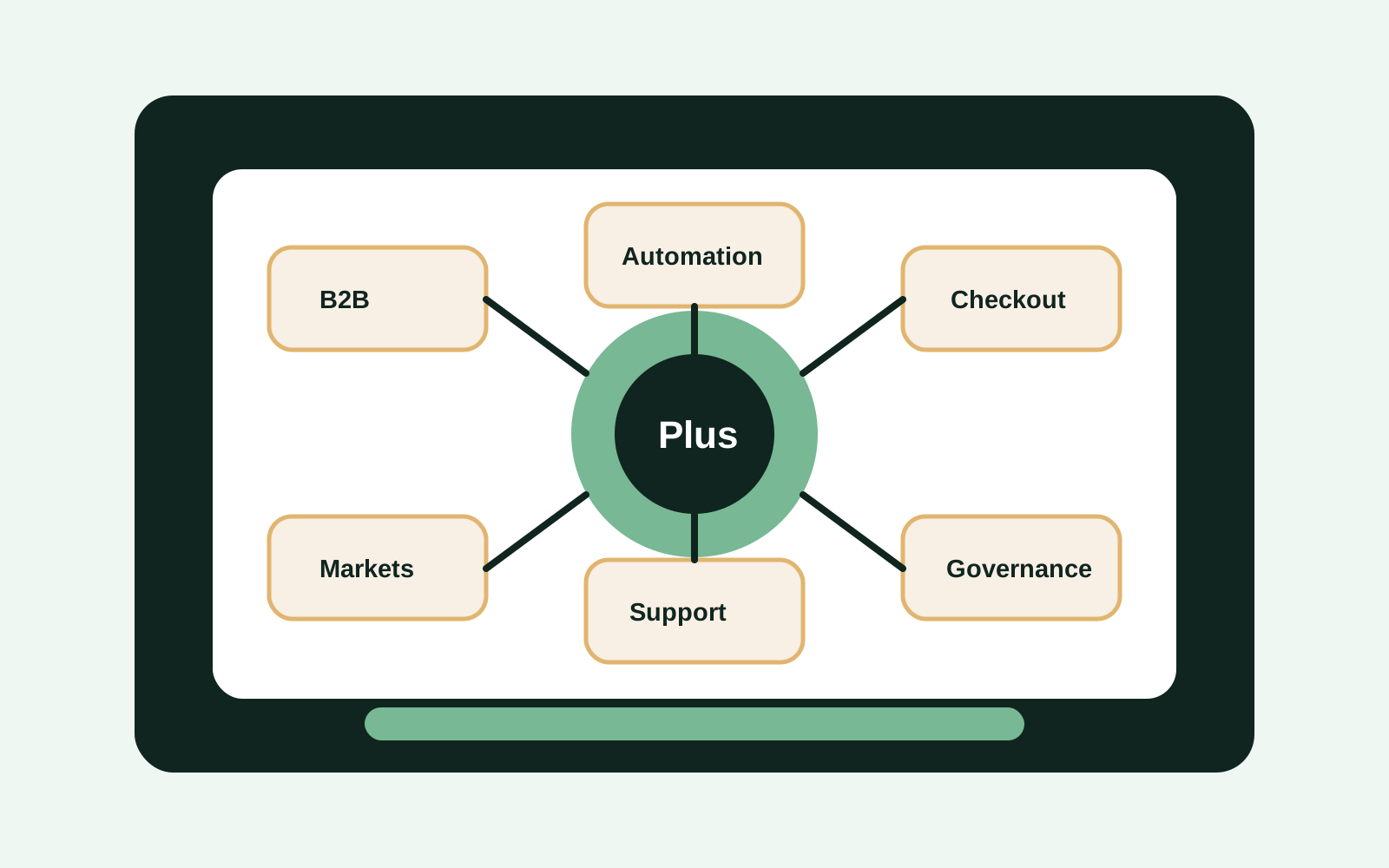
Shopify Plus is most useful when a brand has outgrown simple store management. The benefits usually matter in six areas.
The mistake is evaluating those benefits as a feature checklist. A feature only matters if the team has a use case, an owner, and enough operational maturity to use it without adding new complexity. Plus can make a good operating model stronger, but it cannot replace missing process discipline.
For that reason, StoreBuilt usually starts a Plus conversation with constraints. What is too slow? What is too manual? What is too risky? Which customer journey cannot be served properly on the current setup? Which team is waiting on developer capacity too often? The answers are more useful than a generic list of Plus capabilities.
1. Checkout and conversion control
For high-volume stores, checkout changes can have significant commercial impact. Plus can support deeper checkout customisation and extensibility where the use case justifies it.
That does not mean every store should customise checkout heavily. The best checkout work is disciplined: trust cues, payment fit, shipping clarity, B2B rules, and analytics quality should improve without creating fragility.
2. B2B and wholesale capability
Shopify Plus becomes more compelling when a brand needs account-based buying:
- company profiles;
- trade pricing;
- payment terms;
- customer-specific catalogues;
- reordering;
- sales rep workflows;
- DTC and B2B coexistence.
This is why Plus often belongs in a wider Shopify Plus and B2B conversation rather than a pricing comparison.
3. International and multi-market growth
UK brands expanding into Europe, the US, GCC, or other markets need more than translated copy. They need payment, duties, tax, delivery, content, inventory, and merchandising decisions that can be operated reliably.
Plus can help, but only if the team has a market operating model.
4. Automation and operational governance
As stores scale, manual work becomes expensive. Plus-level thinking should include:
- release governance;
- permissions;
- workflow ownership;
- fraud and order review;
- merchandising operations;
- app procurement;
- support escalation;
- reporting routines.
The benefit is not “automation” in the abstract. It is fewer avoidable mistakes and faster controlled execution.
5. Support, partner ecosystem, and enterprise readiness
Plus can give larger teams a stronger platform relationship and a more enterprise-ready ecosystem. But the agency, internal team, and app stack still matter. Plus does not automatically create clean architecture or better decision-making.
6. Strategic headroom
The strongest reason to move to Plus is headroom. If the business has clear growth constraints around checkout, B2B, markets, operations, or governance, Plus can reduce friction before the constraint becomes a crisis.
When Plus is not the next best move
Shopify Plus is not always the right next step.
It may be premature if:
- the store has unresolved product data issues;
- app bloat is already hurting performance;
- the team lacks ownership over CRO, SEO, and retention;
- international demand is not yet validated;
- B2B requirements are vague;
- checkout changes are speculative;
- the current theme is hard to govern;
- the brand needs a clearer roadmap before more platform capability.
In those cases, a free Shopify audit or support sprint may create more value before the business commits to Plus.
There is also a timing question. Some brands are directionally right for Plus, but not ready this quarter. They may need to improve the theme, clean customer and product data, document wholesale rules, or reduce app overlap first. That preparation is not a delay tactic. It makes the Plus move more valuable because the business arrives with clearer use cases.
The most useful Plus roadmap separates foundation work from platform-upgrade work. Foundation work improves the store whether the team upgrades or not. Platform-upgrade work only matters if the additional capability will be used. Keeping those two lists separate protects budget and makes the decision easier for founders, ecommerce leads, and finance teams.
Shopify Plus decision table
| Business need | Plus can help when | Fix first if |
|---|---|---|
| Checkout control | There is proven revenue impact or B2B logic | The team only wants cosmetic checkout changes |
| B2B | Trade accounts, pricing, terms, and catalogues are defined | Wholesale process is still unclear |
| International growth | Markets have validated demand and operational owners | Localisation is only a vague ambition |
| Automation | Repeated manual work creates errors or delay | Basic process ownership is missing |
| Permissions and governance | More people need controlled access | The team has not documented roles |
| Support and scale | Traffic, releases, and complexity justify stronger platform support | Current issues are mostly theme or app hygiene |
StoreBuilt example
In one Plus-readiness discussion, the brand initially framed the decision as a cost question. The team wanted to know whether the monthly fee was justified. The deeper review showed that the strongest Plus argument was not traffic volume. It was operational complexity: B2B trade pricing, market expansion, checkout messaging, and too many manual processes around launches.
The recommendation was staged. First, clean product data and theme governance. Second, define B2B account rules. Third, model international market requirements. Only then could Plus be assessed against real operating needs.
That avoided a common mistake: paying for headroom before the team knows how it will use it.
The same review also exposed where Plus would not help immediately. Product data still needed cleanup, app ownership was unclear, and reporting definitions were inconsistent across the trading and finance teams. Those fixes were not glamorous, but they made the future Plus decision sharper because the business could separate platform constraints from process debt.
60-day Plus readiness plan
| Period | Work | Output |
|---|---|---|
| Days 1-10 | Constraint review | Where current Shopify setup blocks growth |
| Days 11-20 | Commercial modelling | Plus cost against B2B, checkout, market, and operations value |
| Days 21-35 | Technical readiness | Theme, apps, product data, integrations, analytics, permissions |
| Days 36-45 | Operating model | Owners for B2B, markets, releases, support, automation |
| Days 46-60 | Decision and roadmap | Move to Plus, defer, or fix foundations first |
High-intent AI search implementation layer
The AI-search version of this topic is not just “write more content”. A useful answer engine result needs a page that gives a direct answer, proves the claim, and shows the next operational step inside Shopify.
| Area | StoreBuilt implementation check |
|---|---|
| Primary intent | The page should map to Shopify Plus benefits and one clear buyer or operator problem, not a vague traffic topic. |
| Shopify surface | Identify whether the work belongs on a collection, product page, theme section, checkout step, app workflow, email flow, or support process. |
| Proof | Add first-hand observations, product/category examples, screenshots, policy notes, review signals, or trustworthy external sources where they make the advice safer. |
| Internal route | Link the reader to the service most likely to solve the issue: Shopify Plus and B2B. |
| Measurement | Check Search Console, analytics, assisted conversions, enquiry quality, and AI-response mentions after the update rather than judging success by pageviews alone. |
For this article, the useful research inputs are: StoreBuilt Shopify audits, UK ecommerce SERP intent, Shopify platform documentation, and AI-search measurement patterns. StoreBuilt would prioritise company accounts, price lists, catalogues, net terms, wholesale UX, and B2B operating controls before expanding into broader supporting content.
If this topic maps to a live store problem, review the related StoreBuilt service or Contact StoreBuilt with the store URL and the issue you want fixed.
Final StoreBuilt point of view
Shopify Plus is valuable when the business can name the constraint it removes. It is not valuable because the brand wants to look bigger.
StoreBuilt’s view is that UK ecommerce teams should assess Plus through operating reality: checkout, B2B, international growth, governance, automation, support, and delivery speed. If those needs are real and owned, Plus can be a strong platform move. If they are vague, fix the foundations first.
If you want StoreBuilt to review Shopify Plus readiness for your store, Contact StoreBuilt.