
What we have seen in Shopify builds and audits is this: ecommerce teams often create video for channels, not for decisions. A paid social video is produced for attention. A founder video is produced for brand. A product reel is produced for Instagram. Then the Shopify store is left with static product pages that do not use that content to answer buying questions.
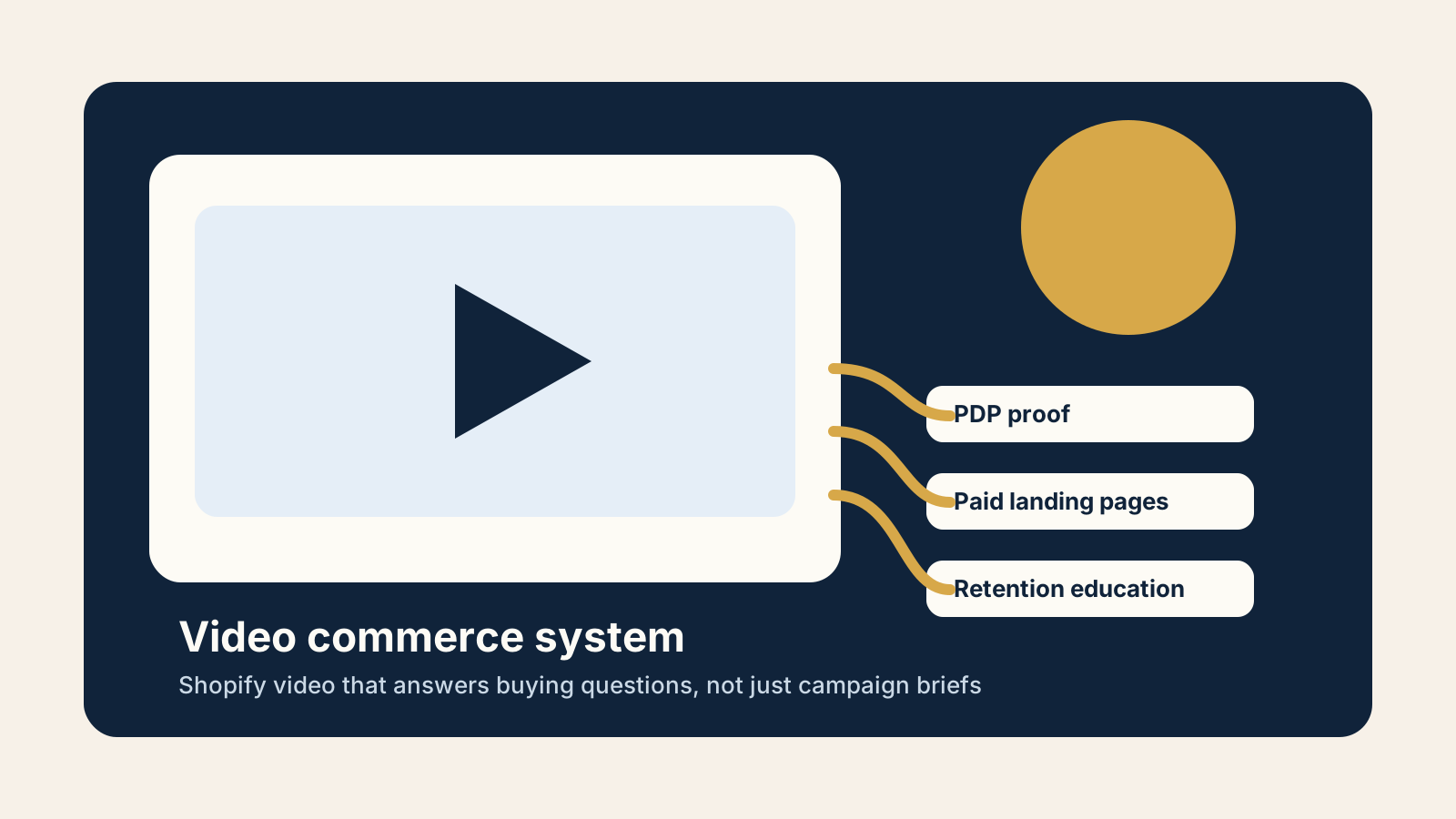
Charle’s article library includes ecommerce marketing, video ads, CRO, and Shopify growth topics, which reflects a real market signal: UK brands know video matters. StoreBuilt’s view is that the stronger opportunity is not “make more videos”. It is to design a video commerce system that supports product understanding, trust, SEO, landing-page conversion, and retention.
If your Shopify content is scattered across social channels but not improving the store journey, Contact StoreBuilt.
Table of contents
- Keyword decision and research inputs
- Where video actually helps ecommerce conversion
- The Shopify video content map
- Performance and implementation rules
- Video commerce planning table
- An anonymous StoreBuilt example
- StoreBuilt point of view
Keyword decision and research inputs
| Decision | Direction |
|---|---|
| Primary keyword | Shopify video commerce |
| Secondary keywords | ecommerce video strategy, Shopify product video, ecommerce UK market, PDP video, ecommerce marketing |
| Search intent | Understand how to use video across Shopify product, landing, and marketing journeys |
| Funnel stage | Middle |
| Page type | Ecommerce content and CRO implementation guide |
| Why StoreBuilt can win | StoreBuilt connects storefront architecture, product pages, content operations, paid landing pages, and conversion measurement |
Research inputs included current SERP and competitor patterns around ecommerce video ads, Shopify product-page optimisation, Charle’s ecommerce marketing and CRO article themes, Shopify storefront media documentation, and a local duplicate-risk pass against StoreBuilt’s product page, landing page, CRO, and content-system articles.
Where video actually helps ecommerce conversion
Video is not automatically better than photography or written content. It helps when it reduces uncertainty. For Shopify brands, that usually means product scale, texture, fit, assembly, use, transformation, setup, ingredient explanation, founder trust, expert demonstration, customer proof, or operational reassurance.
For a fashion brand, video can show drape and movement. For home interiors, it can show scale in a room. For beauty and wellness, it can show routine order and texture. For food and drink, it can show preparation, serving, gifting, or quality cues. For B2B ecommerce, it can show installation, compatibility, pack size, or trade workflow.
The mistake is to place all video in one homepage module. Most conversion questions happen deeper in the journey. A shopper on a PDP wants proof that this product fits their use case. A shopper on a collection page may need help choosing between ranges. A shopper from paid social needs continuity between the advert and the landing page.
The Shopify video content map
Product-page video
PDP video should answer buying questions, not simply decorate the media gallery. The best product videos are short, specific, and placed near the decision they support.
Useful PDP video types include:
- product-in-use demonstrations
- before-and-after or transformation clips where appropriate
- sizing, scale, fit, or texture views
- founder or expert explanations
- care, setup, assembly, or compatibility guidance
- customer-proof or review-led snippets
If video hides critical information behind slow-loading media, it can harm the page. The written content still matters. Search engines, AI answers, accessibility tools, and skim-reading shoppers need clear text alongside video.
Collection and comparison video
Collection pages can use video to explain a range or buying system. This is especially helpful where the product set is not self-explanatory. A short “how to choose” module can support filters, badges, and internal links to comparison pages.
This works well for gifting, skincare routines, supplements, furniture ranges, sports equipment, technical accessories, and B2B product families.
Campaign landing pages
Paid traffic often underperforms when the landing page has no relationship to the creative. If a Meta or TikTok ad shows a specific problem, testimonial, founder story, or product demonstration, the Shopify landing page should continue that thread.
That does not mean embedding every ad. It means building reusable landing-page sections for proof, product explanation, comparison, offer clarity, delivery, reviews, and FAQs. StoreBuilt’s Shopify store design and development service often includes this kind of merchant-editable section architecture.
SEO and long-form content
Video can support SEO when the surrounding page gives Google and customers enough context. A buying guide with embedded demonstrations, transcripts, structured headings, and internal product links is stronger than a silent embed on a thin page.
For ecommerce SEO, the page still needs query intent, useful copy, product routes, and internal links. Video is evidence and explanation, not a replacement for page architecture.
Retention and post-purchase
Video should not stop at acquisition. Post-purchase education can reduce avoidable returns, support tickets, and poor first-use experiences. That includes setup instructions, care guidance, routine building, reorder prompts, and product pairing education.
Performance and implementation rules
Shopify video can slow a store if implemented carelessly. Avoid loading heavy video by default across every page. Use thumbnails, lazy loading, compressed assets, and third-party embeds only where they do not compromise Core Web Vitals.
Do not autoplay sound. Do not rely on video alone for important claims. Add captions or visible text summaries. Keep mobile usability central because much of the ecommerce UK market researches and buys on phones.
Measurement also matters. Track whether video modules affect product clicks, add-to-cart rate, scroll depth, return rate, support contacts, and repeat purchase behaviour. Do not judge video only by views.
Video commerce planning table
| Journey point | Best video use | Shopify implementation | Measurement |
|---|---|---|---|
| PDP | Demonstrate product fit, use, scale, or texture | Media gallery, section block, or explainer module | Add-to-cart, variant selection, support questions |
| Collection | Explain range differences | Editorial module above or within product grid | Product clicks, filter use, comparison-page visits |
| Landing page | Continue paid creative promise | Reusable campaign template sections | Conversion rate, bounce, assisted revenue |
| Blog or guide | Support education and SEO | Embedded video with transcript and product routes | Organic engagement, internal clicks |
| Post-purchase | Reduce confusion and repeat support | Email, account area, QR route, support page | Return reasons, ticket volume, repeat purchase |
An anonymous StoreBuilt example
In one StoreBuilt review, a brand had strong social video content but weak product-page conversion. The videos lived on Instagram and ads, while the Shopify PDPs used static imagery and generic descriptions. Customers still asked basic questions about size, use, and what made one product different from another.
The useful work was not commissioning a large production package. It was mapping existing video assets to the right store moments, adding short product-specific clips, creating clearer copy beside the videos, and building landing-page sections that could be reused for campaigns.
The result was a more coherent buying journey: the advert introduced the problem, the landing page explained the offer, the PDP answered product questions, and post-purchase content supported first use.
High-intent AI search implementation layer
The AI-search version of this topic is not just “write more content”. A useful answer engine result needs a page that gives a direct answer, proves the claim, and shows the next operational step inside Shopify.
| Area | StoreBuilt implementation check |
|---|---|
| Primary intent | The page should map to Shopify video commerce and one clear buyer or operator problem, not a vague traffic topic. |
| Shopify surface | Identify whether the work belongs on a collection, product page, theme section, checkout step, app workflow, email flow, or support process. |
| Proof | Add first-hand observations, product/category examples, screenshots, policy notes, review signals, or trustworthy external sources where they make the advice safer. |
| Internal route | Link the reader to the service most likely to solve the issue: CRO and UX optimisation. |
| Measurement | Check Search Console, analytics, assisted conversions, enquiry quality, and AI-response mentions after the update rather than judging success by pageviews alone. |
For this article, the useful research inputs are: Shopify Help documentation, StoreBuilt implementation patterns, UK ecommerce SERP intent, and common founder/operator questions. StoreBuilt would prioritise PDP hierarchy, cart friction, mobile merchandising, testing policy, analytics QA, and measured releases before expanding into broader supporting content.
If this topic maps to a live store problem, review the related StoreBuilt service or Contact StoreBuilt with the store URL and the issue you want fixed.
StoreBuilt point of view
Video commerce works when it is part of the Shopify operating system, not a folder of creative assets.
StoreBuilt’s view is that UK ecommerce brands should plan video around customer uncertainty. If the video helps shoppers choose, trust, use, compare, or reorder, it deserves a place in the store journey. If it only repeats a generic brand mood, it probably belongs in the campaign archive, not the PDP.
For a Shopify video commerce audit or landing-page section plan, Contact StoreBuilt.