
What we have seen in UK ecommerce agency scoping is this: pricing confusion usually comes from mixing very different Shopify project types into one budget conversation. A redesign, a migration, a CRO sprint, and a Shopify Plus rollout are not priced the same because they do not carry the same delivery risk.
If you want a sharper scope before collecting proposals, Contact StoreBuilt.
Table of contents
- Keyword decision and research inputs
- Why Shopify agency pricing varies so much
- Typical UK budget bands
- What actually changes the quote
- Budget table by project type
- How to compare proposals without guessing
- StoreBuilt example
- Final StoreBuilt point of view
Keyword decision and research inputs
Primary keyword: shopify agency pricing uk
Secondary keywords:
- Shopify agency cost UK
- ecommerce agency pricing UK
- Shopify website cost UK
- Shopify migration cost UK
Search intent: commercial evaluation.
Funnel stage: middle to bottom.
Page type: pricing guide.
Why StoreBuilt can realistically win this topic:
- Searchers here are close to writing a brief or requesting proposals.
- StoreBuilt can explain pricing through workstreams and delivery risk, not generic package tables.
- Many agency pages stay vague on scope drivers, which creates a gap for a more practical guide.
Research inputs used:
- Current SERP patterns for pricing and cost queries around Shopify agencies in the UK.
- UK Shopify competitor review across Charle, Swanky, Eastside Co, Superco, We Make Websites, and Fourmeta.
- Public pricing-intent query modifiers across build, redesign, migration, Shopify Plus, support, and CRO terms.
Why Shopify agency pricing varies so much
Pricing varies because Shopify projects vary in hidden complexity.
Two stores can both say “we need a new Shopify site” while having completely different requirements:
- one may need a clean theme-led launch with simple catalogue structure
- the other may need data migration, redirect planning, subscriptions, B2B pricing, ERP integration, multiple markets, and custom merchandising logic
Those are not the same project even if both start with a homepage redesign discussion.
In the UK market, Shopify agency pricing is usually shaped by four factors:
- strategic complexity
- technical complexity
- operational risk
- post-launch involvement
This is why cheap headline quotes often become expensive projects. If the proposal has not surfaced the real work, the cost usually appears later as change requests, launch delays, or post-launch fixes.
Typical UK budget bands
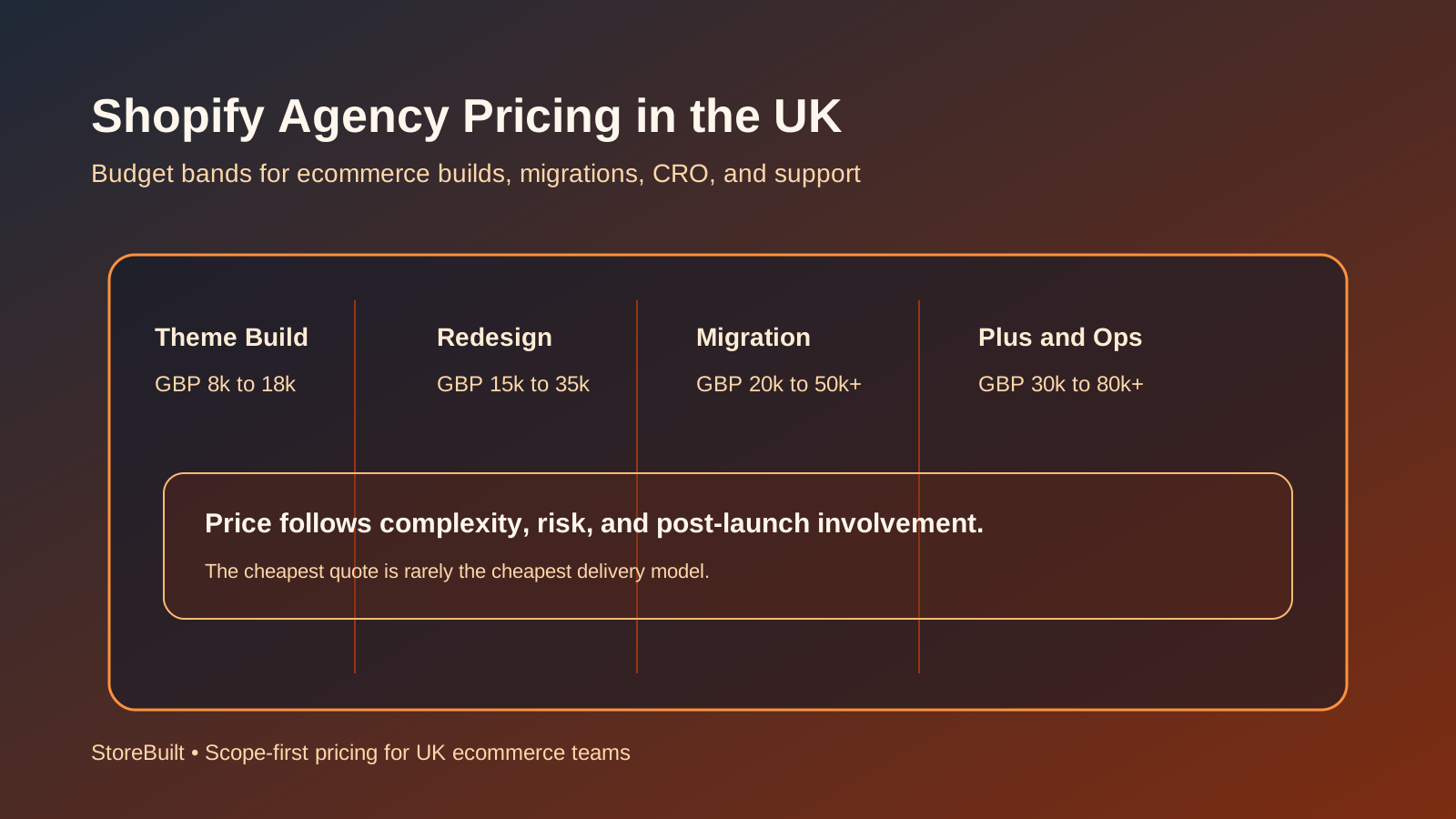
The numbers below are directional, not universal. They reflect how project shape tends to influence pricing, not a fixed tariff.
| Project type | Typical scope | Indicative budget band |
|---|---|---|
| Theme-led Shopify build | Smaller catalogue, lean content, lower integration complexity | GBP 8k to GBP 18k |
| Mid-market redesign | UX, content structure, stronger merchandising, app rationalisation | GBP 15k to GBP 35k |
| Migration and replatforming | Redirects, data mapping, SEO continuity, QA, launch planning | GBP 20k to GBP 50k+ |
| Shopify Plus or complex ops build | Multi-market, B2B, subscriptions, advanced integrations | GBP 30k to GBP 80k+ |
| Ongoing support or growth retainer | Prioritised roadmap, CRO, fixes, iterations, technical support | GBP 2k to GBP 8k+ per month |
These numbers move fast when complexity stacks. A fashion store with simple design requirements may be cheaper than a lower-volume business with a difficult data model and several operational edge cases.
What actually changes the quote
The strongest pricing conversations break the scope into workstreams.
Common quote drivers:
- number of templates and section variants
- collection and PDP UX depth
- migration complexity and content mapping
- redirect planning and SEO continuity
- number of apps and third-party integrations
- subscriptions, bundles, B2B, or multi-currency needs
- stakeholder count and approval complexity
- QA depth and launch support expectations
This is one area where reading competitor positioning is useful. UK agencies often market similar outcomes, but the commercial difference usually sits in how deeply they handle migrations, growth iteration, international complexity, or post-launch support.
If your project includes platform risk as well as design work, see our migration and replatforming service.
Budget table by project type
| Scope question | Low complexity | Medium complexity | Higher complexity |
|---|---|---|---|
| Catalogue structure | Straightforward products | Some variants and filters | Deep catalogue, merchandising, or fitment logic |
| Content migration | Minimal | Moderate blog and landing content | Large archive and SEO-sensitive mapping |
| Integrations | Few | Standard ecommerce stack | ERP, ESP, subscriptions, B2B, or custom workflows |
| QA and launch | Standard | Multi-stakeholder sign-off | Risk-heavy launch with rollback planning |
| Post-launch model | Handover only | Sprint support | Ongoing retainer and optimisation roadmap |
Budgeting works better when the team asks, “Which of these are we actually buying?” instead of “What does a Shopify website cost?”
How to compare proposals without guessing
A cheaper proposal is only cheaper if it covers the same outcome.
Use this comparison checklist:
- Does the quote define what is included in discovery?
- Are redirects, SEO continuity, analytics, and QA named explicitly?
- Is post-launch support included or separate?
- Are content entry, app setup, and integration work clearly scoped?
- Who owns merchant training and handover?
If one proposal looks dramatically lower, the missing cost usually sits in one of those gaps.
For brands in the ecommerce UK market, the biggest commercial mistake is not “overspending.” It is buying a low-clarity scope that creates hidden cost after launch.
StoreBuilt example
One ecommerce team came to us with a proposal set that ranged from low five figures to more than double that amount. At first glance, the pricing looked inconsistent. After reviewing the documents, the issue was simple: the lowest quote had priced a redesign, while the higher-scoped proposals were pricing a redesign plus migration governance, redirect planning, data QA, and a support runway.
Once the project was rewritten into comparable workstreams, the budget conversation became realistic and the team could judge value instead of reacting to sticker price.
What to budget for after launch
The most underestimated cost line is what happens after the new store goes live.
Even strong launches usually need:
- conversion iteration
- search landing page expansion
- merchandising changes
- theme tuning
- app cleanup
- seasonal campaign work
- bug fixing and support
That is why a support or growth retainer can make more sense than trying to over-build everything into phase one. If the roadmap matters as much as launch, review our Shopify support and audit service.
High-intent AI search implementation layer
The AI-search version of this topic is not just “write more content”. A useful answer engine result needs a page that gives a direct answer, proves the claim, and shows the next operational step inside Shopify.
| Area | StoreBuilt implementation check |
|---|---|
| Primary intent | The page should map to Shopify agency pricing and one clear buyer or operator problem, not a vague traffic topic. |
| Shopify surface | Identify whether the work belongs on a collection, product page, theme section, checkout step, app workflow, email flow, or support process. |
| Proof | Add first-hand observations, product/category examples, screenshots, policy notes, review signals, or trustworthy external sources where they make the advice safer. |
| Internal route | Link the reader to the service most likely to solve the issue: Shopify support, maintenance and audits. |
| Measurement | Check Search Console, analytics, assisted conversions, enquiry quality, and AI-response mentions after the update rather than judging success by pageviews alone. |
For this article, the useful research inputs are: Shopify Help documentation, StoreBuilt implementation patterns, UK ecommerce SERP intent, and common founder/operator questions. StoreBuilt would prioritise technical audits, roadmap priority, theme changes, app governance, reporting, and measured improvement before expanding into broader supporting content.
If this topic maps to a live store problem, review the related StoreBuilt service or Contact StoreBuilt with the store URL and the issue you want fixed.
Final StoreBuilt point of view
The right Shopify budget is not the cheapest acceptable quote. It is the budget that matches real project risk, protects launch quality, and leaves the business with a store the team can actually operate after go-live.