
What we have seen across Shopify audits, rescue projects, and discovery calls is this: many UK ecommerce teams start looking for a Shopify agency before they have agreed internally on what problem they are trying to solve. That usually leads to the wrong shortlist.
If you want a senior view on scope, platform fit, or agency selection, Contact StoreBuilt.
Table of contents
- Keyword decision and research inputs
- What a Shopify agency actually does
- When a UK ecommerce brand usually needs one
- What good agencies do differently
- How to assess UK Shopify agency fit
- Agency model comparison table
- StoreBuilt example
- Final StoreBuilt point of view
Keyword decision and research inputs
Primary keyword: what is a shopify agency
Secondary keywords:
- Shopify agency UK
- ecommerce agency UK
- what does a Shopify agency do
- UK ecommerce Shopify partner
Search intent: explanatory and evaluative.
Funnel stage: upper-middle.
Page type: commercial educational guide.
Why StoreBuilt can realistically win this topic:
- The query is broad, but buyers quickly move into evaluation mode.
- StoreBuilt can connect the definition to live delivery realities instead of writing a generic glossary page.
- UK searchers often want to understand the difference between a specialist Shopify agency and a wider ecommerce agency.
Research inputs used:
- Current SERP intent patterns around “what is a Shopify agency”, “Shopify agency UK”, and related comparison modifiers.
- Competitor content review across Charle, Swanky, Eastside Co, Superco, We Make Websites, and Fourmeta.
- Public keyword-modifier research from current search phrasing around ecommerce agency, Shopify development, migration, CRO, and Shopify Plus readiness.
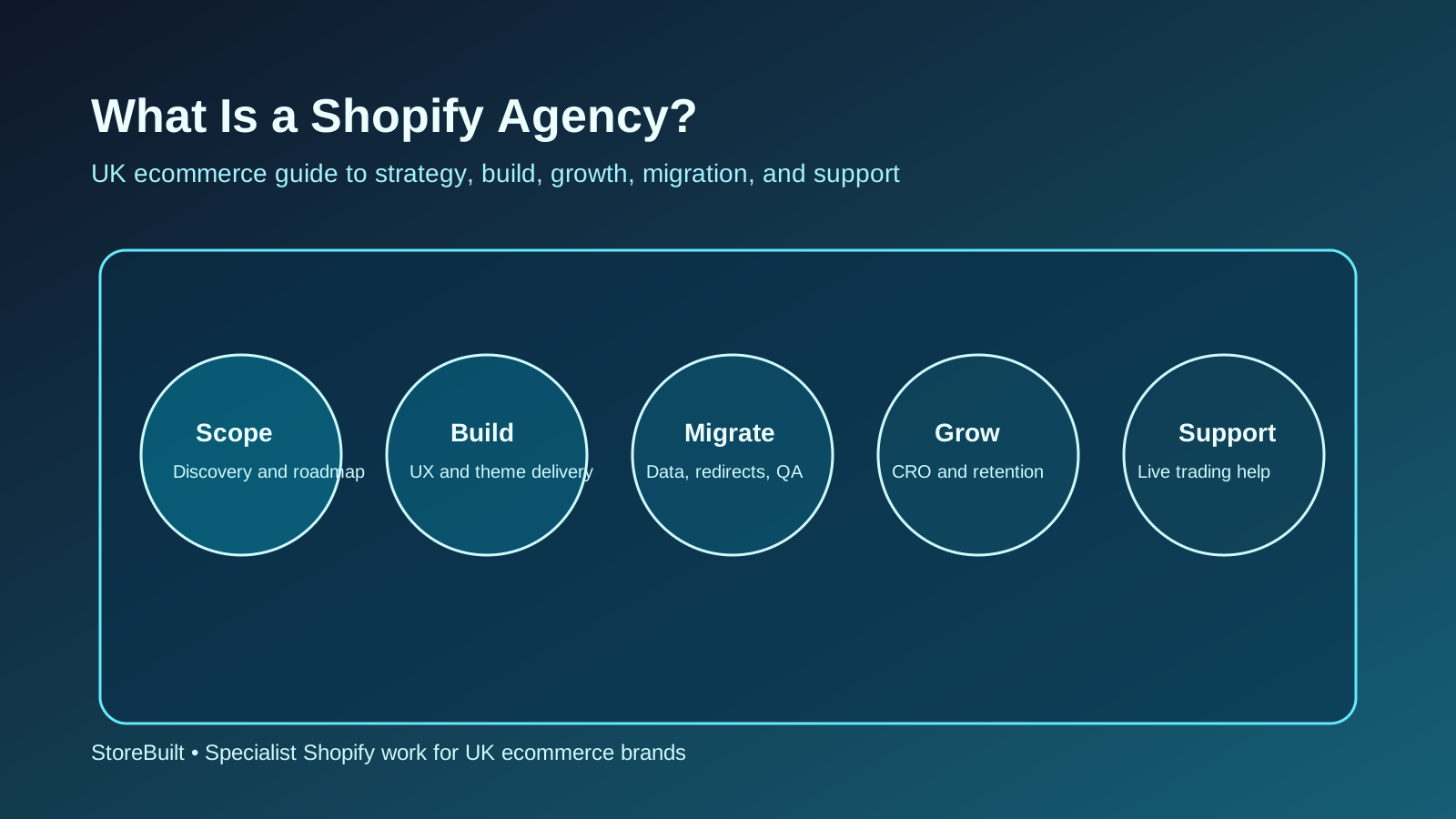
What a Shopify agency actually does
A Shopify agency is not just a design studio that happens to work on Shopify.
At a serious level, the job usually covers five commercial layers:
- platform and scope advice before build begins
- storefront UX and theme delivery
- migration, apps, integrations, and operational setup
- conversion, retention, and post-launch improvement
- support once the store is live and trading
That matters because ecommerce teams rarely buy “a website” in isolation. They are buying a revenue channel that has to keep working when traffic, content, campaigns, product launches, fulfilment pressure, and internal team changes all hit at once.
In the UK market, the strongest agencies usually understand more than homepage polish. They understand collections, product-page proof, merchandising logic, search visibility, checkout friction, and what the internal team will need after launch.
When a UK ecommerce brand usually needs one
The right time to hire a Shopify agency is often earlier than teams think, but not always for the reason they assume.
Common triggers include:
- the current store is hard to update and campaign work is slow
- conversion has stalled and the team cannot agree whether the issue is UX, theme structure, or offer clarity
- a migration is coming from WooCommerce, Magento, BigCommerce, or a legacy Shopify setup
- the brand needs Shopify Plus, B2B, subscriptions, or multi-market structure
- the internal team wants senior execution without hiring multiple in-house specialists
The wrong reason to hire an agency is simply “the site feels old.” A dated design can be a symptom, but in most ecommerce projects the deeper problem is operational. Merchandising is clunky. PDPs do not answer buying questions. Apps are stacked without discipline. Category pages are thin. The marketing team cannot ship fast enough.
If that sounds familiar, see our Shopify design and development service.
What good agencies do differently
From reviewing UK competitor positioning, one pattern is clear: many agencies talk about design, growth, and Shopify expertise in almost identical language. The better differentiator is not the headline. It is how clearly the agency explains its operating model.
A strong Shopify agency should be able to explain:
- how it scopes discovery
- who owns UX and technical decision-making
- how it handles SEO and redirect continuity during migrations
- how much flexibility the merchant gets in the Shopify editor
- what support looks like after launch
- how conversion and retention are handled after the first release
This is where UK competitors like Charle, Swanky, Eastside Co, Superco, We Make Websites, and Fourmeta become useful benchmarks. They each signal different strengths, but the real lesson for buyers is that specialism matters more than broad agency language.
How to assess UK Shopify agency fit
Most agency decisions improve when the buyer moves from inspiration-mode questions into operating questions.
Use this shortlist:
| Question | Why it matters | Weak answer | Strong answer |
|---|---|---|---|
| What percentage of your work is Shopify? | Tests specialism | ”We work across many platforms.” | Clear Shopify-led focus and delivery examples |
| Who will actually work on the project? | Reveals delivery reality | Sales-led vagueness | Named strategic and technical owners |
| How do you handle migrations? | Protects revenue and SEO continuity | Product import and redesign only | Redirects, content mapping, QA, analytics, SEO checks |
| What happens after launch? | Shows long-term usefulness | Undefined support | Clear retainer, sprint, or maintenance path |
| How do you improve conversion? | Tests commercial thinking | Generic CRO claim | Concrete PDP, collection, cart, and checkout methodology |
In our experience, the best agency relationships are the ones where the team can explain what gets better commercially in the first 90 days, not just what will look better on launch day.
If you are comparing specialist partners now, run the free AI audit before committing to a scope.
Agency model comparison table
| Model | Best fit | Risk | Typical outcome |
|---|---|---|---|
| Generalist digital agency | Light brochure-commerce projects | Weak Shopify depth | Polished surface, shallow trading setup |
| Shopify specialist agency | Brands with live revenue stakes | Requires clear brief and senior alignment | Stronger platform fit and better rollout quality |
| In-house only | Teams with broad internal capability | Slow specialist coverage | Control, but often uneven speed |
| Hybrid agency plus internal team | Mid-market ecommerce brands | Needs clean ownership | Best balance of pace and specialist skill |
For many UK ecommerce brands, hybrid is the practical answer. Internal teams keep brand, merchandising, and campaign control. The Shopify agency handles technical depth, UX structure, migration risk, and faster problem-solving.
What a Shopify agency should not be
There are also clear warning signs:
- the agency cannot show live stores, only mockups or static case studies
- it does not talk clearly about post-launch support
- it treats SEO, retention, and merchandising as someone else’s problem
- it over-promises on timeline without discussing data migration, redirects, or QA
- it sells a bespoke build that the merchant cannot actually manage later
A Shopify project fails slowly when these issues are present. Launch still happens. The real cost shows up later in slower content updates, weaker conversion, more technical debt, and frustrated internal teams.
StoreBuilt example
One UK ecommerce team came to us after an early agency discovery round where every proposal sounded similar. Once we mapped the project into actual workstreams, the decision became much easier.
The real need was not “a redesign.” It was a mix of migration planning, theme restructuring, category UX, email capture logic, and post-launch support. Once the brief was rewritten around those workstreams, weak-fit agencies dropped away quickly and the budget conversation became more rational.
That is the practical value of understanding what a Shopify agency is. It lets the buyer write a better brief and judge partners against real operating needs.
High-intent AI search implementation layer
The AI-search version of this topic is not just “write more content”. A useful answer engine result needs a page that gives a direct answer, proves the claim, and shows the next operational step inside Shopify.
| Area | StoreBuilt implementation check |
|---|---|
| Primary intent | The page should map to Shopify agency and one clear buyer or operator problem, not a vague traffic topic. |
| Shopify surface | Identify whether the work belongs on a collection, product page, theme section, checkout step, app workflow, email flow, or support process. |
| Proof | Add first-hand observations, product/category examples, screenshots, policy notes, review signals, or trustworthy external sources where they make the advice safer. |
| Internal route | Link the reader to the service most likely to solve the issue: Shopify store design and development. |
| Measurement | Check Search Console, analytics, assisted conversions, enquiry quality, and AI-response mentions after the update rather than judging success by pageviews alone. |
For this article, the useful research inputs are: Shopify Help documentation, StoreBuilt implementation patterns, UK ecommerce SERP intent, and common founder/operator questions. StoreBuilt would prioritise practical Shopify setup, theme structure, page hierarchy, product data, and launch-ready implementation before expanding into broader supporting content.
If this topic maps to a live store problem, review the related StoreBuilt service or Contact StoreBuilt with the store URL and the issue you want fixed.
Final StoreBuilt point of view
A Shopify agency should be judged less like a creative supplier and more like a commercial systems partner. In the UK ecommerce market, the best partner is the one that can improve how the store trades, not just how the homepage looks.