
What we have seen in Shopify SEO audits is this: many stores do not actually have a keyword problem first. They have a catalogue-governance problem that keeps product, variant, and collection pages from sending a clean signal to search engines or shoppers.
If your category structure or variant logic is starting to hurt discoverability, Contact StoreBuilt.
Table of contents
- Keyword decision and research inputs
- Why variant SEO matters more in the UK market now
- What competitor content is still missing
- The StoreBuilt framework for variant SEO
- Catalogue-governance table
- StoreBuilt example
- Final StoreBuilt point of view
Keyword decision and research inputs
Primary keyword: shopify variant seo
Secondary keywords:
- shopify product variant seo
- ecommerce catalogue governance
- shopify collection structure seo
- product group structured data shopify
Search intent: problem-solving and commercial. The reader is usually running an established store and needs better visibility without creating a messy page estate.
Funnel stage: middle to bottom.
Page type: expert implementation guide.
Why StoreBuilt can realistically win this topic:
- Most UK Shopify agency content covers SEO broadly, but far less content goes deep on product/variant architecture decisions.
- Google has clearer variant structured-data guidance, yet many merchant articles still explain variants in vague terms.
- This topic maps directly to
/services/shopify-seo-and-ai-search-readiness/and often leads into technical cleanup or theme work.
Research inputs used on June 9, 2026:
- Google Search Central documentation on product and product-group structured data for variants.
- Current SERP pattern scan for Shopify variant SEO and product variant indexing topics.
- Competitor library review across Charle and other UK agencies for technical SEO content depth.
Why variant SEO matters more in the UK market now
The ecommerce UK market is increasingly competitive at the category and product level. More merchants are trying to win on long-tail intent, colour intent, size intent, material intent, and use-case intent. That creates pressure to publish more pages.
The mistake is assuming more URLs automatically means more search demand captured.
In practice, weak variant handling creates familiar problems:
- duplicate or near-duplicate pages with no clear canonical intent
- thin variant URLs that add no real value
- collection pages fighting product pages for the same query
- merchandising logic that creates messy internal links
- confusing product data that weakens structured content quality
That hurts both search performance and onsite conversion.
What competitor content is still missing
UK agencies are good at publishing technical SEO overviews, but the catalogue layer often gets compressed into one or two paragraphs. Charle’s technical SEO content is useful because it treats ecommerce SEO as infrastructure, not blog decoration. But there is still room for a more implementation-focused guide around Shopify-specific variant and collection choices.
That gap matters because catalogue decisions on Shopify are not just SEO decisions. They shape:
- filter UX
- collection discoverability
- product-page clarity
- feed quality for paid and merchant surfaces
- long-term admin usability
That is where StoreBuilt can be more practically useful than a generic technical SEO checklist.
The StoreBuilt framework for variant SEO
1. Decide which intent deserves a standalone URL
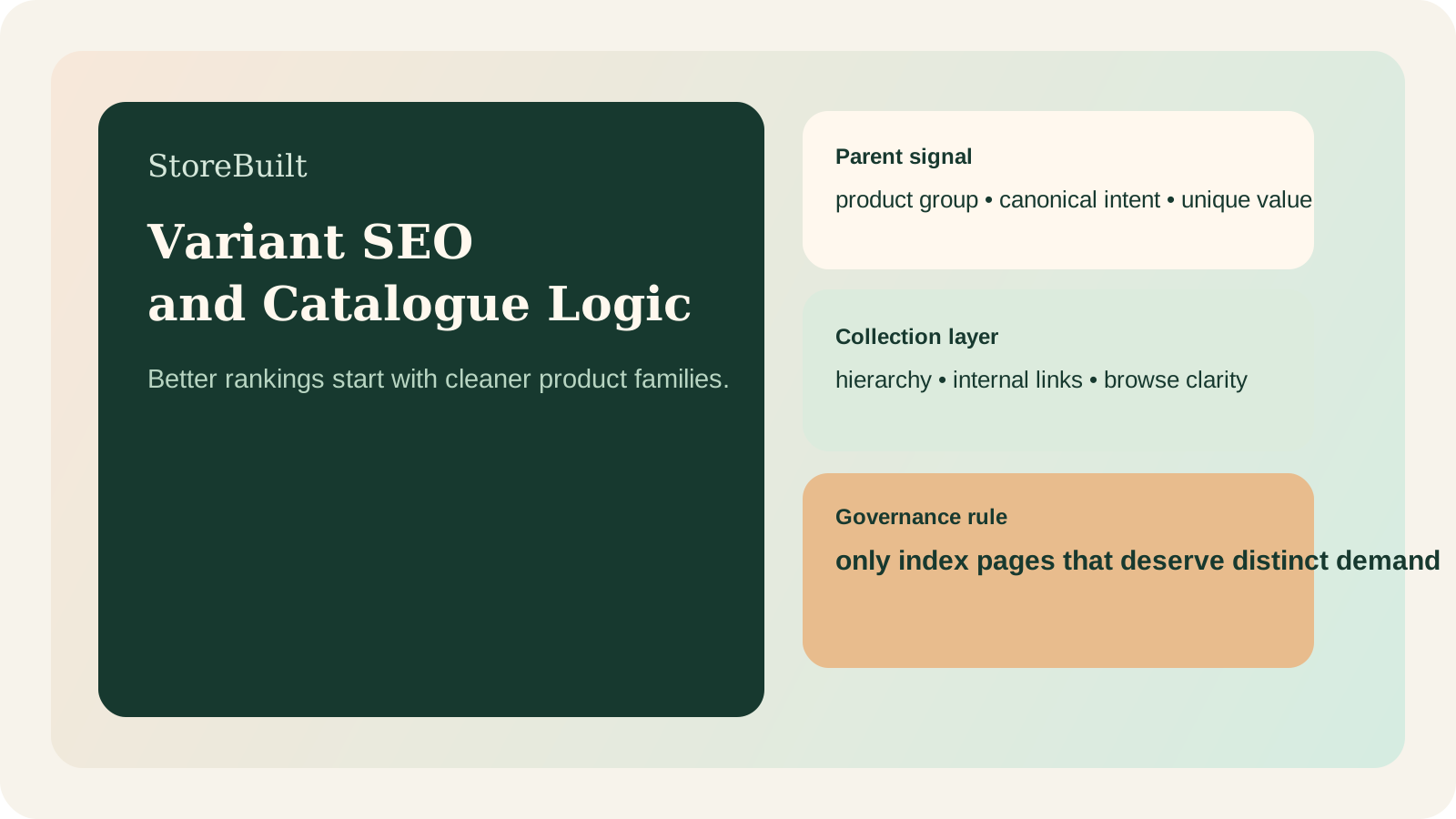
Not every variant deserves its own indexable page. The question is not “Can Shopify create a URL?” The question is “Does this URL represent distinct search intent and real merchandising value?”
Good candidates for stronger variant treatment usually include:
- meaningfully different product names or use cases
- material differences with distinct buyer intent
- configuration differences that change the commercial proposition
Poor candidates usually include:
- small cosmetic variations with no distinct search demand
- duplicate pages created by parameter combinations
- low-value URLs that only fragment authority
2. Use one parent logic for the product family
Google’s current guidance around product groups is helpful here. Search engines need a clearer understanding of how variants relate to a parent product family.
For most stores, the practical rule is simple:
- keep one clear canonical parent where appropriate
- use consistent product-group logic
- ensure variant-specific information is real, not duplicated filler
If your product architecture is already unstable, StoreBuilt can help align the template layer with SEO requirements.
3. Stop collections from becoming accidental duplicates
A lot of Shopify stores have decent product pages but weak collection governance. The result is that category, subcategory, tag-led, and search-generated pages all compete for overlapping intent.
A stronger model usually means:
- one clear collection hierarchy
- fewer low-value auto-generated pages
- clearer internal links between editorial and commercial pages
- intentional copy on index-worthy collections
The goal is not to create every possible landing page. It is to create the right ones.
4. Treat product data as SEO infrastructure
Variant SEO fails when product data is inconsistent.
Common issues include:
- inconsistent size or colour naming
- duplicate variant labels
- weak alt text across media
- missing availability, brand, or pricing consistency
- internal terminology that does not match buyer language
This is why SEO, merchandising, and operations often need to work together. The product catalogue is not just content. It is structured commercial data.
Catalogue-governance table
| Area | What strong governance looks like | What weak governance creates |
|---|---|---|
| Product family logic | Clear parent-child relationship across variants | Duplicate pages and diluted relevance |
| Canonical handling | One obvious signal for the intended ranking page | Indexation confusion |
| Collection structure | Deliberate hierarchy tied to search and browse intent | Cannibalisation and messy internal links |
| Product data | Consistent naming, attributes, and media signals | Poor matching and weak structured content |
| Internal linking | Editorial and commercial pages support each other | Orphaned pages and authority leakage |
| Merchandising ownership | Someone owns ongoing catalogue standards | Drift over time as products scale |
StoreBuilt example
One merchant had a broad catalogue with strong products but inconsistent variant handling. Some colours generated their own URLs, some did not, some collections overlapped heavily, and several top templates repeated near-identical metadata. The result was not a total indexing failure. It was something more common: the store was understandable enough to be crawled, but not clear enough to rank as strongly as it should.
The fix was not “add more SEO content”. We cleaned the page logic. We grouped variants more deliberately, reduced low-value duplication, strengthened collection intent, and improved how products linked into the broader category system. The outcome was better page clarity for both search engines and customers.
That is the real advantage of catalogue governance. It makes the whole store easier to understand.
If your product estate is growing faster than its structure, see StoreBuilt’s Shopify SEO and AI search readiness service.
High-intent AI search implementation layer
The AI-search version of this topic is not just “write more content”. A useful answer engine result needs a page that gives a direct answer, proves the claim, and shows the next operational step inside Shopify.
| Area | StoreBuilt implementation check |
|---|---|
| Primary intent | The page should map to shopify variant seo and one clear buyer or operator problem, not a vague traffic topic. |
| Shopify surface | Identify whether the work belongs on a collection, product page, theme section, checkout step, app workflow, email flow, or support process. |
| Proof | Add first-hand observations, product/category examples, screenshots, policy notes, review signals, or trustworthy external sources where they make the advice safer. |
| Internal route | Link the reader to the service most likely to solve the issue: Shopify SEO and AI search readiness. |
| Measurement | Check Search Console, analytics, assisted conversions, enquiry quality, and AI-response mentions after the update rather than judging success by pageviews alone. |
For this article, the useful research inputs are: Google Search Central guidance, Shopify platform documentation, Ahrefs AI Responses/Brand Radar patterns, and StoreBuilt Shopify audit observations. StoreBuilt would prioritise technical SEO, collection architecture, Product schema, answer-first content, GEO, and Search Console monitoring before expanding into broader supporting content.
If this topic maps to a live store problem, review the related StoreBuilt service or Contact StoreBuilt with the store URL and the issue you want fixed.
Final StoreBuilt point of view
Variant SEO on Shopify is not a trick for generating more URLs. It is a discipline for deciding which product intent deserves visibility and how the catalogue should express that cleanly.
For UK ecommerce teams, the stores that win organic visibility over time are usually not the ones with the most pages. They are the ones with the most understandable catalogue logic.