
What we have seen in Shopify SEO reviews is this: many brands install SEO apps because something feels missing, but they never define whether the gap is metadata workflow, technical output, schema ownership, or crawl governance.
If your SEO stack feels busy but rankings are not compounding, Contact StoreBuilt.
Table of contents
- Keyword decision and research inputs
- Quick answer: when an SEO app is worth it
- The Shopify SEO jobs apps can help with
- A practical SEO app shortlist for UK teams
- Where SEO apps usually get overused
- StoreBuilt example
- 90-day Shopify SEO app review plan
- Final StoreBuilt point of view
Keyword decision and research inputs
Primary keyword: shopify seo apps
Secondary keywords:
- best SEO apps for Shopify
- Shopify SEO tools
- Shopify schema app
- Shopify image SEO
- ecommerce SEO Shopify UK
Search intent: commercial investigation with technical implementation intent.
Funnel stage: middle to bottom.
Page type: practical shortlist with audit guidance.
Why StoreBuilt can realistically win this topic:
- StoreBuilt can separate real SEO needs from app-marketplace noise.
- The topic fits our existing technical SEO, schema, crawlability, and collection-architecture work on Shopify.
- UK ecommerce brands often need an operator view on what should live in theme code, content process, or an app.
Research inputs used in angle selection:
- Current SERP review around
shopify seo apps,best SEO apps for Shopify, and related theme-versus-app intent. - UK competitor patterns, including Charle’s SEO-app coverage and surrounding Shopify SEO article structures.
- Public search guidance and Shopify implementation patterns around metadata, schema, image optimisation, and crawl management.
Quick answer: when an SEO app is worth it
A Shopify SEO app is worth using when it improves workflow quality or technical consistency without taking ownership away from the team.
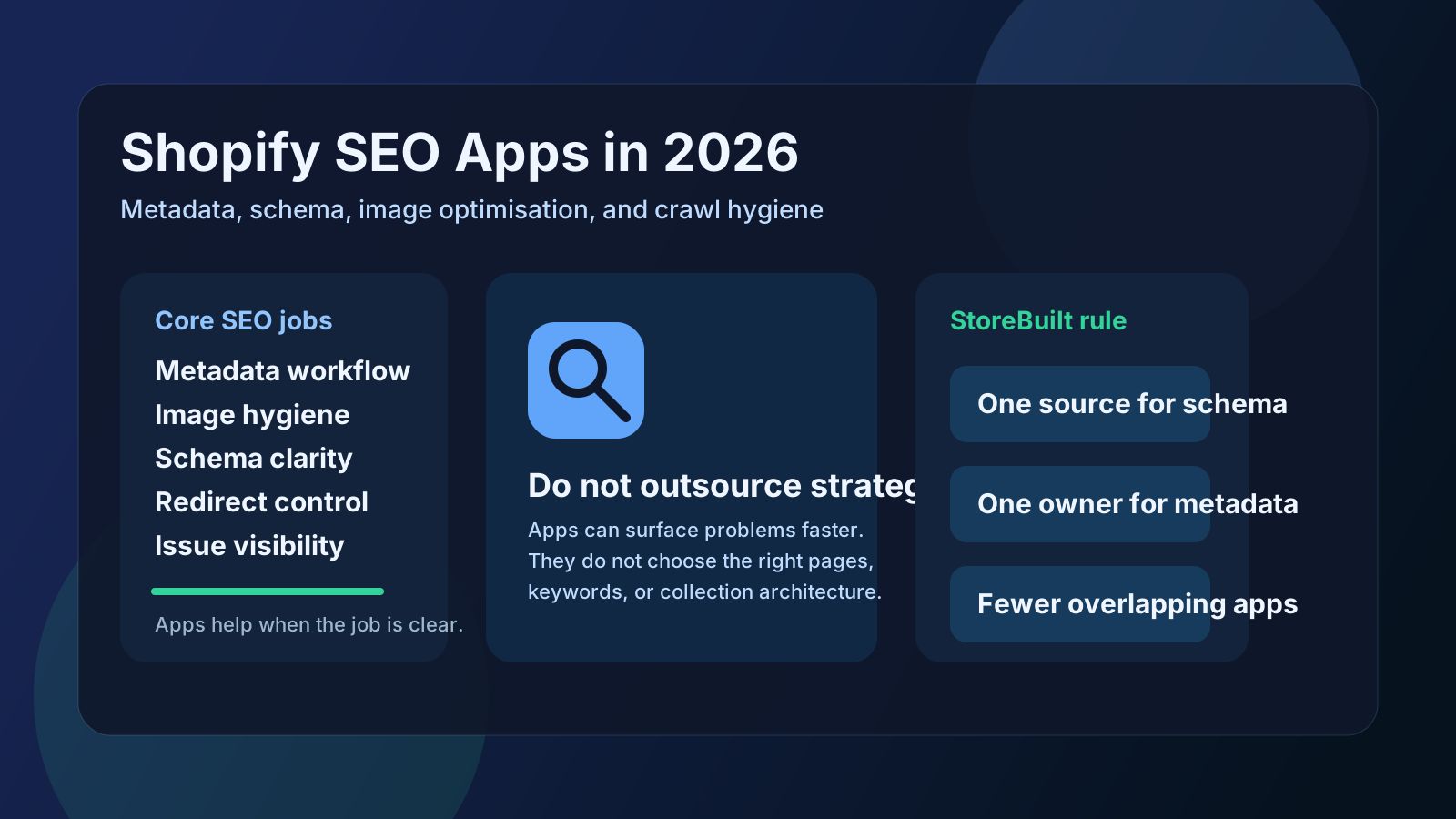
In practice, that usually means one of five jobs:
- metadata workflow
- image compression and alt-text operations
- schema or structured-data control
- broken-link, redirect, or crawl hygiene
- reporting and issue visibility
What an SEO app should not do is become a substitute for clear site architecture, strong category content, or competent technical implementation.
The Shopify SEO jobs apps can help with
Before comparing named tools, define the job.
| SEO job | When an app helps | When it should not be the primary answer |
|---|---|---|
| Titles and meta descriptions at scale | large catalogues need repeatable rules and checks | the site lacks a keyword model or page strategy |
| Image optimisation | product-heavy stores need payload discipline | the theme is fundamentally heavy or badly coded |
| Structured data | markup is incomplete or weakly maintained | multiple apps already output conflicting schema |
| Redirects and crawl hygiene | migration and URL changes are frequent | core navigation and canonical logic are wrong |
| Technical issue monitoring | the team needs routine visibility | no one owns acting on the findings |
This framing matters because “best SEO app” often hides three different needs inside one search. A merchant may need an image optimiser. Another may need schema cleanup. Another may need a better collection strategy, which no app can invent.
A practical SEO app shortlist for UK teams
The exact shortlist changes by store profile, but these are the kinds of tools UK Shopify teams commonly evaluate in 2026.
| Tool type or example category | Strong fit when | Main watch-out |
|---|---|---|
| Metadata and rule-based SEO manager | large catalogues need scalable controls | templated metadata without intent strategy can create bland pages |
| Image optimisation and compression layer | mobile speed and product-heavy collections are under pressure | compression alone does not fix poor image hierarchy |
| Structured data or schema support layer | product markup is incomplete, duplicated, or brittle | app overlap can produce conflicting schema blocks |
| Redirect and broken-link manager | migrations or merchandising changes are frequent | link hygiene cannot rescue weak taxonomy |
| Audit and issue scanner | the team needs regular technical visibility | issue lists become noise without prioritisation |
The right shortlist is not “install one of each.” It is “identify where the current store loses search clarity, then choose the lightest reliable fix.”
Metadata and on-page workflow
This category becomes useful when:
- collection and product counts are high
- titles and meta descriptions are inconsistent
- merchandising teams need repeatable edit workflows
It becomes risky when a store tries to automate its way out of weak keyword decisions. If category targeting is wrong, scaling the wrong metadata faster does not help.
For teams working on category intent and on-page SEO together, see StoreBuilt SEO and AI search readiness.
Image, media, and performance hygiene
Many competitor articles treat image SEO as a simple alt-text problem. That is too narrow.
In Shopify, image-related SEO value usually connects to:
- mobile performance
- PDP clarity
- collection-page payload
- consistent alt coverage
- media that matches the buying question
Apps can help automate parts of that, especially compression or file hygiene. But no tool can decide whether the wrong images are being loaded in the wrong places.
Schema and structured data
This is one of the most overcomplicated areas in Shopify SEO.
An app can help if:
- the theme outputs thin Product markup
- review markup is incomplete
- changes keep breaking schema ownership
An app should not become the default answer if:
- the store already has multiple schema sources
- the theme can support a cleaner direct implementation
- the business needs stable long-term ownership rather than another dependency
StoreBuilt’s consistent view is that maintainability beats cleverness. One boring, accurate schema source is better than three “powerful” SEO apps fighting each other.
Crawling, redirects, and issue visibility
This is where apps are genuinely useful for many teams, especially after migrations, range changes, or content expansion.
| Problem | App can help with | Still needs human ownership |
|---|---|---|
| Broken links | detection and tracking | deciding which pages deserve redirect authority |
| Redirect hygiene | route management and rule maintenance | migration planning and testing |
| Crawl-waste signals | surfacing weak indexable pages or errors | deciding what should rank at all |
| Duplicate metadata | issue detection | rewriting with intent and category context |
The operator mistake is expecting alerts to become decisions. They do not. Alerts are only useful when someone owns the roadmap behind them.
Where SEO apps usually get overused
Most Shopify stores do not have an SEO app problem. They have a clarity problem.
Common overuse patterns:
- multiple apps touching meta tags
- compression apps layered on top of already optimised assets
- schema tools installed without removing old markup
- technical audit apps treated like a replacement for SEO prioritisation
- app settings changed by too many people without documentation
If that sounds familiar, the next SEO gain may come from deletion rather than installation.
StoreBuilt example
One UK ecommerce team had installed several SEO tools over time because each agency or freelancer had preferred a different fix. On paper, the store looked well-equipped. In practice, the SEO layer was harder to trust.
Metadata rules overlapped. Schema output came from more than one source. Compression settings were unclear. The internal team did not know which app to blame when something changed.
The fix was not a better master app. The fix was role clarity:
- one owner for metadata workflow
- one source for schema
- one documented image process
- one prioritised issue list
That made SEO slower for a week and stronger for the next year. That is a good trade.
90-day Shopify SEO app review plan
| Timeline | Focus | Output |
|---|---|---|
| Weeks 1-2 | map every SEO-related app, script, and theme dependency | SEO stack ownership map |
| Weeks 3-5 | remove overlap and choose single-source controls | cleaner metadata and schema setup |
| Weeks 6-9 | fix the biggest crawl, image, or markup issues | measurable technical clarity |
| Weeks 10-13 | align app settings with content and collection strategy | stronger long-term SEO workflow |
Metrics worth reviewing:
- indexed page quality
- collection impressions and CTR
- core category metadata coverage
- image payload patterns
- structured-data consistency
- redirect and broken-link count
If your team is adding SEO apps faster than it is improving category performance, you are likely treating software as strategy.
For an outside view before a migration, redesign, or content push, use the StoreBuilt free Shopify audit.
High-intent AI search implementation layer
The AI-search version of this topic is not just “write more content”. A useful answer engine result needs a page that gives a direct answer, proves the claim, and shows the next operational step inside Shopify.
| Area | StoreBuilt implementation check |
|---|---|
| Primary intent | The page should map to shopify seo apps and one clear buyer or operator problem, not a vague traffic topic. |
| Shopify surface | Identify whether the work belongs on a collection, product page, theme section, checkout step, app workflow, email flow, or support process. |
| Proof | Add first-hand observations, product/category examples, screenshots, policy notes, review signals, or trustworthy external sources where they make the advice safer. |
| Internal route | Link the reader to the service most likely to solve the issue: Shopify SEO and AI search readiness. |
| Measurement | Check Search Console, analytics, assisted conversions, enquiry quality, and AI-response mentions after the update rather than judging success by pageviews alone. |
For this article, the useful research inputs are: Google Search Central guidance, Shopify platform documentation, Ahrefs AI Responses/Brand Radar patterns, and StoreBuilt Shopify audit observations. StoreBuilt would prioritise technical SEO, collection architecture, Product schema, answer-first content, GEO, and Search Console monitoring before expanding into broader supporting content.
If this topic maps to a live store problem, review the related StoreBuilt service or Contact StoreBuilt with the store URL and the issue you want fixed.
Final StoreBuilt point of view
The best Shopify SEO app is the one that solves a defined operational problem with the least possible technical clutter. Apps can support metadata discipline, image hygiene, schema stability, and issue visibility. They cannot replace strategy, information architecture, or sound implementation.
For UK ecommerce brands, that distinction matters. Search growth compounds when the SEO stack becomes simpler to trust, not just larger to describe.