
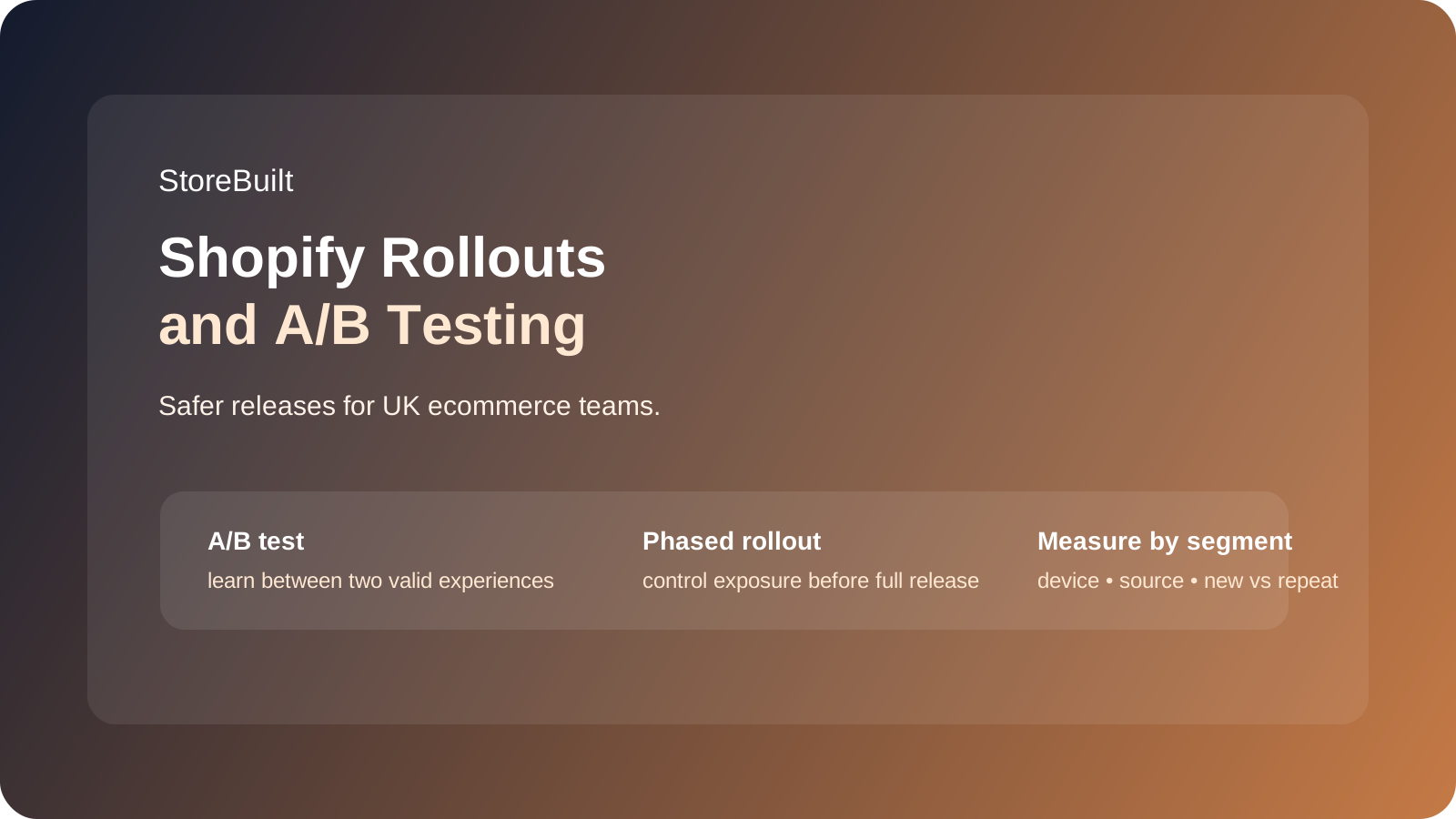
What we have seen in Shopify release work is this: many stores do not lose conversion because a feature idea was bad. They lose conversion because a good idea was shipped too broadly, too quickly, and without a clear rollback plan.
If you need help turning Shopify releases into a cleaner testing and rollout system, Contact StoreBuilt.
Table of contents
- Keyword decision and research inputs
- Why rollout control matters more than teams expect
- When to A/B test and when to phase a release
- A practical rollout decision table
- How to measure a Shopify release properly
- StoreBuilt example
- Final StoreBuilt point of view
Keyword decision and research inputs
Primary keyword: shopify rollouts
Secondary keywords:
- shopify ab testing
- shopify feature release strategy
- ecommerce rollout testing
- shopify conversion testing
Search intent: operational and evaluative. The reader is usually managing feature changes, theme updates, checkout-related adjustments, or conversion experiments and wants a safer release model.
Funnel stage: middle.
Page type: operations and CRO guide.
Why StoreBuilt can win this topic:
- We work on live Shopify stores where release quality matters as much as the feature itself.
- We see how merchandising, CRO, development, and analytics all influence whether a rollout is genuinely safe.
- We can connect platform features such as phased rollouts to real ecommerce trading logic.
Research inputs used:
- Current SERP review around Shopify rollouts, Shopify A/B testing, and ecommerce release testing queries.
- Official Shopify documentation and product guidance reviewed for current rollout capability and customer segmentation concepts where relevant.
- UK competitor and ecommerce-agency content review, including practical article patterns similar to Charle’s buyer-education model.
Why rollout control matters more than teams expect
A release can be technically correct and still commercially damaging.
That is common when a team updates navigation, price presentation, checkout UX, promotional logic, or account flow and only realises later that one segment of users was hit harder than the average.
Phased rollout control matters because ecommerce traffic is uneven:
- device mix is uneven
- source quality is uneven
- new vs repeat customer behaviour is uneven
- peak trading windows can magnify small mistakes
If everything ships to everyone at once, diagnosis gets slower and rollback becomes more expensive.
That is why Shopify’s newer rollout controls are useful. They allow release exposure to become a commercial decision, not only a technical switch.
When to A/B test and when to phase a release
These are not the same thing.
Use A/B testing when:
- you are comparing two plausible experiences
- the goal is learning as well as uplift
- the risk of exposure is manageable
- the success metric is clear enough to evaluate
Examples include:
- PDP trust layout
- promotional messaging hierarchy
- bundle framing
- cart reassurance copy
- mobile CTA placement
Use phased rollout when:
- the feature is operationally important but still risky
- you want controlled exposure before full release
- rollback speed matters
- technical or trading side effects may not show immediately
Examples include:
- search changes
- account flow changes
- navigation architecture changes
- checkout-adjacent scripts or extensibility changes
- release bundles involving multiple moving parts
The mistake is assuming all change belongs in a classic A/B test. Some releases need protection more than experimentation.
A practical rollout decision table
| Scenario | Better approach | Why |
|---|---|---|
| You want to compare two PDP layouts | A/B test | Learning is the main value |
| You are replacing onsite search logic | Phased rollout | Operational risk is high |
| You are changing promotional message order | A/B test | Low-risk behavioural comparison |
| You are shipping a large theme release before peak | Phased rollout | Exposure control matters more than test purity |
| You are updating cart UX and support messaging | Hybrid | Roll out gradually, then test message variants |
For most teams, the smartest path is not choosing between testing and rollout control. It is combining them in the right order.
How to measure a Shopify release properly
Do not measure only headline conversion rate.
At minimum, look at:
- device split
- new vs repeat user performance
- traffic source mix
- AOV movement
- support signal change
- checkout step friction where available
In the ecommerce UK market, some releases look harmless in blended reporting and damaging inside one slice. Mobile paid traffic may drop while direct repeat traffic stays flat enough to hide the issue.
That is why release measurement needs segmentation and a short decision window:
| Measurement layer | What to check |
|---|---|
| Commercial outcome | Conversion rate, revenue per session, AOV |
| Experience signal | Add-to-cart rate, navigation depth, search usage |
| Risk signal | Error reports, support tickets, unusual abandonment patterns |
| Segment impact | Mobile vs desktop, new vs repeat, source-specific performance |
If you are shipping changes that affect discovery, cart flow, or trust architecture, StoreBuilt’s CRO and UX optimisation support is the most relevant path.
StoreBuilt example
One retailer introduced a new storefront feature that looked strategically sound on paper. The experience improved visual clarity, but it was released broadly and close to a busy trading period.
Top-line reporting stayed almost neutral for a short time, so the team assumed risk was low. Once performance was sliced by device and traffic source, the issue became clearer: one mobile-heavy segment experienced added friction that blended reporting masked.
The fix was not only changing the feature. It was changing the release method. Smaller exposure, faster check windows, and clearer segment review would have made the problem easier to detect and cheaper to reverse.
High-intent AI search implementation layer
The AI-search version of this topic is not just “write more content”. A useful answer engine result needs a page that gives a direct answer, proves the claim, and shows the next operational step inside Shopify.
| Area | StoreBuilt implementation check |
|---|---|
| Primary intent | The page should map to shopify rollouts and one clear buyer or operator problem, not a vague traffic topic. |
| Shopify surface | Identify whether the work belongs on a collection, product page, theme section, checkout step, app workflow, email flow, or support process. |
| Proof | Add first-hand observations, product/category examples, screenshots, policy notes, review signals, or trustworthy external sources where they make the advice safer. |
| Internal route | Link the reader to the service most likely to solve the issue: CRO and UX optimisation. |
| Measurement | Check Search Console, analytics, assisted conversions, enquiry quality, and AI-response mentions after the update rather than judging success by pageviews alone. |
For this article, the useful research inputs are: StoreBuilt CRO audit patterns, analytics QA checks, Shopify theme constraints, and buyer-intent SERP patterns. StoreBuilt would prioritise PDP hierarchy, cart friction, mobile merchandising, testing policy, analytics QA, and measured releases before expanding into broader supporting content.
If this topic maps to a live store problem, review the related StoreBuilt service or Contact StoreBuilt with the store URL and the issue you want fixed.
Final StoreBuilt point of view
For UK Shopify teams, rollout control is now part of conversion discipline. A/B testing is still valuable, but not every risky change should start as a full-audience experiment. In 2026, the smarter operating model is to treat release exposure, rollback safety, and measurement segmentation as one system. That is how teams protect revenue while still learning fast enough to improve.