
What we have seen in lifecycle reviews is this: many brands have segmentation, but far fewer have segmentation that changes what the business does next. Lists exist. Economics do not.
If your retention setup is active but repeat revenue still feels flatter than it should, Contact StoreBuilt.
Table of contents
- Keyword decision and research inputs
- Why segmentation needs an economic lens
- What competitor content usually gets right and wrong
- The StoreBuilt segmentation model
- Segment economics table
- StoreBuilt example
- Final StoreBuilt point of view
Keyword decision and research inputs
Primary keyword: shopify retention segmentation
Secondary keywords:
- ecommerce customer segmentation
- shopify customer lifetime value strategy
- retention segments for ecommerce
- uk ecommerce repeat revenue strategy
Search intent: operational and commercial. The reader is not asking what segmentation means. They are trying to decide which segments deserve actual budget, automation, and merchandising attention.
Funnel stage: middle to bottom.
Page type: strategic operating guide.
Why StoreBuilt can realistically win this topic:
- Existing segmentation content in the market is often lifecycle-heavy but margin-light.
- UK ecommerce teams increasingly need retention to work alongside profitability pressure, not against it.
- This topic supports both
/services/klaviyo-email-and-sms-retention/and/services/shopify-support-maintenance-and-audits/.
Research inputs used on June 9, 2026:
- Current SERP pattern review around customer segmentation, retention strategy, and Shopify lifecycle intent.
- Competitor article checks, including Charle’s customer-segmentation style and adjacent lifecycle content.
- StoreBuilt observations from brands where segmentation existed technically but was weak commercially.
Why segmentation needs an economic lens
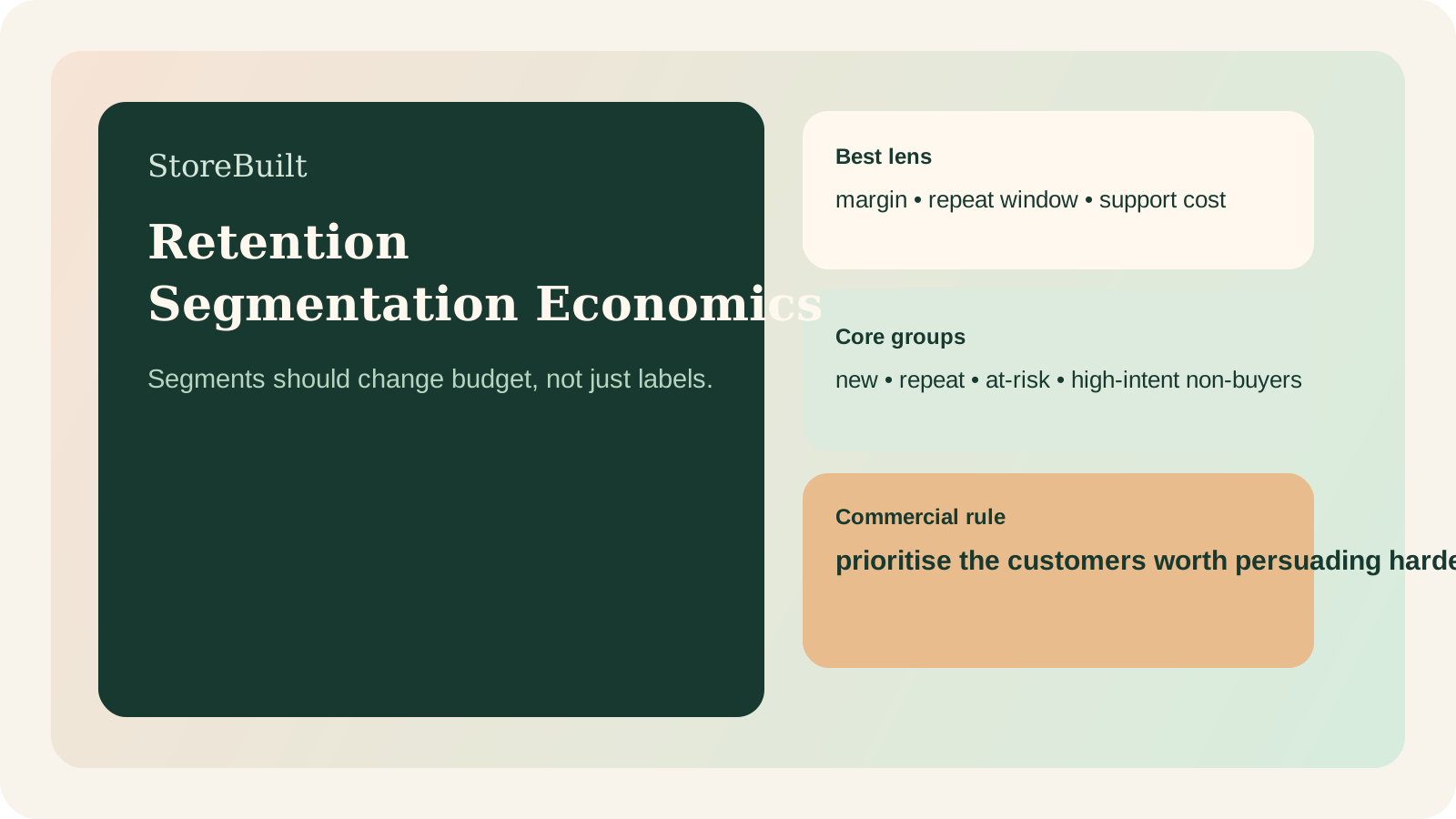
Segmentation becomes shallow when it is built only around engagement behaviour. Openers, clickers, VIPs, and lapsed cohorts can all be useful. But if those segments are disconnected from margin profile, replenishment cadence, discount sensitivity, and service cost, the brand still struggles to make better decisions.
That is the real issue.
In the ecommerce UK market, retention pressure is rising at the same time as acquisition efficiency is harder to depend on. That makes segmentation more important, but also more expensive to get wrong.
Poor segmentation often creates these outcomes:
- too many campaigns aimed at the same broad group
- discounting that lifts orders but weakens profitability
- automation complexity without clear commercial ownership
- retention effort focused on noisy segments instead of valuable ones
The job is not to create more segments. The job is to create segments the team can act on consistently.
What competitor content usually gets right and wrong
Agencies like Charle are right to frame segmentation as a growth lever. Strong competitor content often explains lifecycle stages clearly and helps teams move beyond one-size-fits-all email.
Where the market still leaves room is the economics layer.
Most segmentation guides still underplay:
- contribution margin differences by customer group
- category-specific reorder timing
- fulfilment or service cost by segment
- the fact that some “high engagement” customers are commercially weak
That is where StoreBuilt can be more useful. Retention should not be evaluated as message complexity alone. It should be evaluated as operating leverage.
The StoreBuilt segmentation model
1. Start with commercial questions, not segment names
Ask:
- Which customers are most profitable to reacquire?
- Which customer groups are most likely to buy without a discount?
- Which first-order paths produce stronger repeat behaviour?
- Which segments create the most support load?
Those questions usually matter more than whether the segment is called VIP, at risk, or nurture.
2. Build four practical segment families
For many Shopify brands, a usable retention model starts with four segment families:
- New customers by first-order quality
- Repeat customers by margin and frequency
- At-risk customers by reorder window
- High-intent non-buyers by browse and cart behaviour
Each family should then be refined by business model, product cadence, and margin reality.
3. Align messaging with merchandising, not only email logic
Retention underperforms when campaigns promise one thing and the storefront experience does another.
If a customer segment is sensitive to:
- replenishment timing
- bundle value
- product education
- upsell relevance
then product pages, collections, and landing pages should reflect that too.
That is why retention often overlaps with onsite optimisation. If your lifecycle plan needs storefront support, StoreBuilt can help connect retention with CRO execution.
4. Use discounting as a controlled variable
One of the fastest ways to make segmentation look “successful” is to use more discounts. That does not mean the model is healthy.
A stronger retention programme asks:
- which segments need incentive at all
- where value framing can replace margin erosion
- how often a segment can be targeted before fatigue rises
- whether the store is rewarding the wrong buying behaviour
This is especially important for UK brands dealing with tighter margin expectations.
Segment economics table
| Segment family | Core goal | Main KPI | Common trap |
|---|---|---|---|
| First-order customers | move from trial to second purchase | second-order rate | treating all first orders as equal |
| Healthy repeat buyers | raise revenue without cheapening brand | repeat revenue per customer | over-discounting already loyal buyers |
| At-risk customers | recover value before churn hardens | win-back efficiency | messaging too late or too generic |
| High-intent non-buyers | convert existing demand | assisted conversion rate | endless reminder logic with weak landing pages |
StoreBuilt example
One brand had a technically respectable segmentation setup in Klaviyo, but the commercial outcome lagged. There were many segments, many flows, and plenty of campaign activity, yet repeat revenue quality remained inconsistent. The problem was not lack of effort. It was lack of prioritisation.
When we reviewed the setup, the biggest gap was that segments had not been ranked by commercial usefulness. Some received heavy campaign attention despite low repeat potential or poor margin quality. Others with stronger economics were treated too generically.
Once the team restructured around first-order quality, reorder timing, and margin-aware repeat segments, retention work became easier to prioritise. Fewer campaigns felt performative. More of them had a clearer reason to exist.
That is the practical win with segmentation economics: better focus, not just more automation.
If your lifecycle stack is busy but not commercially decisive, review StoreBuilt’s retention support.
High-intent AI search implementation layer
The AI-search version of this topic is not just “write more content”. A useful answer engine result needs a page that gives a direct answer, proves the claim, and shows the next operational step inside Shopify.
| Area | StoreBuilt implementation check |
|---|---|
| Primary intent | The page should map to shopify retention segmentation and one clear buyer or operator problem, not a vague traffic topic. |
| Shopify surface | Identify whether the work belongs on a collection, product page, theme section, checkout step, app workflow, email flow, or support process. |
| Proof | Add first-hand observations, product/category examples, screenshots, policy notes, review signals, or trustworthy external sources where they make the advice safer. |
| Internal route | Link the reader to the service most likely to solve the issue: Klaviyo email and SMS retention. |
| Measurement | Check Search Console, analytics, assisted conversions, enquiry quality, and AI-response mentions after the update rather than judging success by pageviews alone. |
For this article, the useful research inputs are: UK ecommerce platform SERPs, StoreBuilt platform-selection reviews, Shopify operating constraints, and cost/risk signals. StoreBuilt would prioritise Klaviyo flows, segmentation, subscription retention, post-purchase journeys, and lifecycle reporting before expanding into broader supporting content.
If this topic maps to a live store problem, review the related StoreBuilt service or Contact StoreBuilt with the store URL and the issue you want fixed.
Final StoreBuilt point of view
Shopify retention segmentation should not be treated as a naming exercise or a dashboard exercise. It should be treated as a commercial operating model that decides where the business spends persuasion effort.
The best segmentation systems in UK ecommerce are usually not the most complicated. They are the ones that make budget, messaging, and merchandising choices more intelligent week after week.