
What we have seen in post-launch ecommerce work is this: the term “growth retainer” is often used to describe almost anything after go-live, from a reactive support queue to a serious cross-functional optimisation programme. Those are not the same thing.
If your team is trying to decide whether a growth retainer is worth it, Contact StoreBuilt.
Table of contents
- Keyword decision and research inputs
- What an ecommerce growth retainer should actually do
- What UK competitors are signalling
- The 4 retainer models most brands encounter
- A scope table for a strong Shopify growth retainer
- Red flags that should change your decision
- StoreBuilt example
- Final StoreBuilt point of view
Keyword decision and research inputs
Primary keyword: ecommerce growth retainer
Secondary keywords:
- shopify growth retainer
- ecommerce growth agency uk
- shopify growth agency
- ecommerce retainer services
Search intent: commercial research from brands comparing post-launch support models and looking for a partner to own ongoing improvement work.
Funnel stage: bottom of funnel.
Page type: commercial explainer.
Why StoreBuilt can realistically win this topic:
- The topic sits between support, CRO, SEO, and retention, which matches StoreBuilt’s integrated delivery positioning.
- Buyers want clarity on what a retainer is supposed to include and how to tell whether it is actually useful.
- Most competitor messaging stays high-level and underspecified.
Research inputs used on June 8, 2026:
- Current SERP review for
ecommerce growth retainer,shopify growth agency, and related support and optimisation modifiers. - UK competitor checks across Charle, Sabre Digital, Swanky, and other agencies using growth-retainer language.
- StoreBuilt observations from live support, CRO, SEO, and post-launch roadmap work on Shopify stores.
What an ecommerce growth retainer should actually do
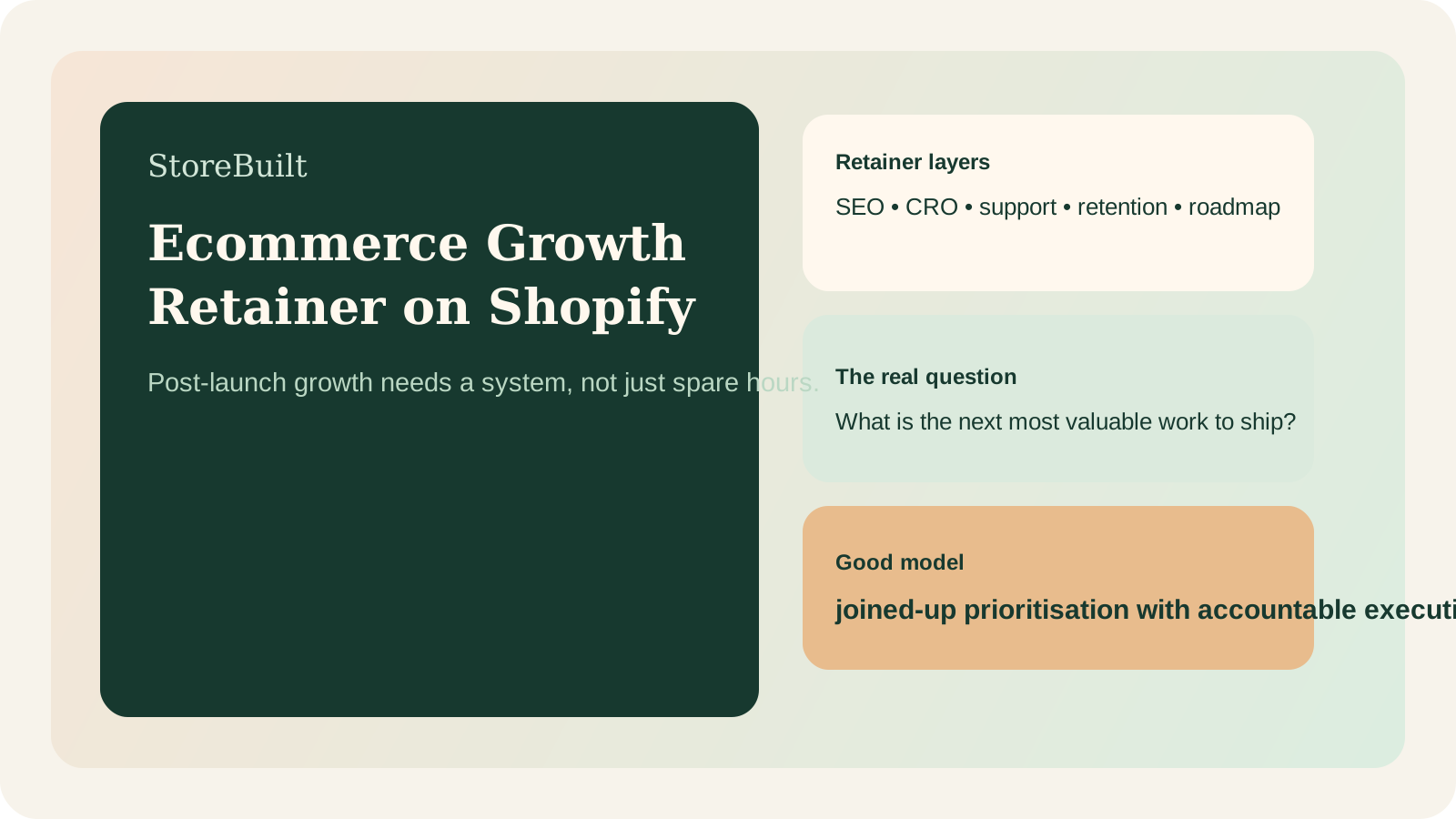
A good growth retainer should create compounding improvement after launch.
In practice, that means connecting:
- SEO and content
- CRO and merchandising
- release quality and support
- retention and lifecycle thinking
- reporting and prioritisation
The retainer should answer one practical question every month: what is the next most valuable work to ship on this store?
If it cannot answer that clearly, it is probably not a real growth model.
What UK competitors are signalling
The UK agency market has moved toward more commercial post-launch language.
Visible patterns include:
- growth and support blended into one offer
- CRO and experimentation used as a differentiator
- SEO and retention included in broader optimisation language
- Shopify-specialist positioning tied to long-term partnership rather than one-off builds
This is directionally positive. It reflects how stores actually need to be run.
The buyer risk is that similar language can hide very different operating models underneath. One agency may be selling a genuine cross-functional retainer. Another may be selling a ticket queue with nicer wording.
The 4 retainer models most brands encounter
| Retainer model | What it usually includes | Main limitation |
|---|---|---|
| Reactive support | fixes, incidents, small changes | little strategic progress |
| Delivery pod | steady dev/design help | may lack SEO or CRO direction |
| Growth pod | CRO, SEO, roadmap priorities, support | needs strong sequencing discipline |
| Fractional leadership plus execution | senior strategy plus implementation bench | cost is higher, but so is clarity |
The best choice depends on the stage of the business.
A smaller store may only need a light support-plus-optimisation model. A scaling Shopify brand with active campaigns, content work, and merchandising change usually needs more joined-up ownership.
A scope table for a strong Shopify growth retainer
Use this as the minimum comparison framework.
| Scope area | What good looks like | Why it matters |
|---|---|---|
| Monthly prioritisation | named owner and clear decision logic | stops random backlog drift |
| CRO and UX | ongoing testing or structured optimisation ideas | turns traffic into higher-value sessions |
| SEO and content implementation | not just recommendations, but shipped changes | visibility gains need execution |
| Release and QA control | launches and improvements handled safely | protects revenue during change |
| Retention coordination | lifecycle and on-site thinking connected | improves LTV, not only acquisition |
| Reporting | commercial view, not vanity-only view | helps leadership trust the spend |
A stronger retainer may also include campaign landing page support, merchandising advisory work, and app or theme governance reviews.
Red flags that should change your decision
Watch for these immediately:
- the proposal uses growth language but defines only support tasks
- SEO, CRO, and retention are all “available” but none has owned capacity
- no one is responsible for prioritisation
- reporting focuses on activity, not commercial movement
- urgent work consistently wipes out planned improvements
These are common reasons brands feel they are “paying for momentum” without seeing much of it.
If you need a more accountable operating model after launch, StoreBuilt’s support and audit route is the right place to start.
When a growth retainer is worth it
It usually makes sense when:
- the store already has baseline revenue and clear commercial goals
- the internal team needs a specialist execution bench
- release speed matters
- the brand wants continuous improvement rather than periodic rebuilds
It is less useful when the business still lacks clarity on proposition, margin, or channel economics. A retainer cannot fix a product-market problem by itself.
StoreBuilt example
One UK brand had already launched successfully, but post-launch work was fragmented between ad hoc development, disconnected SEO advice, and a separate retention freelancer. Nothing was badly broken, but momentum was inconsistent.
The fix was not more vendors. It was a tighter operating model. Once priorities, release ownership, CRO focus, and SEO implementation were brought into one monthly sequence, the business made faster decisions and wasted less energy on context switching.
That is often the hidden value of a good growth retainer. It removes coordination drag as much as it adds specialist skill.
If your current post-launch setup still feels scattered, run a free Shopify audit before committing to another vague retainer.
High-intent AI search implementation layer
The AI-search version of this topic is not just “write more content”. A useful answer engine result needs a page that gives a direct answer, proves the claim, and shows the next operational step inside Shopify.
| Area | StoreBuilt implementation check |
|---|---|
| Primary intent | The page should map to ecommerce growth retainer and one clear buyer or operator problem, not a vague traffic topic. |
| Shopify surface | Identify whether the work belongs on a collection, product page, theme section, checkout step, app workflow, email flow, or support process. |
| Proof | Add first-hand observations, product/category examples, screenshots, policy notes, review signals, or trustworthy external sources where they make the advice safer. |
| Internal route | Link the reader to the service most likely to solve the issue: Shopify support, maintenance and audits. |
| Measurement | Check Search Console, analytics, assisted conversions, enquiry quality, and AI-response mentions after the update rather than judging success by pageviews alone. |
For this article, the useful research inputs are: UK ecommerce platform SERPs, StoreBuilt platform-selection reviews, Shopify operating constraints, and cost/risk signals. StoreBuilt would prioritise technical audits, roadmap priority, theme changes, app governance, reporting, and measured improvement before expanding into broader supporting content.
If this topic maps to a live store problem, review the related StoreBuilt service or Contact StoreBuilt with the store URL and the issue you want fixed.
Final StoreBuilt point of view
An ecommerce growth retainer should be judged by whether it creates a better operating rhythm for the store, not by how many services are listed on the proposal.
For Shopify brands in the UK, the strongest retainers combine prioritisation, execution, QA, and commercial thinking into one accountable system. If the retainer cannot clearly show how the next month of work gets chosen and shipped, it is probably not a growth model yet.