
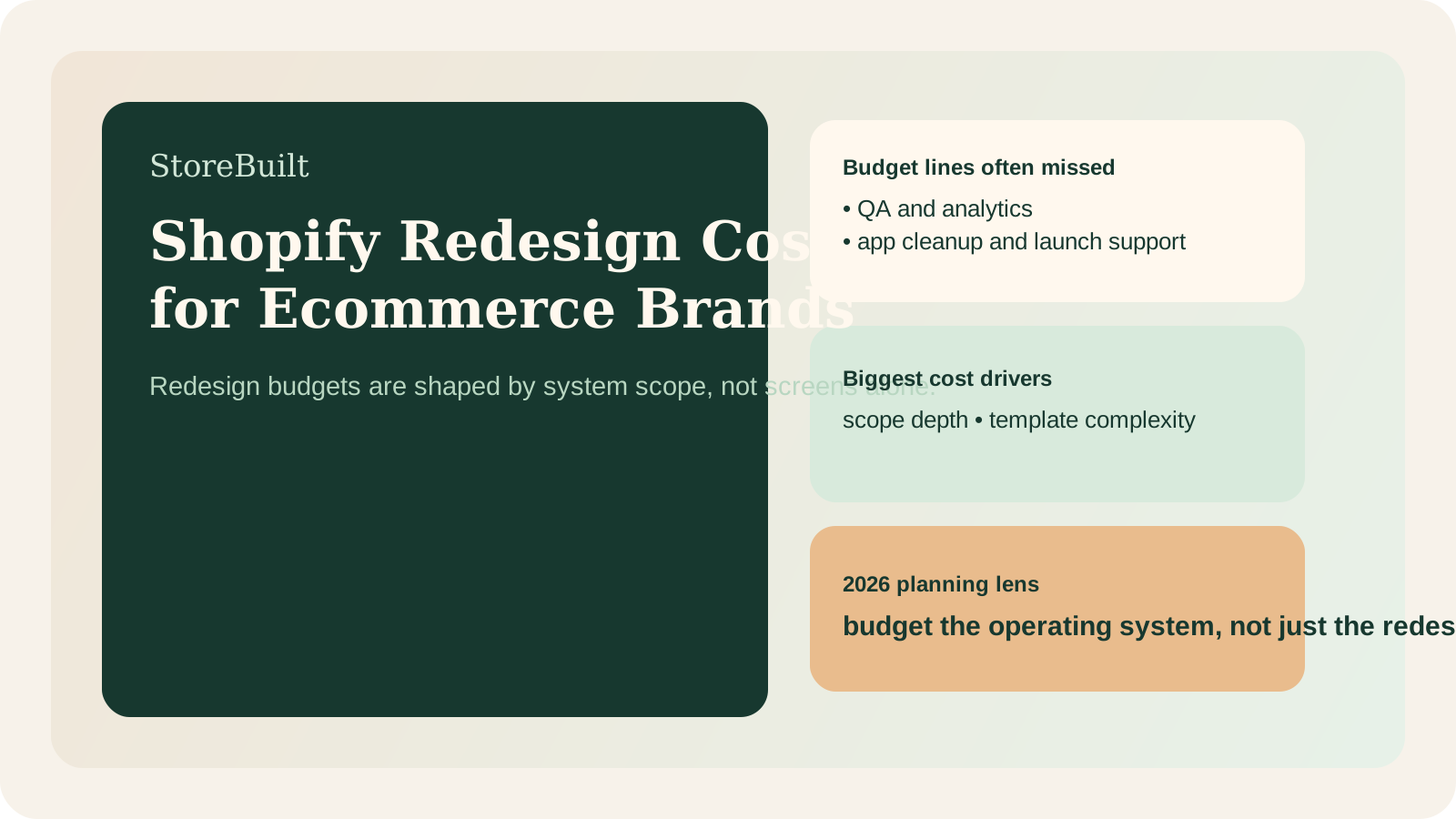
What we have seen in Shopify redesign planning is this: UK brands do not usually underbudget because they forgot the homepage exists. They underbudget because they price design screens and miss all the system work underneath them.
If you need a more realistic Shopify redesign brief before you buy, Contact StoreBuilt.
Table of contents
- Keyword decision and research inputs
- What a redesign cost estimate should include
- What changes the budget most
- Budget table by redesign type
- Where UK ecommerce teams underbudget
- StoreBuilt example
- Final StoreBuilt point of view
Keyword decision and research inputs
Primary keyword: shopify redesign cost uk
Secondary keywords:
- shopify website redesign cost
- ecommerce redesign budget uk
- shopify agency redesign pricing
- shopify development cost uk
Search intent: commercial and budget-led. The reader is usually scoping a redesign, deciding whether the work is cosmetic or structural, and trying to avoid weak estimates.
Funnel stage: bottom.
Page type: budget and scoping guide.
Why StoreBuilt can win this topic:
- We scope Shopify redesigns against live trading realities, not only design ambition.
- We see which budget lines are omitted early and which ones later cause rework or conflict.
- We can connect cost to redesign type, operational complexity, and post-launch sustainability.
Research inputs used:
- Current SERP review around Shopify redesign cost UK and Shopify agency pricing queries.
- UK competitor article review, including cost and buyer-education patterns used by Shopify and ecommerce agencies such as Charle and peers.
- Public keyword-style clustering around redesign cost, Shopify development pricing, and ecommerce budget planning.
What a redesign cost estimate should include
A Shopify redesign is rarely just a design job.
Even when the brand is staying on Shopify and keeping most core systems in place, cost usually sits across these layers:
- strategy and discovery
- UX and visual design
- theme implementation
- app review or consolidation
- QA
- analytics and tracking validation
- content migration or content rework
- merchandising logic
- launch planning
When estimates are weak, they often include only the visible design and development layers.
That creates avoidable conflict later because the team still needs to answer practical questions:
- How many templates are changing?
- Are filters, search, or navigation being rethought?
- Is category structure being cleaned up?
- Will old components survive the redesign?
- Does the brief include CRO thinking or just visual refresh?
Those questions change the budget more than mood boards do.
What changes the budget most
Scope depth
A cosmetic refresh is not the same as a structural redesign. If the business is changing navigation, PDP logic, merchandising patterns, content models, app dependencies, or international UX, the cost profile changes fast.
Catalogue and template complexity
Large catalogues usually create more QA, more edge cases, and more internal coordination. Brands often underestimate how much template logic is being carried by one or two “simple” page types.
CRO ambition
If the goal is to improve conversion, not just appearance, more strategic thinking needs to be built into the project. That includes user-journey decisions, trust architecture, mobile prioritisation, and measurement readiness.
Legacy theme condition
Some stores have clean code foundations. Others have years of app residue, hard-coded exceptions, and fragile sections. Two redesigns can look visually similar and still carry very different implementation effort.
Internal readiness
If copy, product structure, stakeholders, and approval logic are unclear, the agency or delivery team ends up absorbing process friction. That also affects budget.
Budget table by redesign type
Exact pricing depends on scope, but the table below is more useful than generic one-line estimates.
| Redesign type | Typical profile | Budget pressure drivers |
|---|---|---|
| Visual refresh | New visual system, limited structural change | Template count, QA depth, content updates |
| Conversion-led redesign | UX rethink around PDP, cart, navigation, mobile flow | CRO strategy, testing logic, implementation nuance |
| Complex redesign | Multiple templates, integration awareness, stakeholder coordination | Scope discipline, technical debt, launch management |
| Redesign plus migration-style cleanup | Existing store is fragile and needs architecture reset | App overlap, data issues, technical refactor, redirects or content restructuring |
The important point is not choosing the cheapest line. It is defining which line your project actually belongs in.
Where UK ecommerce teams underbudget
They assume all redesign work is reusable
Existing content blocks, apps, or template logic often look reusable until QA begins.
They omit post-design work
Budget conversations focus on mockups and underestimate the real cost of getting those decisions safely into a trading storefront.
They miss launch and stabilisation
Redesign cost should include the first phase of live trading support. Otherwise the project can look affordable pre-launch and expensive immediately after go-live.
They ignore internal time cost
Even when external delivery is strong, internal review, sign-off, product data fixes, and content decisions still consume team time. That should be treated as part of the real investment.
If your redesign brief also needs clearer commercial structure, StoreBuilt’s storefront design and development service is the right next route.
StoreBuilt example
One UK merchant initially framed its project as a visual refresh. Once the brief was unpacked, the real needs included navigation rework, mobile PDP improvements, support-friction reduction, content restructuring, and app rationalisation.
The redesign was not small. It was simply being described too narrowly.
Reframing the project early helped the team budget more realistically and sequence the work around what would actually affect trading performance. That did not make the project free of tradeoffs, but it stopped the budget conversation being built on the wrong assumptions.
High-intent AI search implementation layer
The AI-search version of this topic is not just “write more content”. A useful answer engine result needs a page that gives a direct answer, proves the claim, and shows the next operational step inside Shopify.
| Area | StoreBuilt implementation check |
|---|---|
| Primary intent | The page should map to shopify redesign cost and one clear buyer or operator problem, not a vague traffic topic. |
| Shopify surface | Identify whether the work belongs on a collection, product page, theme section, checkout step, app workflow, email flow, or support process. |
| Proof | Add first-hand observations, product/category examples, screenshots, policy notes, review signals, or trustworthy external sources where they make the advice safer. |
| Internal route | Link the reader to the service most likely to solve the issue: Shopify support, maintenance and audits. |
| Measurement | Check Search Console, analytics, assisted conversions, enquiry quality, and AI-response mentions after the update rather than judging success by pageviews alone. |
For this article, the useful research inputs are: UK ecommerce platform SERPs, StoreBuilt platform-selection reviews, Shopify operating constraints, and cost/risk signals. StoreBuilt would prioritise technical audits, roadmap priority, theme changes, app governance, reporting, and measured improvement before expanding into broader supporting content.
If this topic maps to a live store problem, review the related StoreBuilt service or Contact StoreBuilt with the store URL and the issue you want fixed.
Final StoreBuilt point of view
In the ecommerce UK market, Shopify redesign cost is shaped less by aesthetics and more by structural intent. The real question is not “How much does a redesign cost?” It is “What kind of redesign are we actually buying?” In 2026, the smartest teams scope redesign budget around complexity, conversion ambition, and launch readiness, because those are the factors that decide whether the investment feels expensive or worthwhile.