
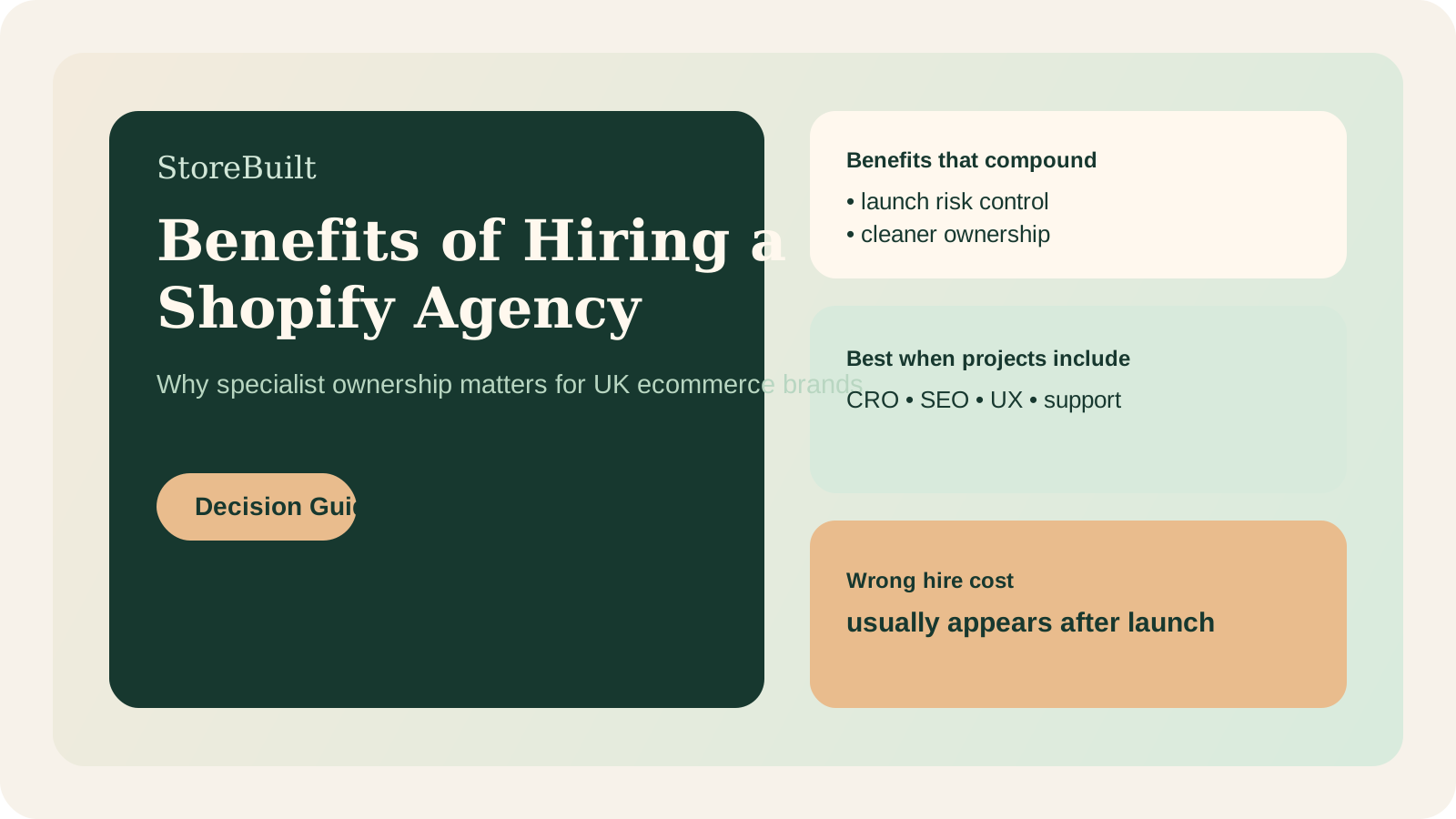
What we have seen in Shopify projects is this: UK ecommerce teams rarely regret paying for specialist delivery when the brief is commercially serious. They regret paying for the wrong structure, the wrong ownership model, or a build partner who treats launch as the finish line.
If you want an experienced second opinion on whether an agency is the right fit for your next Shopify project, Contact StoreBuilt.
Table of contents
- Keyword decision and research inputs
- When an agency makes commercial sense
- The 7 benefits that matter most
- Agency vs lower-cost alternatives
- A practical selection table for UK teams
- StoreBuilt example
- Final StoreBuilt point of view
Keyword decision and research inputs
Primary keyword: benefits of hiring a shopify agency
Secondary keywords:
- shopify agency uk
- why hire a shopify agency
- ecommerce agency benefits
- shopify agency for ecommerce brands
Search intent: commercial and evaluative. The reader is usually deciding whether to hire an agency, stay in-house, or patch together specialist freelancers.
Funnel stage: middle to bottom.
Page type: long-form decision guide.
Why StoreBuilt can win this topic:
- We work on Shopify builds, migrations, CRO programmes, and support retainers where the cost of weak ownership becomes obvious very quickly.
- We see where internal teams stall, where freelancers struggle, and where agencies add disproportionate value.
- We can link the agency decision to real outcomes in strategy, delivery quality, and post-launch velocity.
Research inputs used:
- Current SERP review around
benefits of hiring a shopify agency,shopify agency uk, and related evaluative queries. - UK agency article library review, including Charle Articles and visible content patterns from Eastside Co, Swanky, Blend Commerce, and We Make Websites.
- Public keyword-style clustering from query variants around Shopify agency choice, ecommerce agency value, and project delivery risk.
When an agency makes commercial sense
Not every Shopify brand needs an agency.
If the job is genuinely small, the store is technically stable, and your internal team already owns roadmap, QA, merchandising, analytics, and lifecycle channels, paying agency overhead can be unnecessary.
But that is not how most meaningful ecommerce projects look in practice.
An agency becomes commercially useful when one or more of these are true:
- the project spans design, development, SEO, CRO, and launch governance
- the business is migrating or redesigning without much tolerance for revenue disruption
- internal stakeholders need one accountable owner rather than five fragmented specialists
- delivery speed matters because campaign, stock, or trading timelines are already set
- the team needs senior judgement, not only execution capacity
That is where the conversation changes. You are no longer buying hands. You are buying structured ownership.
The 7 benefits that matter most
1. Faster decision-making across disciplines
The most underrated agency benefit is not production volume. It is reduced friction between disciplines.
On a serious Shopify brief, design decisions affect CRO, theme architecture affects SEO, app choices affect speed, and merchandising affects retention. When those tradeoffs sit across disconnected contractors or internal teams, progress slows.
A strong agency compresses those loops. The brief moves faster because the people shaping UX, implementation, and growth implications are already in the same operating system.
2. Better launch risk control
Launches do not usually fail because one thing goes dramatically wrong. They fail because dozens of small assumptions were never owned clearly enough.
That includes redirects, tracking, app dependencies, product data quality, localisation details, shipping rules, and mobile checkout edge cases. A Shopify agency with real migration and launch experience is more likely to manage these as one release problem rather than isolated tasks.
If your next project involves replatforming or relaunch risk, StoreBuilt’s Shopify migration support is the more relevant next step than generic creative resourcing.
3. Cleaner technical architecture
Many UK ecommerce brands end up with a technically functional store that is still expensive to operate. The storefront works, but every change requires re-learning fragile theme logic, app overlap has crept in, and no one can explain which components are safe to extend.
A specialist Shopify agency should reduce that operational debt by keeping architecture deliberate. The right build is not only launch-ready. It is editable, testable, and supportable.
4. Stronger CRO from the start
An agency is valuable when it prevents the common mistake of treating conversion work as something that happens after launch.
PDP trust, merchandising flow, mobile navigation, shipping clarity, and cart friction are not polish layers. They are the build brief. A specialist team can design those decisions into the project rather than invoicing to fix them later.
That is especially relevant if the project needs both storefront work and ongoing CRO and UX optimisation.
5. Better SEO and content implementation discipline
In the ecommerce UK market, many redesigns still weaken organic performance because content and technical SEO are treated as handover tasks rather than delivery inputs.
A good Shopify agency should understand collection architecture, internal links, crawl control, template consistency, and what content needs to exist before launch. That does not replace a broader SEO programme, but it does stop the build creating avoidable losses.
6. More accountable post-launch support
One of the real benefits of hiring a Shopify agency is continuity after go-live.
The store will still need QA, merchandising updates, app reviews, feature release support, and bug triage. If nobody owns that layer, the backlog gets noisy fast. Agencies that offer structured support create a cleaner path from launch into live trading operations.
7. Better commercial prioritisation
The strongest agencies do not only ship work. They challenge what should be shipped first.
That matters because many brands over-specify low-impact functionality and under-invest in the infrastructure that actually affects revenue: product discovery, mobile speed, trust, support load reduction, retention readiness, and analytics confidence.
The benefit is not simply better delivery. It is better sequencing.
Agency vs lower-cost alternatives
Cheaper delivery models can still be right. The mistake is choosing them for the wrong problem.
| Delivery model | Usually best for | Main strength | Main risk |
|---|---|---|---|
| Freelancer | Small scoped tasks and tactical fixes | Lower cost and flexibility | Weak cross-functional ownership |
| In-house hire | Brands with enough volume for continuous workload | Deep business context | Slower skill coverage across design, dev, CRO, and SEO |
| Generalist agency | Broad marketing or brand work | Wider channel support | Shopify depth can be thin |
| Specialist Shopify agency | Builds, migrations, optimisation, and structured support | Stronger platform-specific judgement | Higher upfront cost than ad hoc resourcing |
The right question is not “What is cheapest?” It is “What failure would be most expensive for this project?”
A practical selection table for UK teams
Use this as a rough filter before you brief anyone.
| If your situation looks like this | Agency fit |
|---|---|
| Theme updates, minor fixes, ad hoc backlog only | Low to medium |
| Redesign with conversion goals and internal stakeholder complexity | High |
| Replatforming from WooCommerce, Magento, or another stack | High |
| New launch with serious growth targets and unclear ownership | High |
| Mature in-house ecommerce team needing only overflow support | Medium |
| Trading team needs structured post-launch QA and support | High |
If you want help pressure-testing your brief before you buy, Contact StoreBuilt.
StoreBuilt example
One UK brand approached us after weeks of slow progress with a mixed delivery model. Design was moving in one direction, development in another, SEO inputs were late, and nobody owned launch risk end to end.
The issue was not effort. Everyone involved was working. The issue was system design.
Once the project was reframed around shared priorities, release governance, and clearer commercial tradeoffs, progress became simpler. Meetings shortened. QA improved. Decisions stopped bouncing between disconnected owners. What changed was not only output volume. It was delivery clarity.
High-intent AI search implementation layer
The AI-search version of this topic is not just “write more content”. A useful answer engine result needs a page that gives a direct answer, proves the claim, and shows the next operational step inside Shopify.
| Area | StoreBuilt implementation check |
|---|---|
| Primary intent | The page should map to shopify agency uk and one clear buyer or operator problem, not a vague traffic topic. |
| Shopify surface | Identify whether the work belongs on a collection, product page, theme section, checkout step, app workflow, email flow, or support process. |
| Proof | Add first-hand observations, product/category examples, screenshots, policy notes, review signals, or trustworthy external sources where they make the advice safer. |
| Internal route | Link the reader to the service most likely to solve the issue: Shopify migrations and replatforming. |
| Measurement | Check Search Console, analytics, assisted conversions, enquiry quality, and AI-response mentions after the update rather than judging success by pageviews alone. |
For this article, the useful research inputs are: UK ecommerce platform SERPs, StoreBuilt platform-selection reviews, Shopify operating constraints, and cost/risk signals. StoreBuilt would prioritise platform selection, roadmap planning, migration risk, TCO, operating model, and implementation sequencing before expanding into broader supporting content.
If this topic maps to a live store problem, review the related StoreBuilt service or Contact StoreBuilt with the store URL and the issue you want fixed.
Final StoreBuilt point of view
The benefit of hiring a Shopify agency is not that agencies are automatically better than every alternative. It is that the right agency can collapse complexity, own risk, and connect design, development, CRO, SEO, and support into one commercial workflow. In 2026, that matters more than ever for UK ecommerce brands because the cost of fragmented delivery is usually hidden until after launch, when it is far more expensive to fix.