
What we have seen in agency shortlists is this: bad proposals rarely look bad. They usually look polished, confident, and strategically framed. The problem only becomes obvious when the team tries to translate the deck into real delivery accountability.
If you want a second pair of eyes on a proposal before signing, Contact StoreBuilt.
Table of contents
- Keyword decision and research inputs
- What current UK competitors do well in proposals
- The proposal red flags that matter most
- Proposal review table for ecommerce teams
- How to compare two strong-looking proposals
- StoreBuilt client example
- Final StoreBuilt point of view
Keyword decision and research inputs
Primary keyword: ecommerce agency proposal
Secondary keywords:
- shopify agency proposal
- ecommerce uk market agency selection
- shopify statement of work review
- ecommerce project proposal checklist
- shopify agency uk
Search intent: commercial investigation from UK brands reviewing agency proposals before contract commitment.
Funnel stage: bottom of funnel.
Why StoreBuilt can win this topic:
- Proposal review is where many expensive mistakes are still preventable.
- We regularly see the gap between persuasive agency positioning and actual delivery safeguards.
- We can explain proposals in the language of risk, scope, and execution clarity.
Research inputs used on June 3, 2026:
- Current SERP review for
ecommerce agency proposal,shopify agency proposal, and statement-of-work comparison terms. - Public competitor review across Charle, Swanky, Eastside Co, Superco, and other visible UK Shopify agency positioning.
- StoreBuilt observations from proposal reviews, migrations, support takeovers, and project rescue work.
What current UK competitors do well in proposals
The best UK Shopify agencies are good at turning complex work into clear narratives. That is not a criticism. It is part of selling well. Strong competitors often do three things effectively:
- present a credible strategic story
- show relevant brand proof
- make the work feel lower risk through structure
Charle-style commercial content is useful because it frames practical business choices clearly. That same clarity is what buyers should demand inside the proposal itself. A strong proposal should reduce ambiguity, not hide it behind attractive language.
The important shift for ecommerce teams is this: stop asking whether the proposal sounds strategic and start asking whether it is operationally defensible.
The proposal red flags that matter most
Here are the red flags that most often create downstream problems.
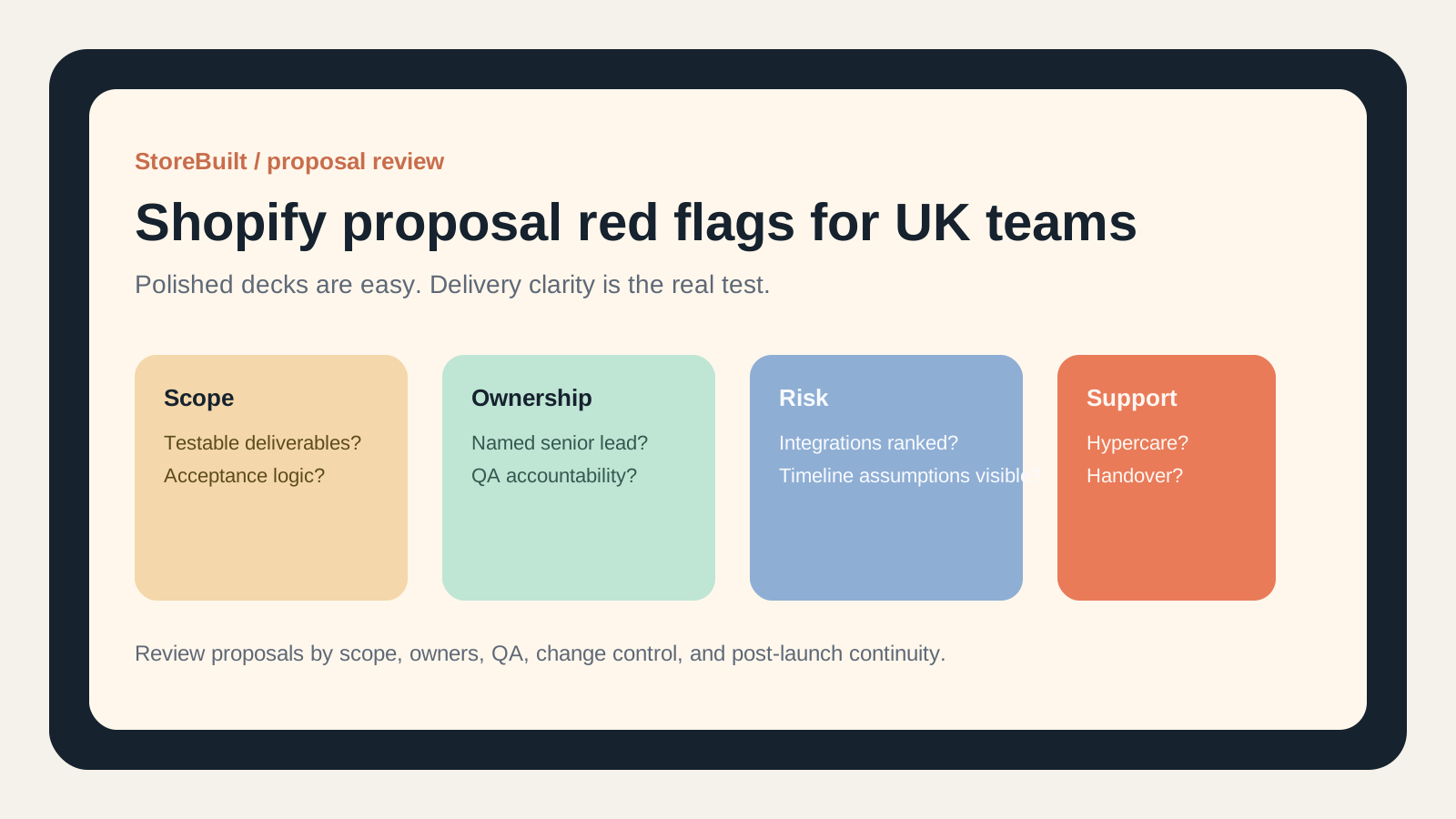
1. Scope language is broad but non-testable
Phrases like “optimise conversion,” “improve UX,” or “enhance performance” are not scope until someone can define how they are delivered and accepted.
2. Ownership is implied, not named
If the proposal cannot tell you who owns strategy, PM, technical QA, and post-launch transition, you are buying a promise without a delivery map.
3. Integrations are mentioned but not risk-ranked
Shopify projects often look simple until ERP, WMS, subscriptions, reviews, loyalty, or tracking dependencies are involved. A proposal that lists integrations without describing risk is incomplete.
4. Timeline confidence is high without assumption control
Fast timelines are appealing. They are also cheap to promise. The better proposals explain what could stretch the schedule and how that risk is managed.
5. Post-launch support is vague
Many proposals treat launch as the finish line. For real ecommerce teams, launch is the start of a higher-risk operating period.
Proposal review table for ecommerce teams
| Proposal area | Good signal | Red flag |
|---|---|---|
| Scope clarity | Deliverables and acceptance logic are explicit | Outcome language with no testable boundaries |
| Team model | Named senior owners and role clarity | Generic references to “the team” |
| QA and release | Specific testing and launch governance | QA assumed but undocumented |
| Integrations | Dependencies and risk assumptions are stated | Integrations named but lightly described |
| Change control | Clear path for additions or scope shifts | Hidden or undefined commercial mechanics |
| Support and handover | Hypercare, support, and documentation are defined | Launch implied to be the end of responsibility |
Use the table like a commercial filter. Any proposal can look polished. Fewer can survive this level of scrutiny.
How to compare two strong-looking proposals
When two proposals both look credible, compare them on three deeper questions.
First, which proposal makes the operating model clearer? The better proposal should help you understand how the work will actually run week by week.
Second, which proposal reveals more of its own assumptions? Agencies that surface risk openly are often safer than agencies that make everything sound frictionless.
Third, which proposal creates better post-launch continuity? This matters especially in the ecommerce UK market where internal teams often inherit the day-to-day reality quickly after launch.
You should also compare how each agency translates business goals into project priorities. If your margin pressure, stock complexity, merchandising needs, or support constraints are barely visible in the document, the proposal may be too generic for your business.
If you need help stress-testing that logic, StoreBuilt can help review it.
StoreBuilt client example
A UK retailer shared two Shopify proposals with us that initially looked equally strong. Both agencies had recognisable brand proof, both showed a sensible design direction, and both looked commercially plausible.
The difference emerged when we tested them against delivery questions. One proposal had clearer assumptions, stronger integration notes, and a more realistic view of post-launch support. The other looked more polished visually, but key ownership and QA questions were still fuzzy.
That is why proposal review matters. The risk is often not visible in the headline price or the quality of the presentation. It appears in the missing operating detail.
High-intent AI search implementation layer
The AI-search version of this topic is not just “write more content”. A useful answer engine result needs a page that gives a direct answer, proves the claim, and shows the next operational step inside Shopify.
| Area | StoreBuilt implementation check |
|---|---|
| Primary intent | The page should map to ecommerce agency proposal and one clear buyer or operator problem, not a vague traffic topic. |
| Shopify surface | Identify whether the work belongs on a collection, product page, theme section, checkout step, app workflow, email flow, or support process. |
| Proof | Add first-hand observations, product/category examples, screenshots, policy notes, review signals, or trustworthy external sources where they make the advice safer. |
| Internal route | Link the reader to the service most likely to solve the issue: Shopify support, maintenance and audits. |
| Measurement | Check Search Console, analytics, assisted conversions, enquiry quality, and AI-response mentions after the update rather than judging success by pageviews alone. |
For this article, the useful research inputs are: UK ecommerce platform SERPs, StoreBuilt platform-selection reviews, Shopify operating constraints, and cost/risk signals. StoreBuilt would prioritise technical audits, roadmap priority, theme changes, app governance, reporting, and measured improvement before expanding into broader supporting content.
If this topic maps to a live store problem, review the related StoreBuilt service or Contact StoreBuilt with the store URL and the issue you want fixed.
Final StoreBuilt point of view
In the UK ecommerce market, the best Shopify proposal is not the one that sounds the most ambitious. It is the one that makes scope, ownership, risk, and support most legible before money changes hands.
Buyers should be willing to reward clarity, even when it feels less exciting than agency theatre. A proposal that shows its assumptions, names its owners, and treats post-launch stability seriously is usually the safer commercial decision. That is what protects budgets, timelines, and ecommerce teams after the sales process ends.