
What we have seen in channel-readiness work is this: many UK ecommerce teams think they have a Google Shopping or product-feed problem when they actually have a product-data governance problem. The feed only exposes the weakness faster.
If feed quality is blocking visibility, margin control, or campaign efficiency, Contact StoreBuilt.
Table of contents
- Keyword decision and research inputs
- Why product feed governance matters beyond ads
- The governance layers most teams skip
- Feed governance table for Shopify brands
- How to build a working governance model
- StoreBuilt example
- Final StoreBuilt point of view
Keyword decision and research inputs
Primary keyword: shopify product feed governance
Secondary keywords:
- Shopify Google Shopping feed
- product feed optimization UK
- ecommerce product data governance
- Shopify Merchant Center feed
- ecommerce UK market product feed QA
Search intent: practical-commercial intent from ecommerce teams trying to improve feed quality and channel performance on Shopify.
Funnel stage: middle to bottom.
Likely page type: operational SEO and channel-governance guide.
Why StoreBuilt can realistically win this topic:
- This is a real commercial problem connecting SEO, merchandising, paid acquisition, and operations.
- Competing UK agency content often focuses on campaign setup but under-covers ownership and governance standards.
- StoreBuilt can translate product-feed performance into a repeatable operating model rather than one-off optimisation.
Research inputs used on June 4, 2026:
- Current SERP review for
shopify product feed,google shopping feed optimization, and channel-ready product-data queries. - UK competitor review across Shopify agency SEO content, including content clusters like Charle’s SEO guidance and channel-adjacent articles.
- Public keyword-style research from recurring modifiers around Merchant Center, feed errors, approvals, title optimisation, and product data quality.
Why product feed governance matters beyond ads
Product feeds are often treated as a paid-media utility. That is too narrow.
For a Shopify brand, feed quality affects:
- Google Shopping and Performance Max efficiency;
- free listings visibility;
- product accuracy in channel surfaces;
- promo clarity;
- margin protection;
- the workload required to fix repeated product-data issues.
A weak feed does not only reduce reach. It creates operational waste.
In the ecommerce UK market, product teams are often balancing catalogue growth, promotions, seasonal campaigns, and channel expectations at the same time. Without feed governance, teams end up in a reactive loop:
- titles are rewritten inconsistently;
- attributes are missing or handled ad hoc;
- promo messaging leaks into the wrong products;
- out-of-stock or unavailable items keep distorting spend;
- nobody owns the QA standards end to end.
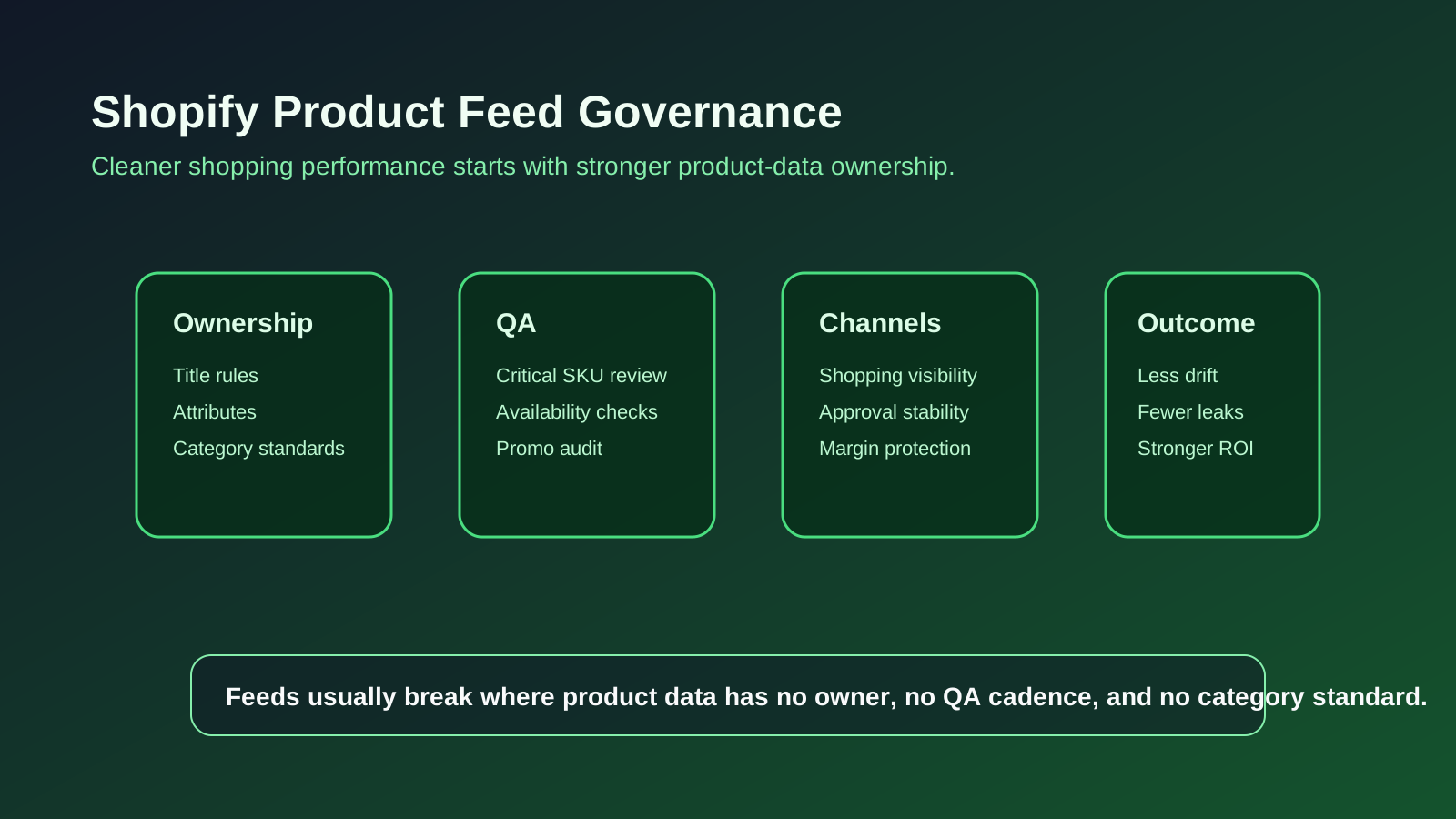
That is why feed quality should be treated as a system of rules and owners, not a dashboard full of warnings.
The governance layers most teams skip
1. Title logic is not standardised
Teams often optimise product titles one by one without agreeing a consistent naming model by category. That makes scaling harder and weakens channel clarity.
2. Attributes exist, but ownership does not
If brand, GTIN, MPN, size, colour, condition, or taxonomy attributes are incomplete, the problem is usually not just missing data. It is missing ownership.
3. Merchandising and paid teams work from different assumptions
One team may prioritise customer-friendly naming while another wants channel keyword coverage. Without a shared model, the feed becomes inconsistent.
4. Promotions are not governed carefully enough
Promotional language and pricing logic can create approval, margin, or trust issues when feed rules are not managed deliberately.
5. There is no feed QA cadence
Many brands only look at feed errors when performance drops or a disapproval appears. By then, the issue is already expensive.
Feed governance table for Shopify brands
| Governance area | What good looks like | Common failure mode | Commercial effect |
|---|---|---|---|
| Product titles | Category-specific naming rules with clear inputs | Manual title rewrites with no standard | Weak relevance and messy scaling |
| Core attributes | Mandatory fields owned by role and workflow | Attributes filled inconsistently or late | Approval risk and poor matching |
| Availability and price | Channel data reflects live selling reality | Feed lags operational changes | Spend inefficiency and shopper distrust |
| Promotions | Offer logic is controlled and auditable | Discount messaging leaks or conflicts | Margin erosion and feed inconsistency |
| Feed QA | Weekly review of critical issues and drift | Error review only after performance pain | Slow recovery and repeated mistakes |
| Cross-team ownership | Merchandising, SEO, and acquisition are aligned | No one owns the whole standard | Recurring channel instability |
This table is useful because it turns feed work into operating discipline. Teams stop asking only “how do we optimise?” and start asking “who owns quality before the channel sees it?”
How to build a working governance model
Start with the product data, not the channel warning.
Define category-level feed rules
Different categories need different emphasis. Apparel, electronics, supplements, and gifting products do not need identical title logic or attribute depth.
Make the mandatory fields explicit
Agree which fields must be present before a product is considered channel-ready. This should not depend on who happens to upload the item.
Separate customer copy from feed logic where needed
A strong PDP title and a strong channel title may need slightly different structures. That does not mean they should contradict each other. It means the governance model should be deliberate.
Create a recurring QA cycle
Critical products, top-spend SKUs, and launch ranges deserve routine feed review before issues become budget waste.
Connect feed governance to commercial reporting
Feed quality should be reviewed alongside performance, not isolated from it. If products with incomplete attributes keep underperforming or misfiring operationally, that is not coincidence.
Useful related resources:
- Shopify Google Merchant Center Feed Optimization UK
- Shopify SEO and AI Search Readiness
- Shopify Product Taxonomy and Navigation for SEO and CRO
If your team needs a cleaner route from product data into channel performance, review our Shopify SEO and AI search service.
StoreBuilt example
A UK ecommerce team had healthy catalogue demand but unstable Shopping performance. The immediate assumption was that bidding and campaign structure were the problem.
On review, the feed revealed deeper governance issues. Product titles were inconsistent by range, attributes were incomplete on commercially important SKUs, and promotion handling was too loose to scale cleanly. The problem was not one isolated error. It was the absence of a category-led feed standard.
Once the team moved from reactive fixes to defined data ownership and QA rules, channel performance became easier to stabilise because the input quality improved.
High-intent AI search implementation layer
The AI-search version of this topic is not just “write more content”. A useful answer engine result needs a page that gives a direct answer, proves the claim, and shows the next operational step inside Shopify.
| Area | StoreBuilt implementation check |
|---|---|
| Primary intent | The page should map to shopify product feed governance and one clear buyer or operator problem, not a vague traffic topic. |
| Shopify surface | Identify whether the work belongs on a collection, product page, theme section, checkout step, app workflow, email flow, or support process. |
| Proof | Add first-hand observations, product/category examples, screenshots, policy notes, review signals, or trustworthy external sources where they make the advice safer. |
| Internal route | Link the reader to the service most likely to solve the issue: Shopify SEO and AI search readiness. |
| Measurement | Check Search Console, analytics, assisted conversions, enquiry quality, and AI-response mentions after the update rather than judging success by pageviews alone. |
For this article, the useful research inputs are: Google Search Central guidance, Shopify platform documentation, Ahrefs AI Responses/Brand Radar patterns, and StoreBuilt Shopify audit observations. StoreBuilt would prioritise technical SEO, collection architecture, Product schema, answer-first content, GEO, and Search Console monitoring before expanding into broader supporting content.
If this topic maps to a live store problem, review the related StoreBuilt service or Contact StoreBuilt with the store URL and the issue you want fixed.
Final StoreBuilt point of view
Product feeds do not fail in isolation. They fail where product-data governance is weak.
For UK Shopify brands, better feed performance usually comes from stronger structure, ownership, and QA discipline rather than endless one-off optimisation. The goal is not to make the feed look cleaner for its own sake. It is to create a product-data system that supports visibility, margin, and channel confidence together.
If your team is still fixing Merchant Center symptoms without addressing the data model behind them, you are solving the wrong layer. Build the governance properly and the feed becomes far easier to trust. If that needs a more structured audit, Contact StoreBuilt.