
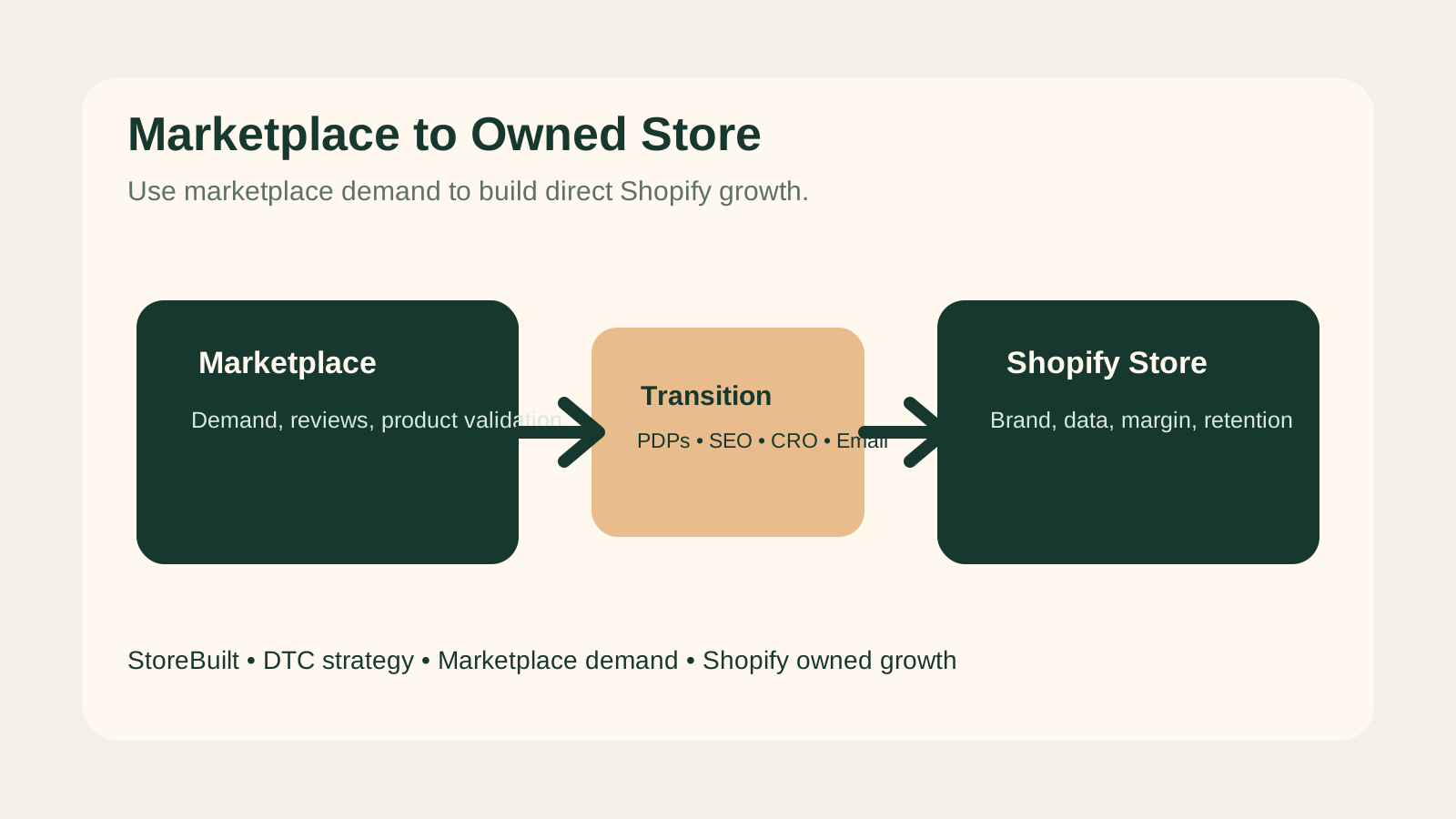
What we have seen in marketplace-to-Shopify projects is this: brands often treat marketplaces as a problem to escape from, but the better view is more balanced. Marketplaces can prove demand, move stock, create product discovery, and reduce early friction. The risk is becoming dependent on a channel that owns the customer relationship, controls the rules, compresses margin, and makes brand building harder.
Charle and other UK ecommerce agencies publish platform and growth guides because merchants are trying to choose where to invest next. StoreBuilt’s view is that the strongest marketplace-to-owned-store strategy is not “leave marketplaces”. It is “use marketplace demand intelligently, then build a Shopify store that earns the direct relationship”.
If your brand sells through Amazon, TikTok Shop, Etsy, eBay, Not On The High Street, or wholesale channels and wants a stronger owned Shopify route, Contact StoreBuilt.
Table of contents
- Keyword decision and research inputs
- Why marketplace demand is different
- The owned-store transition model
- Marketplace-to-Shopify table
- StoreBuilt example
- 90-day owned-store plan
- Final StoreBuilt point of view
Keyword decision and research inputs
Primary keyword: marketplace to Shopify
Secondary keywords: marketplace to DTC, ecommerce UK market, Shopify owned store, Amazon to Shopify, TikTok Shop to Shopify.
Search intent: strategic and commercial. The reader has marketplace traction and wants to decide whether Shopify can become a stronger direct channel.
Funnel stage: middle funnel, with migration, build, SEO, CRO, and retention service relevance.
Page type: implementation playbook.
Why StoreBuilt can realistically win this topic:
- The topic supports Shopify store design and development, Shopify migrations and replatforming, and Klaviyo email and SMS retention.
- Existing articles often frame marketplace versus DTC as a simple channel choice. StoreBuilt can explain the operating model required to make Shopify perform.
- The topic is commercially relevant for UK brands moving from validation into owned growth.
Research inputs used on July 2, 2026:
- Current SERP review for marketplace to Shopify, marketplace to DTC, ecommerce UK market, Amazon to Shopify, and TikTok Shop ecommerce strategy.
- Charle article hub review for ecommerce strategy, platform, CRO, and marketing guide topic patterns.
- StoreBuilt content inventory around marketplace-to-DTC, platform choice, SEO, CRO, and retention.
Why marketplace demand is different
Marketplace demand usually starts with product intent. A customer searches for a specific product type, compares price, reads reviews, and buys inside a trusted marketplace environment. The brand benefits from traffic and transaction confidence, but loses control over much of the relationship.
An owned Shopify store has a different job. It has to create enough confidence without the marketplace wrapper. That means the store needs stronger:
- product storytelling;
- reviews and proof;
- delivery and returns clarity;
- category navigation;
- trust signals;
- payment options;
- comparison content;
- customer capture and retention;
- post-purchase communication.
This is why simply copying marketplace listings into Shopify rarely works. Marketplace listings are built for a marketplace context. Owned-store product pages need a fuller decision journey.
The transition also changes measurement. Marketplace sales may look efficient because the demand is already concentrated. Shopify sales require investment in acquisition, SEO, content, email, CRO, and operations. The goal is not to beat marketplace conversion rate immediately. The goal is to build a direct channel that improves margin, customer data, repeat purchase, and brand equity over time.
The owned-store transition model
1. Identify marketplace winners
Start with products that already prove demand. Look for stable sales, strong reviews, clear repeat-purchase potential, defensible margin, and product categories where brand education can improve the decision.
2. Build owned product pages properly
The Shopify PDP should not be a thin listing. It should include product benefits, specifications, reviews, delivery promises, returns reassurance, FAQs, comparison points, and relevant cross-sells.
3. Create category and buying-guide content
Search demand often sits above the product level. Category pages and buying guides help customers compare options before selecting a product. This is where Shopify SEO and AI search readiness becomes important.
4. Capture customers without cheapening the brand
Email capture, bundles, first-order incentives, samples, loyalty, and replenishment should be designed carefully. The owned store should not rely only on discounting to compete with marketplaces.
5. Protect operations
Direct customers expect clear delivery, support, returns, and post-purchase communication. If operations are weaker than the marketplace experience, customers will not feel the benefit of buying direct.
6. Keep marketplaces in the model where useful
Marketplace channels can remain useful for discovery, clearance, product validation, or specific customer segments. The question is not whether marketplaces are good or bad. The question is what each channel is allowed to do.
Marketplace-to-Shopify table
| Transition area | Marketplace strength | Shopify owned-store requirement |
|---|---|---|
| Discovery | Built-in search demand | SEO, content, paid, social, and email capture |
| Trust | Marketplace reviews and guarantees | Product proof, brand credibility, returns clarity |
| Conversion | Familiar buying environment | Faster mobile PDPs, payment fit, checkout trust |
| Margin | Fees and price pressure | Bundles, retention, AOV, lifecycle, direct data |
| Customer relationship | Limited customer ownership | Email/SMS, accounts, post-purchase, loyalty |
| Product education | Listing constraints | Guides, comparisons, FAQs, video, rich PDPs |
StoreBuilt example
In one Shopify planning discussion, a brand had strong marketplace traction but weak owned-store performance. The team initially wanted a redesign. The deeper issue was that Shopify had never been given a different job from the marketplace. Product pages were short, collection pages had little context, email capture was generic, and marketplace bestsellers were not surfaced clearly in navigation.
The plan was to start with proven products. We mapped marketplace winners into owned-store collections, expanded product-page content, added comparison and FAQ modules, improved delivery reassurance, and built retention flows around repeat-purchase timing. The goal was not to remove marketplace revenue. It was to make Shopify capable of earning direct customers.
That distinction matters. A marketplace can be a sales channel. Shopify should become the operating base for brand, data, content, retention, and margin improvement.
90-day owned-store plan
| Period | Work | Output |
|---|---|---|
| Days 1-15 | Marketplace demand audit | Product winners, review themes, margin, repeat potential |
| Days 16-30 | Shopify route mapping | Collections, PDPs, buying guides, and navigation priorities |
| Days 31-50 | Page build and CRO | Rich PDPs, proof modules, FAQs, delivery and return clarity |
| Days 51-70 | SEO and content | Category copy, comparison guides, internal links, schema |
| Days 71-90 | Retention system | Welcome, post-purchase, replenishment, winback, and VIP flows |
High-intent AI search implementation layer
The AI-search version of this topic is not just “write more content”. A useful answer engine result needs a page that gives a direct answer, proves the claim, and shows the next operational step inside Shopify.
| Area | StoreBuilt implementation check |
|---|---|
| Primary intent | The page should map to marketplace to Shopify and one clear buyer or operator problem, not a vague traffic topic. |
| Shopify surface | Identify whether the work belongs on a collection, product page, theme section, checkout step, app workflow, email flow, or support process. |
| Proof | Add first-hand observations, product/category examples, screenshots, policy notes, review signals, or trustworthy external sources where they make the advice safer. |
| Internal route | Link the reader to the service most likely to solve the issue: Apps, integrations and automation. |
| Measurement | Check Search Console, analytics, assisted conversions, enquiry quality, and AI-response mentions after the update rather than judging success by pageviews alone. |
For this article, the useful research inputs are: UK ecommerce platform SERPs, StoreBuilt platform-selection reviews, Shopify operating constraints, and cost/risk signals. StoreBuilt would prioritise app stack decisions, integration logic, automation, data flow QA, and operational reliability before expanding into broader supporting content.
If this topic maps to a live store problem, review the related StoreBuilt service or Contact StoreBuilt with the store URL and the issue you want fixed.
Final StoreBuilt point of view
The best marketplace-to-Shopify strategy does not pretend marketplaces are useless. It uses them as demand signals, then builds owned-store assets that marketplaces cannot provide: brand depth, customer data, retention, content, and margin control. StoreBuilt’s view is simple: do not leave demand behind, but do not let someone else’s platform own the customer relationship forever.
For help turning marketplace traction into a stronger Shopify store, Contact StoreBuilt.