
What we have seen in Shopify platform reviews is this: many brands ask if they are ready for Shopify Plus when the better question is whether Plus will remove a real constraint in the next 12 to 18 months. Without that link, the conversation turns into status-signalling instead of platform strategy.
If you need help deciding whether Plus belongs in the roadmap, Contact StoreBuilt.
Table of contents
- Keyword decision and research inputs
- What Shopify Plus readiness really means
- Signs the upgrade may be justified
- Signs a standard Shopify setup may still be enough
- Readiness checklist table
- How agencies and competitors frame the decision
- StoreBuilt example
- Final StoreBuilt point of view
Keyword decision and research inputs
Primary keyword: shopify plus readiness checklist
Secondary keywords:
- Shopify Plus UK
- ecommerce Shopify Plus guide
- is Shopify Plus worth it UK
- Shopify Plus for UK ecommerce brands
Search intent: strategic evaluation.
Funnel stage: middle to bottom.
Page type: decision guide.
Why StoreBuilt can realistically win this topic:
- This is a commercially meaningful query where operators want a framework, not product marketing.
- Many existing pages stay feature-led instead of constraint-led.
- StoreBuilt can connect Plus readiness to actual merchandising, B2B, international, and operational issues.
Research inputs used:
- Current SERP patterns around Shopify Plus readiness, worth-it, and UK evaluation queries.
- UK competitor positioning and service framing across leading Shopify agencies including Charle, Swanky, Eastside Co, Superco, We Make Websites, and Fourmeta.
- Public query-modifier research around B2B, checkout customisation, international expansion, automation, and complex ecommerce operations.
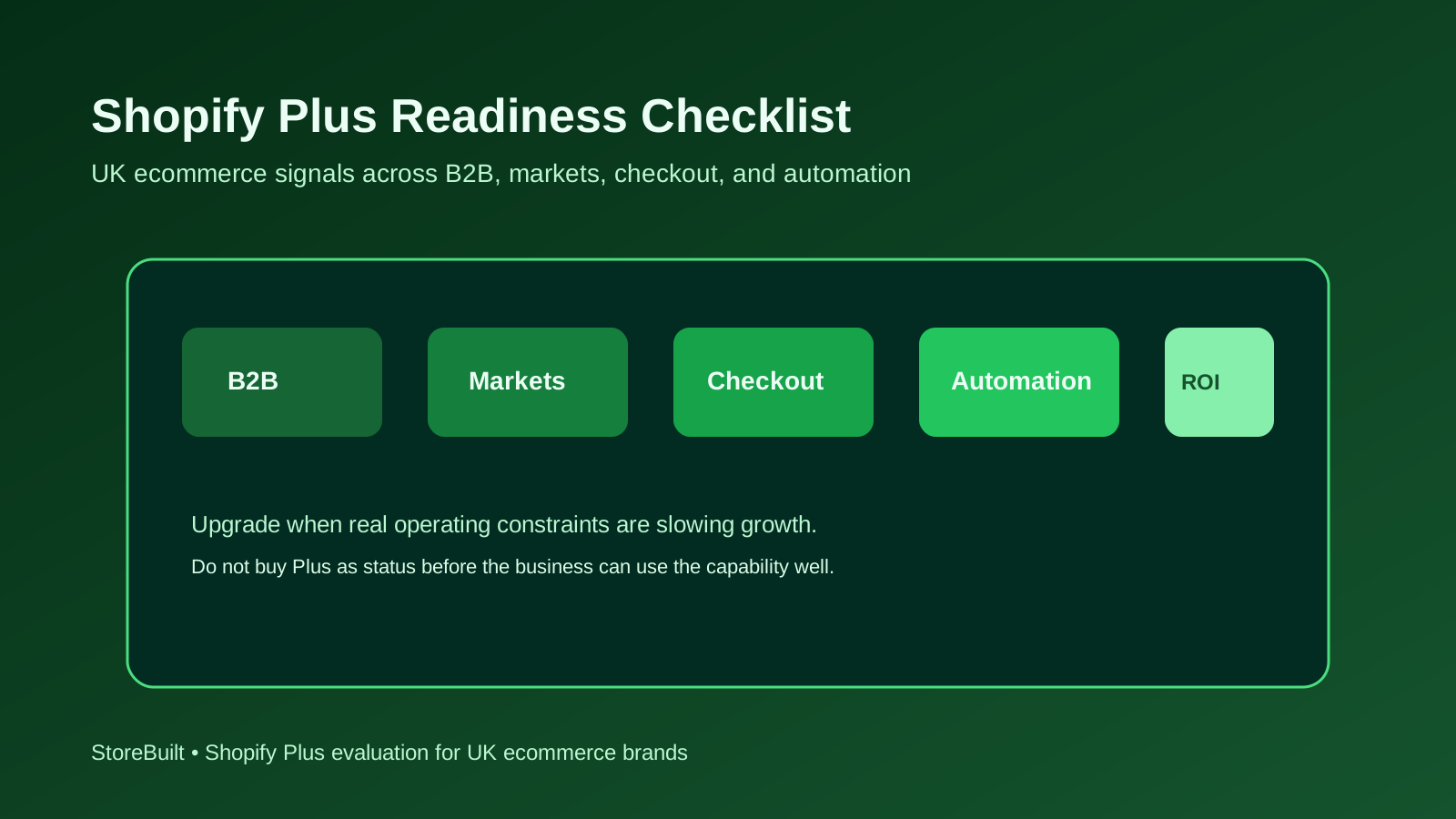
What Shopify Plus readiness really means
Shopify Plus readiness is not about revenue vanity alone.
A brand can be growing well and still not need Plus yet. Another can be smaller but already justify the upgrade because the operating model is becoming complex in ways standard Shopify is beginning to constrain.
Useful readiness signals usually sit in one of these areas:
- multi-market complexity
- B2B requirements
- higher checkout control needs
- workflow automation pressure
- multiple stakeholder teams with heavier operating requirements
The wrong way to evaluate Plus is to ask whether the plan sounds more premium. The right way is to ask whether current constraints are slowing revenue, team speed, or rollout quality.
Signs the upgrade may be justified
In the ecommerce UK market, the strongest Plus cases often look like this:
- a brand is balancing DTC and wholesale or trade orders
- checkout logic needs more control around shipping, payments, discounts, or scripts/functions strategy
- international expansion is increasing operational complexity
- the app stack is doing too much work around process gaps
- launches require better governance, permissions, and automation
There is also a team-shape signal. If internal ecommerce, operations, marketing, and finance stakeholders are all relying on the store more heavily, platform friction becomes more expensive.
If your roadmap includes B2B or more advanced platform structure, review our Shopify Plus and B2B service.
Signs a standard Shopify setup may still be enough
Many brands do not need Plus yet, even if they expect to later.
Common reasons to stay put:
- the main issues are still theme UX, conversion, and content quality
- the catalogue and order workflows are manageable
- there is no meaningful B2B or international complexity yet
- the team has not fully used what the current Shopify stack can already support
- post-launch discipline is weaker than platform capability
We see this often on stores where the instinct is to upgrade platforms before fixing fundamentals. If the product page is weak, the collection structure is unclear, and retention flow quality is low, Plus will not solve those problems.
Readiness checklist table
| Area | Ask this question | Why it matters | Readiness signal |
|---|---|---|---|
| Markets | Are we managing multiple countries or regional trading rules? | International structure can outgrow simple setups | Medium to high |
| B2B | Do we need trade pricing, account logic, or self-serve wholesale workflows? | Standard setups can become awkward | High |
| Checkout | Are checkout rules or customer journeys becoming a growth constraint? | Control matters once scale adds friction | Medium to high |
| Automation | Are staff handling too many manual exceptions? | Platform efficiency starts to matter more | Medium |
| Governance | Do multiple teams need cleaner permissions, rollout discipline, and process control? | Operational maturity affects ROI | Medium |
If most of your answers are still low urgency, the better investment may be CRO, theme restructuring, or a migration readiness sprint rather than a Plus jump.
How agencies and competitors frame the decision
Competitor review is useful here because many UK Shopify agencies position Shopify Plus as a growth-stage milestone. That framing is partly right, but it can become too broad if it ignores operational fit.
The more reliable question is not “Are we a growing brand?” It is “Which limits are already costing us time, margin, or execution quality?”
That is where good agency guidance should become specific:
- is the main problem B2B?
- is the issue international architecture?
- is the bottleneck checkout control?
- is the theme still the biggest constraint?
- is the real answer better support and optimisation before any plan upgrade?
StoreBuilt example
One UK brand initially approached the Plus conversation as a prestige move. After reviewing the roadmap, the better answer was to delay the upgrade slightly and first fix catalogue UX, subscriptions, and internal merchandising workflow on the existing setup.
A later phase then made more sense because the team could point to concrete constraints that Plus would solve. That sequence produced a better business case and avoided paying for capability before the organisation was ready to use it.
What the business case should include
Before approving Shopify Plus, write the decision into a short table:
| Decision area | Question |
|---|---|
| Commercial outcome | What revenue, margin, or operating benefit should Plus unlock? |
| Constraint | What cannot be solved cleanly on the current setup? |
| Timing | Why now, not six months earlier or later? |
| Team readiness | Who will own the new capability after rollout? |
| Delivery path | Do we need migration, theme work, B2B setup, or support around the move? |
That removes emotion from the decision and makes agency scoping easier.
High-intent AI search implementation layer
The AI-search version of this topic is not just “write more content”. A useful answer engine result needs a page that gives a direct answer, proves the claim, and shows the next operational step inside Shopify.
| Area | StoreBuilt implementation check |
|---|---|
| Primary intent | The page should map to Shopify Plus and one clear buyer or operator problem, not a vague traffic topic. |
| Shopify surface | Identify whether the work belongs on a collection, product page, theme section, checkout step, app workflow, email flow, or support process. |
| Proof | Add first-hand observations, product/category examples, screenshots, policy notes, review signals, or trustworthy external sources where they make the advice safer. |
| Internal route | Link the reader to the service most likely to solve the issue: Shopify Plus and B2B. |
| Measurement | Check Search Console, analytics, assisted conversions, enquiry quality, and AI-response mentions after the update rather than judging success by pageviews alone. |
For this article, the useful research inputs are: UK ecommerce platform SERPs, StoreBuilt platform-selection reviews, Shopify operating constraints, and cost/risk signals. StoreBuilt would prioritise company accounts, price lists, catalogues, net terms, wholesale UX, and B2B operating controls before expanding into broader supporting content.
If this topic maps to a live store problem, review the related StoreBuilt service or Contact StoreBuilt with the store URL and the issue you want fixed.
Final StoreBuilt point of view
Shopify Plus is worth it when it removes real operating constraints, not when it simply sounds like the next serious move. UK ecommerce brands usually make the best Plus decision when they treat it as an execution unlock, not a badge.