
What we have seen in Shopify growth reviews is this: UK ecommerce brands often talk about “more traffic” when the actual problem is demand capture. Search demand, paid traffic, social attention, repeat-purchase intent, and marketplace leakage already exist in the market. The store has to catch that intent with the right page, message, product route, proof, checkout, and follow-up.
Charle’s article library shows the same market pressure from another angle. Their Shopify and ecommerce guides cover CRO, marketing automation, platform decisions, SEO, and ecommerce statistics because UK merchants are no longer asking one simple platform question. They are asking how the whole growth system works. StoreBuilt’s angle is more operational: demand only becomes revenue when the ecommerce team can turn intent into a clear journey.
If your Shopify store is getting visibility but not enough commercially useful orders, Contact StoreBuilt.
Table of contents
- Keyword decision and research inputs
- What demand capture means
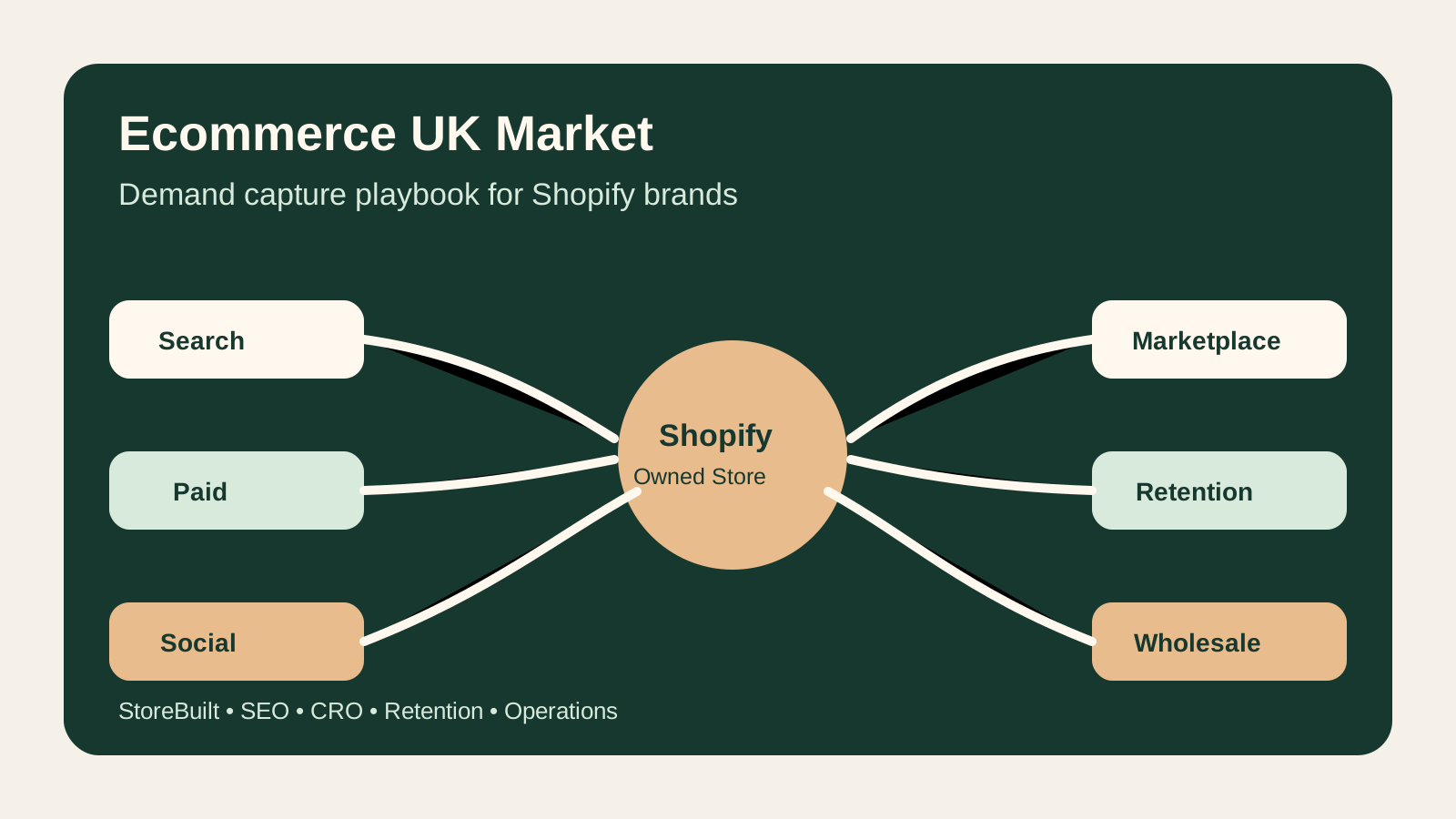
- The six demand routes
- Demand capture table
- StoreBuilt example
- 60-day implementation plan
- Final StoreBuilt point of view
Keyword decision and research inputs
Primary keyword: ecommerce UK market
Secondary keywords: ecommerce strategy UK, Shopify growth UK, ecommerce demand capture, Shopify CRO, ecommerce SEO UK.
Search intent: strategic and commercial. The reader wants a practical view of how to grow a Shopify store in the UK market, not a generic definition of ecommerce.
Funnel stage: middle funnel, moving toward audit, CRO, SEO, or support enquiry.
Page type: long-form strategic playbook.
Why StoreBuilt can realistically win this topic:
- The topic supports Shopify SEO and AI search readiness, CRO and UX optimisation, and Klaviyo email and SMS retention.
- Many competitor articles discuss individual channels. Fewer explain how UK demand moves through Shopify architecture, content, checkout, and lifecycle.
- StoreBuilt can speak from audit and implementation patterns across Shopify builds, migrations, CRO, and retention.
Research inputs used on July 2, 2026:
- Current SERP and UK Shopify agency review for ecommerce UK market, Shopify growth, ecommerce CRO, and ecommerce SEO queries.
- Charle article hub review, including their emphasis on CRO, marketing automation, platform guides, Shopify Plus, Online Store 2.0, POS, and SEO statistics.
- Public Shopify UK blog and platform context around ecommerce, checkout, agentic commerce, and growth operations.
What demand capture means
Demand capture is the work between attention and revenue. It is not the same as acquisition. A brand can create demand through paid media, social content, PR, marketplace sales, retail distribution, influencer activity, and offline awareness. Demand capture asks whether the Shopify store is ready when that intent arrives.
In practical terms, demand capture depends on:
- whether searchers land on the right category, product, guide, or service page;
- whether the page answers the decision the customer is trying to make;
- whether product data, stock, delivery, returns, and trust are clear;
- whether checkout supports the payment and delivery expectations of the UK market;
- whether post-purchase and lifecycle flows bring customers back;
- whether the team can measure the route from intent to margin.
The common mistake is treating each channel separately. SEO creates collection traffic, paid media creates landing page traffic, email creates repeat traffic, and marketplaces create product validation. But customers do not experience those channels as separate internal teams. They experience one brand, one store, and one buying decision.
For Shopify teams, this means the store architecture has to carry the strategy. A strong homepage can help, but most commercial demand lands deeper: collection pages, product pages, buying guides, comparison pages, campaign pages, and cart. If those pages are weak, the brand may blame the channel when the storefront is leaking confidence.
The six demand routes
1. Search demand
Search demand is usually the most durable because it reflects active intent. The issue is not only ranking for broad keywords. UK ecommerce brands need category pages, buying guides, comparison content, and product pages that match what customers actually search before purchase.
This is where Shopify SEO and AI search readiness matters. Search engines and AI-shopping surfaces need clean product data, crawlable content, structured category logic, and pages that explain the decision clearly.
2. Paid demand
Paid demand should not be sent into weak generic pages. A paid landing page must match the offer, product stage, audience problem, and next action. If the ad promises a specific solution but the landing page sends shoppers into a broad collection, the campaign pays for confusion.
3. Social and creator demand
Social traffic often arrives with lower patience and higher visual expectation. These visitors need fast mobile pages, clear product proof, strong reviews, and obvious routes to the products featured in the content.
4. Marketplace demand
Amazon, TikTok Shop, Etsy, Not On The High Street, and other marketplaces can prove demand, but they can also hide customer relationships. A Shopify strategy should identify which marketplace winners deserve owned-store treatment.
5. Retention demand
Retention demand comes from existing customers who already know the brand. These customers need replenishment, cross-sell, VIP, subscription, or education paths that feel useful rather than noisy.
6. Wholesale and partner demand
For some UK brands, growth is not only DTC. Trade accounts, stockists, corporate gifting, and B2B buying may need a separate Shopify Plus or B2B path. The store should make that route obvious without confusing retail customers.
Demand capture table
| Demand route | Shopify page or system | Main risk | Better operating question |
|---|---|---|---|
| Organic search | Collections, PDPs, guides | Ranking pages do not match buying intent | Which query deserves which canonical page? |
| Paid media | Campaign landing pages | Ad promise and page content diverge | Does the landing page answer the exact offer? |
| Social | Mobile PDPs and featured collections | Traffic cannot find the shown product | Can a visitor buy within two confident steps? |
| Marketplace | Owned-store product paths | Marketplace winners stay isolated | Which products deserve DTC expansion? |
| Retention | Email, SMS, account, reorder | Same message sent to everyone | What customer decision should this flow help? |
| Wholesale | B2B portal, forms, account logic | Trade demand hidden in a DTC journey | What needs a separate buying path? |
StoreBuilt example
In one Shopify audit, the brand had demand from several places: organic category searches, paid campaigns, creator content, and repeat customers. The problem was not a lack of interest. The problem was that each route landed in a different quality of experience.
Paid campaigns landed on a visual page with weak product proof. Organic visitors landed on collection pages with almost no buying guidance. Returning customers had to search manually for replenishment products. Marketplace bestsellers were not highlighted clearly on the owned store. The team was measuring channel performance, but the real issue was journey quality.
The useful fix was to map demand by route. We identified which collections deserved SEO copy, which campaign pages needed stronger proof, which products needed clearer replenishment messaging, and which marketplace winners should be built into owned-store navigation. That created a growth plan the team could actually operate.
60-day implementation plan
| Period | Work | Output |
|---|---|---|
| Days 1-10 | Demand route audit | Map search, paid, social, marketplace, retention, and wholesale routes |
| Days 11-20 | Page intent mapping | Assign each query and campaign to a canonical page |
| Days 21-35 | Storefront fixes | Improve category copy, PDP proof, landing pages, and navigation |
| Days 36-45 | Retention alignment | Add flows for reorder, education, winback, and VIP demand |
| Days 46-60 | Measurement | Dashboard routes from traffic source to conversion, margin, and repeat purchase |
High-intent AI search implementation layer
The AI-search version of this topic is not just “write more content”. A useful answer engine result needs a page that gives a direct answer, proves the claim, and shows the next operational step inside Shopify.
| Area | StoreBuilt implementation check |
|---|---|
| Primary intent | The page should map to Shopify growth and one clear buyer or operator problem, not a vague traffic topic. |
| Shopify surface | Identify whether the work belongs on a collection, product page, theme section, checkout step, app workflow, email flow, or support process. |
| Proof | Add first-hand observations, product/category examples, screenshots, policy notes, review signals, or trustworthy external sources where they make the advice safer. |
| Internal route | Link the reader to the service most likely to solve the issue: Shopify migrations and replatforming. |
| Measurement | Check Search Console, analytics, assisted conversions, enquiry quality, and AI-response mentions after the update rather than judging success by pageviews alone. |
For this article, the useful research inputs are: UK ecommerce platform SERPs, StoreBuilt platform-selection reviews, Shopify operating constraints, and cost/risk signals. StoreBuilt would prioritise platform selection, roadmap planning, migration risk, TCO, operating model, and implementation sequencing before expanding into broader supporting content.
If this topic maps to a live store problem, review the related StoreBuilt service or Contact StoreBuilt with the store URL and the issue you want fixed.
Final StoreBuilt point of view
The UK ecommerce market is not short of channels. It is short of clean operating systems that turn demand into confident purchase decisions. StoreBuilt’s view is that growth work should start by mapping where intent already exists, then making Shopify catch that intent better. More traffic helps only after the store is ready to convert, retain, and measure the demand it already has.
For a practical review of your current demand routes, Contact StoreBuilt.