
What we have seen across growth retainers is this: most Shopify teams do not have a traffic problem or a platform problem in isolation. They have a coordination problem. SEO, CRO, retention, and merchandising are all being worked on, but not as one operating system.
If your team needs a tighter growth model on Shopify, Contact StoreBuilt.
Table of contents
- Keyword decision and research inputs
- Why a growth operating model matters
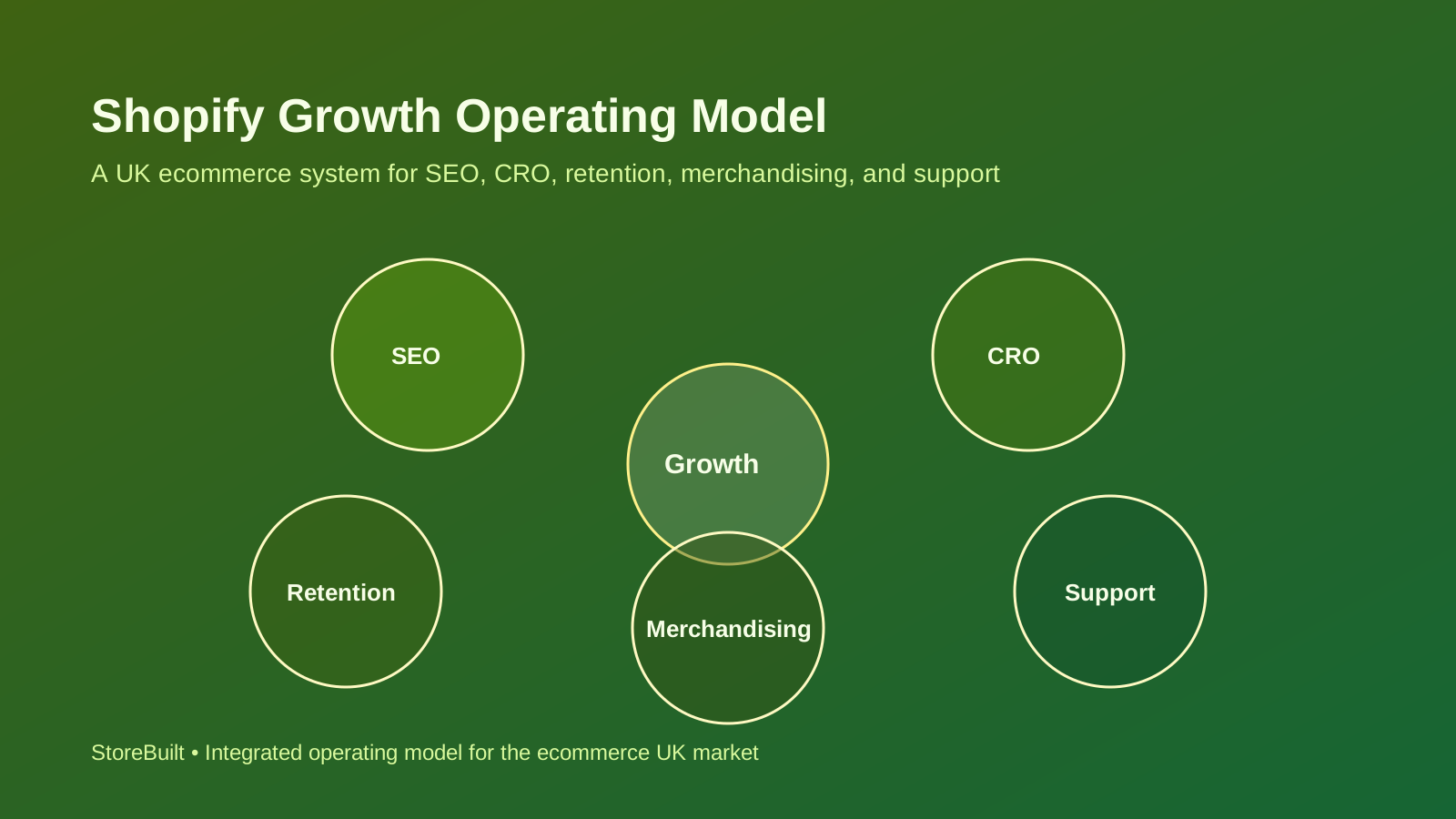
- The five workstreams that should connect
- Operating-model table for UK Shopify teams
- How competitor content points to the same gap
- StoreBuilt example
- What to review every month
- Final StoreBuilt point of view
Keyword decision and research inputs
Primary keyword: shopify growth operating model
Secondary keywords:
- ecommerce UK market growth strategy
- Shopify growth strategy UK
- ecommerce operating model Shopify
- UK ecommerce growth system
Search intent: strategic implementation.
Funnel stage: middle.
Page type: operations playbook.
Why StoreBuilt can realistically win this topic:
- The topic matches StoreBuilt’s crossover between SEO, CRO, support, and retention.
- It translates several separate growth conversations into one decision framework.
- Competitor article libraries often cover channels separately, leaving a gap for integrated execution content.
Research inputs used:
- Current SERP patterns around Shopify growth strategy, ecommerce operations, CRO, and SEO execution queries.
- UK Shopify competitor content review across Charle and peer agencies publishing on growth, SEO, migration, and performance.
- Public query-modifier research around retention, merchandising, conversion, and growth planning for ecommerce teams.
Why a growth operating model matters
Many ecommerce teams still run growth as a collection of separate specialist tasks:
- SEO owns rankings
- paid owns traffic
- ecommerce owns the site
- email owns retention
- support or dev owns fixes
The problem is that customer experience does not follow those internal lanes.
A search landing page affects conversion. A product page affects email capture. A return policy affects trust. Merchandising choices affect repeat purchase. Site speed affects all of it.
For the ecommerce UK market, where margin pressure and acquisition pressure often hit at the same time, disconnected growth work becomes expensive quickly.
The five workstreams that should connect
At StoreBuilt, the most useful operating model usually includes five connected workstreams.
1. Search demand capture
This covers category architecture, collection intent, buying-guided content, and technical hygiene. The goal is not more articles for the sake of output. It is stronger qualified entry points for the right queries.
If organic demand capture matters, see our Shopify SEO service.
2. Conversion architecture
This is where the site turns traffic into action:
- collection clarity
- PDP proof and objection handling
- cart logic
- checkout trust
- navigation and search quality
SEO can open the door, but conversion architecture decides whether the session becomes revenue.
3. Retention system
Retention should not be treated as a separate channel after the purchase. It should be fed by the onsite experience:
- what promise was made on the PDP
- what offer triggered first purchase
- what email or SMS flow matches that buyer intent
- what support friction threatens repeat rate
This is where Klaviyo retention work becomes part of the same system rather than an isolated platform job.
4. Merchandising and trading rhythm
Many UK Shopify brands underuse this layer. Campaign cadence, launch timing, stock visibility, bundles, navigation, and homepage hierarchy all affect growth performance more than teams expect.
The best growth models include a defined trading calendar and clear ownership for homepage, collection, and campaign merchandising decisions.
5. Support and iteration discipline
Growth compounds when the team can ship reliably. That needs a realistic support model:
- bug triage
- sprint priorities
- release discipline
- QA before campaigns or peak periods
- app and theme maintenance
Without this layer, strong strategy degrades into backlog noise.
Operating-model table for UK Shopify teams
| Workstream | Core question | Main KPI type | Common failure mode |
|---|---|---|---|
| Search demand capture | Are we visible for qualified intent? | Qualified organic entry | Content volume without page-role clarity |
| Conversion architecture | Can the customer move forward with confidence? | Conversion rate, PDP engagement | Design polish without proof structure |
| Retention system | Are we building profitable repeat demand? | Repeat purchase, flow revenue quality | Over-automated messaging with weak onsite context |
| Merchandising rhythm | Are launches and categories commercially aligned? | Revenue mix, AOV, campaign efficiency | Disconnected campaign and catalogue logic |
| Support discipline | Can the team ship improvements reliably? | Delivery speed, issue resolution | Strategy with no execution capacity |
How competitor content points to the same gap
One useful insight from reviewing UK Shopify agency content is that many agencies write well about single themes such as migrations, design, or SEO. Fewer explain how those pieces should work together after launch.
That gap matters because buyers do not live inside one channel problem. They live inside trading reality. Traffic quality, PDP clarity, stock logic, CRM timing, and support responsiveness all hit the same P and L.
StoreBuilt example
One UK brand had decent activity across several growth channels but weak coordination. SEO pages were improving traffic quality, yet product pages were not resolving key buying questions. Email flows were active, but the offer logic did not match category behaviour. Merchandising and campaign pages were also drifting apart.
The fix was not a new channel. It was a weekly operating model that joined SEO priorities, CRO changes, CRM timing, and trading decisions into one sequence. Output became cleaner and revenue conversations became less fragmented.
What to review every month
We recommend a monthly review table that keeps the operating model grounded:
| Review area | Ask this question |
|---|---|
| Search | Which landing pages are bringing qualified traffic and which are leaking intent? |
| PDP and collection UX | Where are customers hesitating most? |
| CRM | Which flows are driving useful repeat behaviour rather than just attributed revenue? |
| Merchandising | Which launches, bundles, or collections need clearer priority? |
| Technical support | What is slowing release speed or creating avoidable risk? |
This is where a support partner often becomes more valuable than another isolated tactic. If the store needs ongoing execution support, review our support and maintenance service.
High-intent AI search implementation layer
The AI-search version of this topic is not just “write more content”. A useful answer engine result needs a page that gives a direct answer, proves the claim, and shows the next operational step inside Shopify.
| Area | StoreBuilt implementation check |
|---|---|
| Primary intent | The page should map to growth strategy and one clear buyer or operator problem, not a vague traffic topic. |
| Shopify surface | Identify whether the work belongs on a collection, product page, theme section, checkout step, app workflow, email flow, or support process. |
| Proof | Add first-hand observations, product/category examples, screenshots, policy notes, review signals, or trustworthy external sources where they make the advice safer. |
| Internal route | Link the reader to the service most likely to solve the issue: Shopify support, maintenance and audits. |
| Measurement | Check Search Console, analytics, assisted conversions, enquiry quality, and AI-response mentions after the update rather than judging success by pageviews alone. |
For this article, the useful research inputs are: StoreBuilt support-retainer reviews, Shopify operations documentation, fulfilment/app governance patterns, and UK ecommerce operator intent. StoreBuilt would prioritise store operations, app governance, fulfilment logic, support workflows, reporting, and technical maintenance before expanding into broader supporting content.
If this topic maps to a live store problem, review the related StoreBuilt service or Contact StoreBuilt with the store URL and the issue you want fixed.
Final StoreBuilt point of view
Shopify growth in the UK market should be run as an operating model, not a channel checklist. The brands that compound fastest are usually the ones that connect SEO, CRO, retention, merchandising, and support into one commercial system.