
What we have seen in Shopify app-stack audits is this: the problem is rarely that a brand has one bad app. The problem is that nobody owns the system. A review app is added by marketing, a delivery app by operations, a popup by growth, a subscription app by trading, a tracking script by paid media, and a search tool by ecommerce. Each decision makes sense locally. Together, the stack can become slow, expensive, hard to QA, and difficult to measure.
Charle and other UK Shopify agencies publish app and tool guides because merchants search for quick answers: best review app, best email tool, best shipping app, best automation setup. StoreBuilt’s view is that app selection should start one step earlier. Before asking which app is best, ask which business job the app must do, who owns it, where it loads, how it affects performance, and when it should be removed.
If your Shopify store has app bloat, unclear ownership, or slow templates, Contact StoreBuilt.
Table of contents
- Keyword decision and research inputs
- Why app governance matters
- The app stack layers
- App governance table
- StoreBuilt example
- 45-day cleanup plan
- Final StoreBuilt point of view
Keyword decision and research inputs
Primary keyword: Shopify app stack
Secondary keywords: Shopify apps UK, ecommerce tech stack, Shopify app bloat, Shopify app audit, ecommerce UK market.
Search intent: practical and commercial. The reader wants to choose, audit, or simplify apps without damaging conversion or operations.
Funnel stage: middle funnel for support, audit, CRO, and development enquiries.
Page type: operational guide.
Why StoreBuilt can realistically win this topic:
- The article supports Shopify apps, integrations and automation and Shopify support, maintenance and audits.
- Competitor app guides often list tools. This guide explains governance, ownership, performance, and removal criteria.
- StoreBuilt can connect app decisions to storefront UX, speed, support load, and post-launch maintainability.
Research inputs used on July 2, 2026:
- Current SERP review for Shopify app stack, best Shopify apps, ecommerce tech stack, Shopify app bloat, and Shopify app audit.
- Charle article hub review for apps, tools, ecommerce marketing, CRO, and platform guide patterns.
- Shopify platform context around app blocks, checkout extensibility, customer accounts, and app ecosystem expectations.
Why app governance matters
Apps are useful because Shopify’s ecosystem is strong. A store can add reviews, subscriptions, loyalty, bundles, search, delivery, returns, fraud tools, analytics, personalisation, and marketing automation without building everything from scratch. That is a major advantage.
The risk is accumulation. Over time, a store can end up with:
- overlapping tools that solve the same problem;
- scripts loading on templates where they are not needed;
- old trial apps still injecting code;
- subscription fees nobody reviews;
- app widgets that slow product pages;
- checkout or cart behaviour that nobody has QA’d properly;
- reporting definitions that conflict across platforms.
For UK ecommerce teams, this becomes more painful as the business grows. More campaigns, more product categories, more fulfilment complexity, more retention activity, and more team members all create pressure to add tools. Without governance, the stack becomes a collection of reactions.
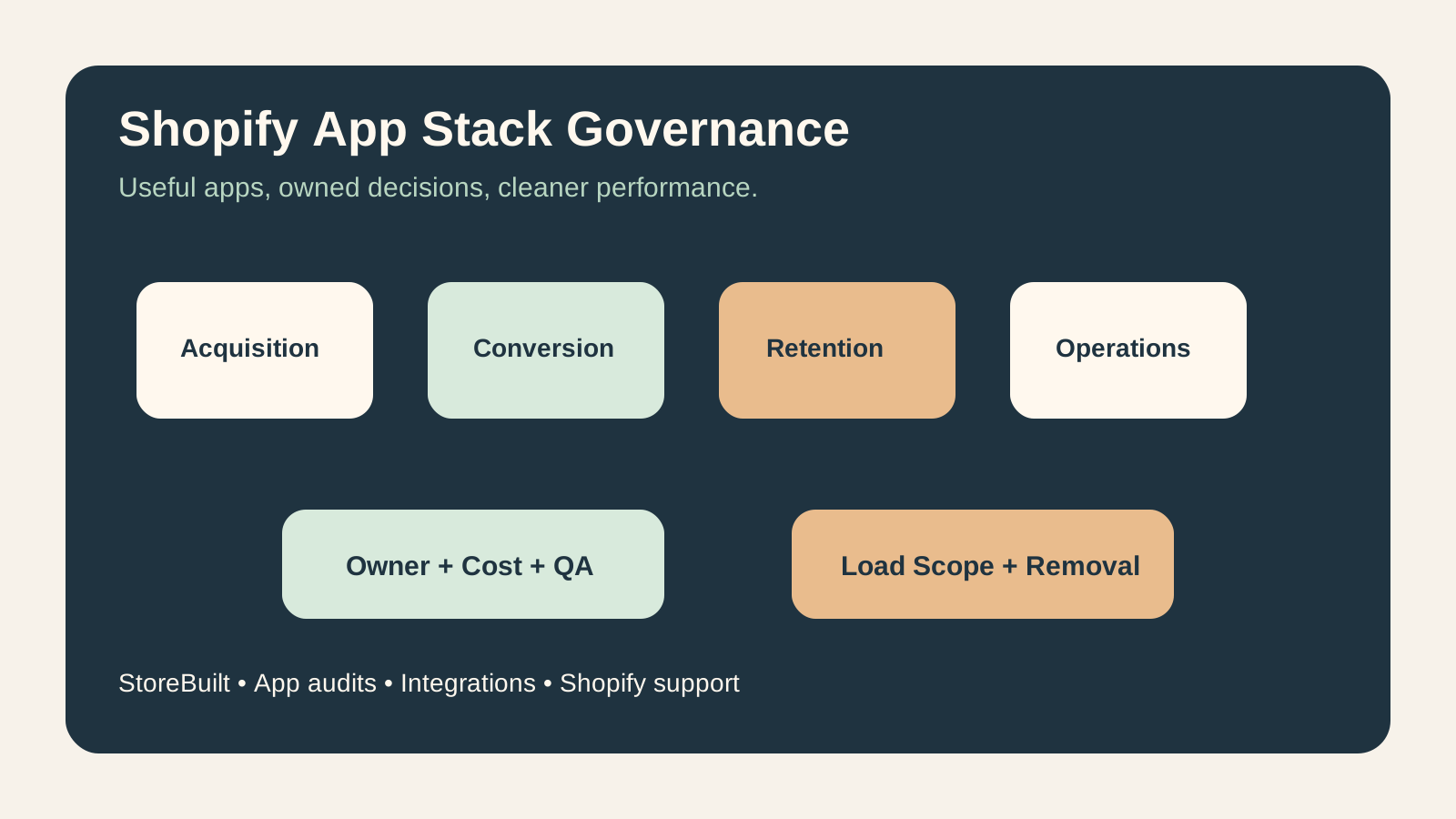
Strong app governance does not mean avoiding apps. It means making app decisions visible. Each app should have a commercial owner, a technical owner, a reason to exist, a known cost, a loading scope, a measurement plan, and a removal process.
The app stack layers
1. Acquisition and tracking
This layer includes pixels, feeds, attribution tools, analytics platforms, consent tools, and campaign landing-page scripts. The main risk is measurement clutter. If every channel adds scripts without review, performance and data quality both suffer.
2. Conversion and onsite experience
This includes reviews, search, merchandising, bundles, upsells, recommendations, stock alerts, size guides, subscriptions, and cart tools. These apps are close to revenue, so changes need stronger QA.
3. Retention and lifecycle
Klaviyo, SMS tools, loyalty, referrals, subscriptions, and post-purchase platforms should be treated as part of the customer journey, not a separate marketing island. Onsite capture, customer accounts, product tags, and fulfilment events must support them.
4. Operations and fulfilment
Shipping, returns, WMS, ERP, inventory, fraud, support, and accounting tools need clean ownership. If an operational app breaks, the cost may show up in support tickets, failed promises, oversells, or manual work.
5. Theme and checkout extensions
App blocks and checkout extensions can be cleaner than older snippets, but they still need governance. The question is not only whether the app works. It is where it loads, how it behaves on mobile, and how it interacts with other extensions.
App governance table
| App category | Good reason to add | Warning sign | Owner to assign |
|---|---|---|---|
| Reviews and UGC | PDP proof is weak or fragmented | Widget slows every template | Ecommerce or trading |
| Search and merchandising | Catalogue is hard to navigate | Search logic replaces taxonomy work | Ecommerce |
| Subscriptions | Product has genuine repeat cycle | Subscription offer is unclear onsite | Retention and operations |
| Shipping and returns | Delivery promise needs automation | Customer-facing copy is inconsistent | Operations |
| Analytics | Decision-making needs cleaner data | Multiple tools disagree with no source of truth | Ecommerce lead |
| Popups and capture | List growth has a defined plan | Every campaign adds a new overlay | Retention |
| Checkout extensions | Checkout needs useful trust or B2B logic | Cosmetic change adds risk | Ecommerce and development |
StoreBuilt example
In one app-stack review, a Shopify store had added tools gradually over several years. The stack included two review widgets, three analytics scripts, a legacy popup, a search app, a cart upsell tool, a subscription app, a returns tool, and several old snippets from apps that were no longer active.
The issue was not that every app was wrong. The issue was that nobody could explain the full stack. Some apps were commercially useful, some were duplicating native Shopify or theme functionality, and some were loading code without an active owner.
The fix was a governance pass. We grouped apps by business job, removed dead code, limited load scope where possible, documented owners, and tied the most important apps to a monthly review rhythm. That made future app decisions easier because the team had a standard: no new app without a job, owner, cost, QA plan, and removal path.
45-day cleanup plan
| Period | Work | Output |
|---|---|---|
| Days 1-7 | Inventory | List apps, scripts, costs, owners, and template load points |
| Days 8-15 | Commercial scoring | Keep, replace, consolidate, or remove recommendation |
| Days 16-25 | Technical cleanup | Remove unused snippets and reduce unnecessary loading |
| Days 26-35 | QA and measurement | Test PDP, collection, cart, checkout, account, and lifecycle events |
| Days 36-45 | Governance rhythm | Monthly app review, procurement checklist, and owner register |
High-intent AI search implementation layer
The AI-search version of this topic is not just “write more content”. A useful answer engine result needs a page that gives a direct answer, proves the claim, and shows the next operational step inside Shopify.
| Area | StoreBuilt implementation check |
|---|---|
| Primary intent | The page should map to Shopify app stack and one clear buyer or operator problem, not a vague traffic topic. |
| Shopify surface | Identify whether the work belongs on a collection, product page, theme section, checkout step, app workflow, email flow, or support process. |
| Proof | Add first-hand observations, product/category examples, screenshots, policy notes, review signals, or trustworthy external sources where they make the advice safer. |
| Internal route | Link the reader to the service most likely to solve the issue: Apps, integrations and automation. |
| Measurement | Check Search Console, analytics, assisted conversions, enquiry quality, and AI-response mentions after the update rather than judging success by pageviews alone. |
For this article, the useful research inputs are: StoreBuilt support-retainer reviews, Shopify operations documentation, fulfilment/app governance patterns, and UK ecommerce operator intent. StoreBuilt would prioritise app stack decisions, integration logic, automation, data flow QA, and operational reliability before expanding into broader supporting content.
If this topic maps to a live store problem, review the related StoreBuilt service or Contact StoreBuilt with the store URL and the issue you want fixed.
Final StoreBuilt point of view
Shopify apps are not the enemy. Ungoverned apps are. The best UK ecommerce teams treat the app stack as part of the operating model: useful, measured, owned, and periodically simplified. StoreBuilt’s view is that every app should either improve the customer journey, reduce operational friction, or strengthen measurement. If it does none of those things, it is probably debt.
For a practical app-stack audit, Contact StoreBuilt.
For invoice-level checks, use our Shopify app billing reconciliation guide to match charges, service periods, usage and adjustments.