
What we have seen in Shopify operations reviews is this: returns become expensive long before they become visible in a board report. The signs are scattered across support tickets, refund reasons, product descriptions, sizing doubts, delivery exceptions, weak exchanges, manual warehouse work, and customers who never buy again after a bad post-purchase experience.
Competitor article libraries in the UK Shopify space often cover CRO, apps, checkout, SEO, and platform decisions. Returns are usually treated as a policy or an app choice. StoreBuilt’s angle is different: returns strategy is a margin, UX, retention, and operational control problem.
If returns are being handled as admin instead of ecommerce strategy, Contact StoreBuilt.
Table of contents
- Keyword decision and research inputs
- Why returns strategy matters in the UK market
- The Shopify returns strategy model
- Returns policy clarity without conversion damage
- Exchange, credit, refund, and restock table
- Operational reporting that should feed CRO
- An anonymous StoreBuilt example
- StoreBuilt point of view
Keyword decision and research inputs
| Decision | Direction |
|---|---|
| Primary keyword | ecommerce returns strategy |
| Secondary keywords | Shopify returns, ecommerce returns UK, Shopify returns portal, ecommerce margin, post-purchase UX |
| Search intent | Improve returns handling on Shopify while protecting customer confidence and margin |
| Funnel stage | Middle |
| Page type | Operations and post-purchase strategy guide |
| Why StoreBuilt can win | StoreBuilt connects returns UX, product content, customer support, store credit, exchange logic, analytics, and Shopify operations |
Research inputs included current Google SERP intent for ecommerce returns and Shopify returns queries, Charle’s Shopify app and CRO content patterns, UK competitor emphasis on growth and platform guidance, Shopify Help material around post-purchase and order management concepts, and a duplicate-risk pass against StoreBuilt’s existing returns portal, order editing, fraud, margin, and support posts.
The content gap is practical: teams do not need another generic “write a returns policy” article. They need a returns operating model that improves purchase confidence without giving away margin.
Why returns strategy matters in the UK market
UK shoppers expect a clear returns process. They also compare brands quickly. A hidden or confusing returns policy can reduce conversion because it introduces risk before purchase. A generous but unmanaged policy can increase refund rate, support load, warehouse work, and margin leakage.
The right answer is not to hide the policy or make returns difficult. That may reduce refunds in the short term, but it damages trust and support quality. The better answer is to reduce avoidable returns before purchase and handle necessary returns with controlled choices after purchase.
For Shopify brands, returns strategy touches:
- PDP content and size guidance;
- imagery and product expectation setting;
- delivery estimates;
- customer support;
- returns portal rules;
- exchange and store-credit incentives;
- warehouse restock process;
- fraud and abuse controls;
- reporting by product, channel, and cohort.
When these areas are disconnected, the team argues about refund policy instead of fixing the reasons customers return products.
The Shopify returns strategy model
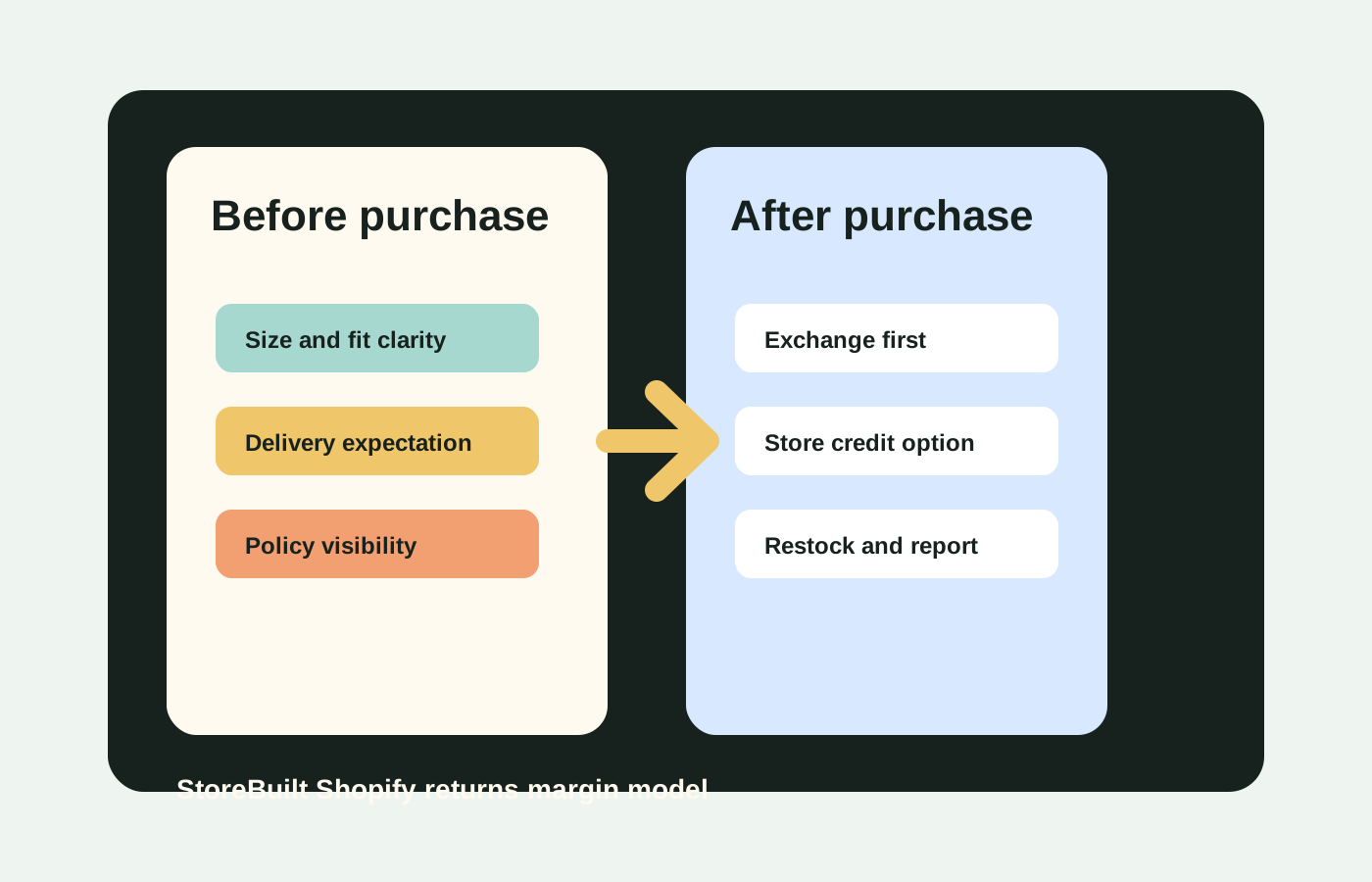
A practical returns strategy has four layers.
1. Prevent avoidable returns
Most avoidable returns begin before checkout. Customers buy the wrong size, misunderstand product dimensions, miss compatibility limits, overestimate colour accuracy, choose the wrong variant, or expect delivery faster than the brand can provide.
Better PDPs reduce avoidable returns. Clear comparison tables, sizing guidance, model information, use cases, materials, ingredients, compatibility notes, care instructions, delivery expectations, and review filters all help customers make a better decision.
2. Make the policy findable
Customers should be able to find returns information from PDPs, cart, footer, order emails, and the order status page. The policy should be written in plain language and separated by scenario: refund, exchange, faulty item, wrong item, sale item, international order, gift, and subscription.
Clarity helps conversion because it lowers perceived risk.
3. Guide the post-purchase choice
Not every return should default to refund. Exchanges, store credit, replacement, repair, and support-assisted troubleshooting may be better for the customer and the business.
The returns portal should guide customers toward the best option without feeling manipulative. For example, a sizing return can prioritise exchange. A damaged product can prioritise replacement. A change-of-mind return can offer store credit where commercially appropriate.
4. Feed returns data back into ecommerce decisions
Return reasons should not stay in the warehouse or support tool. They should inform PDP copy, photography, product data, sizing guidance, supplier quality checks, fulfilment packaging, merchandising, and paid landing pages.
StoreBuilt’s Shopify support, maintenance, and audits service is built around this kind of operational feedback loop.
Returns policy clarity without conversion damage
A strong policy does not need to sound defensive. It should answer the customer’s next question.
Weak policy language says: “Returns accepted within 14 days subject to terms.”
Stronger ecommerce language says: “You can request a return within the stated window if the item is unused and in its original condition. Exchanges and store credit are available through the returns portal, and faulty items are handled separately by support.”
That second version is not legal advice. It is clearer customer communication. For regulated or complex categories, teams should still use proper legal review. But most ecommerce stores can make their policy easier to understand without changing the underlying terms.
Exchange, credit, refund, and restock table
| Return path | Best use | Margin impact | Shopify implementation note |
|---|---|---|---|
| Exchange | Size, colour, variant, replacement | Protects revenue when inventory is available | Portal rules and stock visibility matter |
| Store credit | Change of mind, gift, future purchase | Keeps value in the brand but needs expiry governance | Credit communication must be clear |
| Refund | Product mismatch, cancellation, unsuitable item | Direct margin loss plus handling cost | Track reason and channel source |
| Replacement | Faulty or damaged item | Protects trust but costs stock and delivery | Connect support evidence to order record |
| Repair or part | High-value products, accessories, technical categories | Can reduce full replacement cost | Needs support workflow and customer education |
| Restock | Resellable returned inventory | Recovers value if grading is fast | Warehouse status should feed inventory accuracy |
Operational reporting that should feed CRO
Returns reporting should not stop at total refund value. UK Shopify teams should review:
- return rate by product and variant;
- return reason by product;
- refund value by acquisition channel;
- exchange rate by category;
- store credit uptake;
- time from delivery to return request;
- support contact before return;
- repeat purchase after return;
- return rate for discounted orders;
- return rate for bundles and subscriptions.
These numbers can reveal UX and merchandising issues. If one product has high “not as expected” returns, review PDP imagery and copy. If one size has high exchanges, improve fit guidance. If paid traffic has higher returns than organic, check whether ad creative is overpromising.
An anonymous StoreBuilt example
In one post-purchase review, a Shopify brand saw returns as a warehouse problem. The returns portal worked, but the reasons showed a storefront issue. Customers were buying a product for the wrong use case because the PDP led with lifestyle imagery and placed practical limitations low on the page.
The recommended fix was not to make returns harder. It was to move suitability guidance higher, add a comparison module, improve variant labels, and route uncertain customers to support before purchase. The returns process stayed clear, but the store became better at preventing avoidable purchases.
That distinction matters. Returns strategy is not anti-customer. It is better customer qualification.
High-intent AI search implementation layer
The AI-search version of this topic is not just “write more content”. A useful answer engine result needs a page that gives a direct answer, proves the claim, and shows the next operational step inside Shopify.
| Area | StoreBuilt implementation check |
|---|---|
| Primary intent | The page should map to ecommerce returns strategy and one clear buyer or operator problem, not a vague traffic topic. |
| Shopify surface | Identify whether the work belongs on a collection, product page, theme section, checkout step, app workflow, email flow, or support process. |
| Proof | Add first-hand observations, product/category examples, screenshots, policy notes, review signals, or trustworthy external sources where they make the advice safer. |
| Internal route | Link the reader to the service most likely to solve the issue: Shopify support, maintenance and audits. |
| Measurement | Check Search Console, analytics, assisted conversions, enquiry quality, and AI-response mentions after the update rather than judging success by pageviews alone. |
For this article, the useful research inputs are: StoreBuilt support-retainer reviews, Shopify operations documentation, fulfilment/app governance patterns, and UK ecommerce operator intent. StoreBuilt would prioritise store operations, app governance, fulfilment logic, support workflows, reporting, and technical maintenance before expanding into broader supporting content.
If this topic maps to a live store problem, review the related StoreBuilt service or Contact StoreBuilt with the store URL and the issue you want fixed.
StoreBuilt point of view
Returns should be visible enough to build trust and structured enough to protect margin.
StoreBuilt’s view is that Shopify brands should treat returns as a feedback system. If return reasons are not improving PDP content, product data, support macros, warehouse workflows, and paid creative, the business is wasting one of its clearest sources of customer truth.
For a Shopify returns, support, or post-purchase audit, Contact StoreBuilt.